
The Owl Service
"She wants to be flowers, but you make her owls."
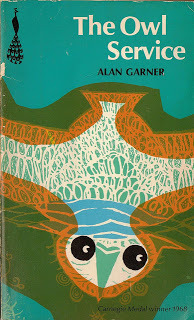
A couple of posts back I talked about stories and TV dramas from my childhood that have shaped what I write as an adult. I promised that I'd write in a little more detail about them, and this is the first of those posts. In that post I mentioned the (new to me) genre of 'folk horror', and although that was initially used as a description of a short-lived run of films, I'm shamelessly appropriating it for books, and 'The Owl Service' fits firmly with that idea.This description at the review blog The Bookbag resonated with me:
"The Owl Service is thick and heavy with that Celtic notion of an Otherworld being not so much other as present in all that we see and all that we do. It draws heavily on the Ancient British cult of ancestor worship and on the idea of a past whose tendrils curl and creep around the present, unseen, but never unfelt."
It's one of those books which has children as the protagonists, is read by children, usually gets shelved with books for children, but is not a 'children's book', if you see what I mean. It's typical of Alan Garner's work in a number of ways:
It's largely driven by dialogue, which is oblique and fragmentary and sometimes obscured by dialect. The reader has to work, nothing is spoon-fed, nothing is on a plate, and much is implied.The landscape is a character itself within the book: dominating everything, embedded in everything, and utterly haunted.There's always a sense of something larger going on that is not revealed or known, and which may not even be knowable.Myth and the landscape are inextricably bound together, and myth has a power that is strange and terrible.History repeats, or at least echoes, and the characters are caught up in that, as much as they are trapped within the landscape.Read 'The Owl Service', and then read Garner's dense and complex and astonishing 'Thursbitch', written thirty-six years later, and you can see the same themes at work, the same fascination with the power of myth and the landscape that links this book with very different works like the film Penda's Fen, and with M R James' haunted East Anglia. Although James is famous as a writer of 'ghost stories', it's interesting how few of his stories contain ghosts, or at least ghosts as we usually think of them. The vengeful East Anglian king of 'A Warning To The Curious', or what Parkin accidentally summons in 'Oh Whistle And I'll Come To You' are more rooted in myth, history and the power of the landscape than they are in any spirit of the undead, returned from the grave.


A couple of posts back I talked about stories and TV dramas from my childhood that have shaped what I write as an adult. I promised that I'd write in a little more detail about them, and this is the first of those posts. In that post I mentioned the (new to me) genre of 'folk horror', and although that was initially used as a description of a short-lived run of films, I'm shamelessly appropriating it for books, and 'The Owl Service' fits firmly with that idea.This description at the review blog The Bookbag resonated with me:
"The Owl Service is thick and heavy with that Celtic notion of an Otherworld being not so much other as present in all that we see and all that we do. It draws heavily on the Ancient British cult of ancestor worship and on the idea of a past whose tendrils curl and creep around the present, unseen, but never unfelt."
It's one of those books which has children as the protagonists, is read by children, usually gets shelved with books for children, but is not a 'children's book', if you see what I mean. It's typical of Alan Garner's work in a number of ways:
It's largely driven by dialogue, which is oblique and fragmentary and sometimes obscured by dialect. The reader has to work, nothing is spoon-fed, nothing is on a plate, and much is implied.The landscape is a character itself within the book: dominating everything, embedded in everything, and utterly haunted.There's always a sense of something larger going on that is not revealed or known, and which may not even be knowable.Myth and the landscape are inextricably bound together, and myth has a power that is strange and terrible.History repeats, or at least echoes, and the characters are caught up in that, as much as they are trapped within the landscape.Read 'The Owl Service', and then read Garner's dense and complex and astonishing 'Thursbitch', written thirty-six years later, and you can see the same themes at work, the same fascination with the power of myth and the landscape that links this book with very different works like the film Penda's Fen, and with M R James' haunted East Anglia. Although James is famous as a writer of 'ghost stories', it's interesting how few of his stories contain ghosts, or at least ghosts as we usually think of them. The vengeful East Anglian king of 'A Warning To The Curious', or what Parkin accidentally summons in 'Oh Whistle And I'll Come To You' are more rooted in myth, history and the power of the landscape than they are in any spirit of the undead, returned from the grave.


No comments have been added yet.


