
Excerpt: The Coach’s Guide to Teaching
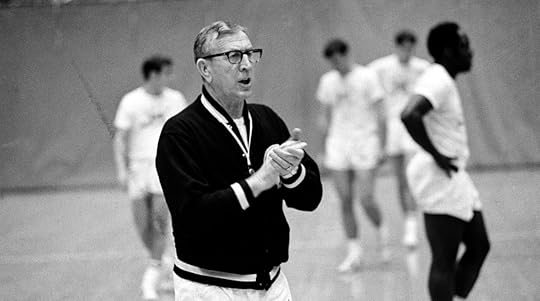 Teaching is knowing the difference between ‘I taught it’ and ‘They learned it.’
I’m closing in on my manuscript deadline on my new book, The Coach’s Guide to Teaching. The sense of urgency–some might call it desperation–is palpable. But I’ve just finished Chapter 4, which is about Checking for Understanding. Here’s an excerpt to whet your appetite. Hope you enjoy
John Wooden was among the greatest coaches of the 20th century. No doubt he was among the winningest, but he remains among the most admired and most quoted, too. Wooden’s stories, aphorisms and principles are often afforded nearly canonical status and retold like parables from the gospel:
The story of how he began the UCLA season by instructing his players in how to put on their socks reveals that we should begin at the beginning- and perhaps that the beginning starts earlier than we think.
The tale of his response to Bill Walton’s announcement that he didn’t want to cut his hair in accordance with team rules–Wooden praised Walton for standing up for his convictions before adding, “and we’re sure going to miss you around here, Bill”—reminds us that the test of our principles is whether we apply them to our best players and when they result in our losing games.
Perhaps because he was a teacher before
he became a coach, his wisdom about the teaching side of the craft is
practical, wise and so far, mostly, timeless. Of all his adages and sayings,
the one I find most useful is his definition of coaching (and teaching). Teaching,
he said, was knowing the difference between “I taught it” and “They
learned it.” No matter the setting,
bridging the gap between those two ideas is at the core of what teachers do and
often the greatest challenge of the job.
Certainly it is in coaching sports.
Any teacher seeks to present a
concept for study as well as she can—clearly, memorably so that as many students
understand as much of it as possible–but no matter how good the initial
instruction, learning will break down. Gaps will emerge. Often our first
response is to try to establish whose fault that is, but mostly it is what
happens when people try to teach and learn things, especially when they try to
teach and learn things that are challenging and complex. Quite possibly the
greatest insight from Wooden’s adage is its calm presumption that the gap is
inevitable. It is not a question of whether it exists but how we deal with it. Teaching,
he proposed, is not eliminating the gap; it is understanding it. It is the
coach’s job not to offer a perfect initial explanation but to seek out and
anticipate the ways athletes will struggle. To be a great coach is not just to
have a deep knowledge of the zone press, not just to be able to translate it to
players, but to see what goes wrong as they try to learn it. This process is called
Checking for Understanding and is as challenging to master as it is important.
Among other things it requires coaches to shift how they prepare to teach and
even how they observe when athletes are training.
The Trials of Looking
In chapter 1 I discussed the
critical role perception plays in decision making for athletes. To perceive
well is not only necessary to good decision-making, in many cases the line
between perception and decision blurs. An athlete reads the first incipient
cues that suggest how her opponent will move and is already acting on them in
real time—we call it anticipation; it is as if she knew what her opponent might
do–and she succeeds. Or, alternatively, her eyes are elsewhere when the
critical information—they are pressing!– emerges and so she fails to react. The
perception and the decision are hard to separate. Athletes can be lucky once or
twice but in the long run their decisions can never be better than their
capacity to see and understand what is happening around them.
It is the same for coaches. A
coach’s ability to teach and develop athletes is limited by his or her ability
to perceive what they are doing during training- a task that is far from
simple. We presume that seeing is all but mechanical–you direct your eyes toward
an event and become aware of what is happening–but in fact this couldn’t be farther
from the truth. Seeing is technical, challenging, and subjective, a skill you
might argue, certainly a cognitive process far more than a physiological one. All
of which is especially important to recognize because the ability to see
accurately is a coach’s first skill.
Here’s a tiny example of what I
mean: a stoppage at a recent training led by a very good young coach. He was
using passing patterns to familiarize his players with common movements in buildup
play and he noticed that girls were often static when waiting to receive a
pass. He paused them briefly and,
standing next to a central midfielder, said, “Girls, when you see the outside
back receiving the ball, you know that you are going to be one of her primary
options, so you don’t just have to be ready to receive the ball, you
have to create separation so that you make an opportunity. That means a
movement like this [he demonstrated checking away] to take your defender
away-and then come back to the ball. As we work on these patterns, I want to
see you making movements like that. Every time. Check away, then come back for
the ball. Go!”
By the basic rules of feedback (see
chapter 3) his feedback was strong. He explained one idea, demonstrated and described
the solution clearly and quickly then gave athletes a chance to try it right
away. But he failed to do something so simple that most coaches don’t even
realize when they fail to do it. He failed to observe. He positioned himself
well afterwards to watch for their follow-through, he looked at the girls
cycling through the patterns, but after he said ‘go,’ eight out of the next ten
girls receiving the ball failed to make a movement like the one he had described,
and somehow he did not notice. He was looking but not seeing; perhaps he simply
assumed they were doing it and was only half-looking. Perhaps he was thinking
about something else. But for whatever reason, play went on without correction,
and his next stoppage addressed a new detail.
He had taught it, but they had not
learned it. Or even done it really, and it’s not hard to imagine a Saturday,
not to far down the road, where at halftime he would say with some urgency, and
perhaps even frustration, edging into his voice, “Girls, we’re static.
We’ve talked about using our movements to create space to receive. We’ve got to
be creating space.” In that moment he will
be describing John Wooden’s gap to them: Girls I taught you how to create space,
but you have not learned it.
There are a wide range of reasons why athletes would not be able to execute something they did in practice in a game, and I have tried to discuss many of them elsewhere in this chapter and this book. There could have been insufficient variation and spacing of retrieval practice so that athletes forgot what they did a few times in training on game day. The training environment might have never progressed to a complex enough setting to prepare athletes to execute under performance conditions. Athletes might have failed to read perceptive cues telling them it was the right time to execute a skill they know how to do. But in this example I am describing something much simpler to make a point about the perils of observation for coaches. A coach asks players to do something, athletes fail to do it, right then and there, and the coach fails to see it.
To remediate the learning gap the coach might have said something like: “Girls, I didn’t see the sorts of movement we discussed there. Let’s try again.” Perhaps he might have added, “I’ll watch ten of you now and shout “yes” or “no” to show whether I see a movement away and back.” Perhaps he might have said, “Girls, we’re struggling to make those movements and I suspect it’s because we’re trying to make them too late. Try to start them a little earlier and see if that helps.” Perhaps something else. But a coach can only respond to errors that he sees. First you have to perceive the error, and surprisingly, that is the step where the process breaks down far more often than almost anyone would suspect.
In fact if there is one thing I can offer in this chapter to help you teach better it is to urge you to resist the temptation to judge this coach. Some version of this story has undoubtedly played out in one of your recent trainings whether you coach 7-year-olds or professional athletes, whether you are a new coach or an established and respected veteran. There is a part of you that does not believe this, but I am 100% certain it is true. This is the remarkable part of the story. With some regularity the athletes you train simply do not do what you have asked them to do, and you fail to see it. If someone showed you a video afterwards, they could easily point it out to you. You asked for the combination to end with crosses on the ground. Count the number of crosses on the ground. Or, you asked them to practice using both feet. Count how often they use their left foot. What was hidden in the moment you were coaching would now be obvious. Players were not striking crosses on the ground. Almost nobody used their left foot. You fail to see what was right in front of you, therefore to fail to understand your athletes and their struggle to learn. We all do this. We are all, with some frequency, the coach I have just described. The only question is whether we will have the humility to accept this. Only then can we take steps to change it.
Science tell us that we see only a fraction
of what’s right before our eyes and there are a variety of reasons for this. One
is attention. We miss things because we’re not concentrating on looking. We’re
looking passively. Observing carefully to see what 16 athletes are actually doing
at a complex activity is hard work, and the brain is designed to only work hard
when it must, when we force it to. What’s more ‘observing’ doesn’t feel like
coaching so we may be unlikely to focus on making the effort it requires if we
don’t see it as a critical task. Much of the time we should be observing
intensely, we feel like we should be saying something or at least setting up
some cones. Instead of really looking we’re thinking about what we’re going to
say or do next or who’s going to start on Saturday. But looking well takes
single-minded concentration. We have to see it as a task. We have to force out
minds to do it actively.
There are technical problems to
overcome as well. Your optic nerve connects to the back of your eye in a spot
about fifteen degrees to the side of your center of vision, for example. There
are no receptor cells there. Your cortex receives an incomplete picture of the
world around you. To compensate, it fills in the gaps with what it thinks it’s
likely to have seen in the blind spot. It uses other sources of information— your
other eye, what you saw when your eyes looked in the space you cannot see a few
moments ago. The brain does this so
seamlessly that most people never even know the blind spot is there[2]
but it is shockingly large. We often say
that we see the world as we imagine it to be and mean that metaphorically, but it
is often literally true as well. What we think is there is different from a
person standing beside us.
Our perception is subjective and immensely
fallible. We just don’t want to believe it’s true. As Chabris and Simons put
it, “We are aware of only a small portion of our visual world at any moment” but
“the idea that we can look but not see is flatly incompatible with how we
understand our own minds.” We can only fix the first part if we fix the second.
If we want to be better at developing athletes, we have to take the task of
seeing them as they learn far more seriously.
Let’s return for a moment to the
session where the girls failed to make the checking movement their coach had
asked them to make. The technical name for not seeing what is right before our
eyes is ‘inattentional blindness,’ and one reason I saw what the coach did not is
that, I had been discussing the
challenges of observation with a group of coaches just the day before. I walked
in the door expecting it to happen. I saw it not because I am especially
perceptive—I am as likely as anyone else to miss what is right before my
eyes—but because I was prepared, and this Chabris and Simons tell us is the key
to seeing better. “There is one proven way to eliminate inattentional blindness,” they write. “Make
the unexpected object or event less unexpected.”
[2]
Any cognitive scientist can prove it’ presence in seconds https://www.eyemichigan.com/what-is-a-blind-spot-how-do-i-find-it/
The post Excerpt: The Coach’s Guide to Teaching appeared first on Teach Like a Champion.


Doug Lemov's Blog

- Doug Lemov's profile
- 112 followers

