
Bullshit Numbers
You are seeing a lot of covid-19 numbers thrown around. Virtually all of those numbers are bullshit.
The death rates are bullshit. In a given country, there is considerable subjectivity regarding how deaths are qualified. The Great Scarfini* (Dr. Deborah Birx) pretty much let that cat out of the bag when she acknowledged that not only are the decedents who test positive (regardless of other co-morbidities) declared as covid-19 deaths, but those who have some colorable connection to covid-19 (clinical presentation, exposure to someone who tested positive) are declared to be covid-19 deaths.
It is likely that hospitals and physicians–and politicians–have an incentive to attribute deaths to covid-19. These incentives can be financial (a hospital could get greater compensation from covid victim than someone dying of something else) or power (death numbers are being used to justify draconian restrictions).
Further, different countries use different methods to count deaths.
What we are really interested in is people who would not have died but for covid-19. The official death statistics do NOT do this. And the fact that virtually all of the dead are aged and/or have multiple serious health problems, a but for attribution is dubious even in the presence of a positive test.
The only rigorous way to estimate these but for deaths is excess deaths (i.e., deaths in excess of expected deaths, conditioning on time of year, demographics, etc.). And preferably excess deaths from respiratory illness (or at least excess deaths from non-accidental causes). This is a good template for the analysis. This also presents some good cross-country data, which shows that in Italy and Spain there is evidence of excess deaths. Elsewhere? Not so much. Of particular interest is Sweden, which has implemented mainly voluntary social distancing measures, to the hysterical response of those deeply invested in mandatory lockdowns.
Do this for a variety of jurisdictions (countries, states in the US) and you would have enough cross-sectional and time series variation to do some real analysis that could provide reasonable support for policy decisions..
The case numbers are bullshit, at least if you want to measure infection rates. As I’ve been saying for weeks, there are so many selection biases that the numbers tell you NOTHING about the prevalence of the virus in the population, either at a point in time or crucially over time. Indeed, the CDC guidelines could be titled “How to Produce a Wildly Biased Sample”:
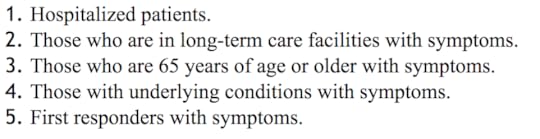
This testing protocol could be justified on clinical and diagnostic grounds, but it is a disaster from the perspective of generating data that is useful in shaping policy.
Further, trends in positive test numbers is driven to a considerable degree by . . . a greater number of tests.
The graphs that you see depicting trends deaths or cases across countries over time are bullshit. They are bullshit because the inherit all the flaws of the data discussed above (exacerbated by the fundamentally different data reporting methods across countries), and they almost fail to adjust for population size or demographic characteristics.
Chinese numbers are obviously bullshit. No need to elaborate this point.
The models that are being used to drive (or at least justify) lockdowns are bullshit. Their predictions went from apocalyptic to well, a small fraction of apocalyptic. Sometimes between one day and the next. Models should be evaluated on predictive accuracy. The predictions of these models have proved to be excessively pessimistic, i.e., bullshit.
And don’t buy the line that the lockdowns reduced the death tolls. For one thing, many of the models’ predictions included the effects of social distancing–and still came out way too high. For another, many countries’ death and case rates (above caveats apply) peaked before the lockdowns could have had any effect.
I keep hearing the IHME model referred to as the “top model.” Who says? On what basis? Basically because somebody else said it. And oh, Bill Gates is somehow involved. So that claim is bullshit too.
Also be very suspicious that the modelers are very opaque. We don’t see their assumptions or their methods. Notoriously, the most influential modeling team (at least initially) that did more than any to spark the panic, has not released its modeling code.
At least the honest modelers admit that social isolation and shutting down the economy doesn’t change the integral under the curve (i.e., the total number of deaths) but merely the time pattern of those deaths. And some epidemiologists claim that extending the period of time before the burnout may result in a higher number of total deaths.
But even putting that possibility for a higher total toll aside, the argument is made that it is necessary to “flatten the curve” in order to reduce the burden on the healthcare system. Well, one thing the models vastly overpredicted hospitalization/ICU visits as well. And I have yet to see any evidence of systematic shortages of ICU beds/ventilators. Yes, there are hotspots. But that just means that we need to understand the hotspots–and the non-hotspots–better.
Along those lines, I can’t say the numbers on ICU utilization are bullshit–because the numbers are largely non-existent. Instead we’ve had anecdotal journalistic (i.e., “if it bleeds it leads”) accounts that provide no objective quantitative standard by which to evaluate how binding the constraints are in the healthcare system.
But again the issue is cost-benefit. Basically what lockdowns do is discount future deaths/cases relative to present deaths/cases (since they accept an approximately equal number of future deaths for each death that does not occur today). And the discount rate is huge. We are losing trillions of dollars in lost output/income to push some deaths into the future. The interest rate is astronomical. Put differently, we are paying an immense price to kick the can down the road.
I understand the the supply of ICU beds, ventilators, physicians and nurses is pretty inelastic over the short run. But even given pretty substantial inelasticity, it would be far more efficient to throw billions at expanding capacity in the short run than to sacrifice ~25 percent of world income to reallocate the deaths over time. Capacity is not a fate. It is a choice.
And the fact that well into the crisis the foretold capacity disaster in hospitals has not been realized, the additional capacity required may well be quite small.
There is also the issue of how much the temporal pattern of deaths will really change. This depends on a variety of factors, including when the virus first spread and its virulence. The more we learn, the more likely it is that the virus has been spreading since late-fall/early-winter 2020. Which means that the lockdowns are reactive, not proactive, and that they have little impact even on the time pattern of deaths let alone the number: they are the proverbial locking the barn door after the horse done bolted.
In brief: our betters are destroying futures based on bullshit data. It’s as simple as that. And they are vastly increasing their power as a result, so they are destroying freedoms too.
In an earlier post I said that we have to grasp the nettle and decide what price are we willing to pay to save a life (usually of an aged, ill person). But it’s actually worse than that. It is very likely that the real question is: how much are we willing to pay to defer a death (of such a person) a few months? The cost that those who govern (or rule) us (and those who support them) are apparently willing to pay is astronomical.
*Dr. Birx is always adorned with a scarf. On my first trip to NYC in 1978, when NYC was near its nadir, I saw an obviously psychotic individual dancing on near Grand Central Station waving around a long scarf. Every once and a while he would shout “I AM THE GREAT SCARFINI” and then start dancing again.


Craig Pirrong's Blog

- Craig Pirrong's profile
- 2 followers

