Solar 101 (extended preview)
Hi Readers,
Since Amazon’s “Look Inside” preview of my book is so truncated, I’m providing a better glimpse by including the first, brief chapter, below; I may not continue this with later chapters, but the preview was too short to give readers a clear idea of the book
Chapter 1 – Solar Electricity Explained
Simply put, solar electricity is produced by light from the sun. Panels on your roof (or on the ground), are receptacles for that light. The electricity produced is direct current, as in a battery. The electricity is then inverted to alternate current, so that any appliances in your home, anything that plugs into the electric service or outlets, can be powered subject to the size of your system.
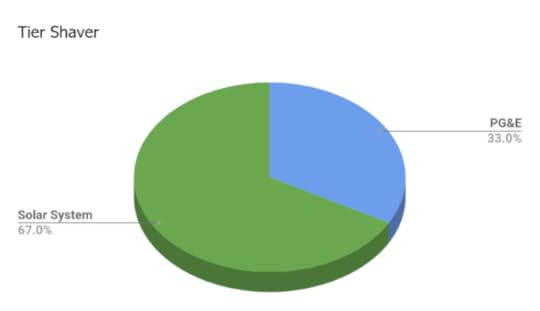
Most people want a full offset of their current or anticipated demand, because a large balance left with the utility, PG&E, in this instance will rise in cost with their high rates. In the past, people often acquired tier-shaver systems as PG&E charged customers so much per kWh for a baseline quantity, and as the customer exceeded that baseline amount, the rate would go progressively higher within that month.Here is a very rudimentary illustration:
Tier Shaver
PG&E Baseline Quantity: Covered by PG&E in this scenario
X kWh @ .23 per kWh
Tier 2: Covered by solar in this scenario
X kWh @ .27 per kWh
Tier 3: Covered by solar in this scenario
X kWh @ .32 per kWh
Result: Too much electric demand remains subject to rate increases
See Pie Chart below:
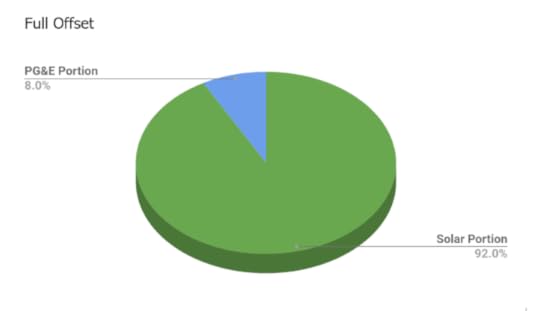
But now notice the benefit of a full offset:
Full Offset
Solar system produces 92%-100% of the home’s current demand
If demand is anticipated to increase, larger initial system may be warranted
Result: When PG&E rates go up, only a small percentage of your home’s electric demand is subject to increase/See Pie Chart on next page:
…the above might seem moot as PG&E tiered rates are going away, commencing in 2020, but the fact remains that the more electricity you buy from PG&E, the more subject you are to rate increases, whether charged based on when you use the energy (time of use/TOU), or how much you use within a tiered structure (usually E-1).
Now it is true that not all customers are financially motivated, but I’ll maintain my motto that whether you’re seeking fiscal return, environmental renewal, or independence from the power-grid, solar energy and now battery storage, are all part and parcel of all three of those goals.
If you help the environment, you’ll often save money; if you save money, you’ll likely also be more energy independent. It’s a win-win-win, with renewable energy. That’s one of the things I love about it. There’s something for everyone and all stand to benefit mutually. That’s my view. I hope the details about solar described in this book are helpful to you, and also easy to understand.
In the next chapter, I go on to describe why not all utilities are the same, and how, accordingly, solar ROI will not be the same.
Click here to purchase my book on Amazon
[image error]