
The Web of the Snyder – Part 1
First This
Sorry it's been so long between posts. Harsh reality sometimes asserts and fun has to wait.
Now This
In an answer to a comment regarding "What Has Gone Before and a Modest Proposal" I said this:
In any other medium besides comics, the person who has and reasonably develops the original idea is the creator. Usually the writer. Ask 1,000 people who created Star Wars. George Lucas, not the army of designers, artists, even re-writers who participated. Ask 1,000 people who created Jurassic Park. Michael Crichton, not the designers and filmmakers who developed the visuals, or even David Koepp who wrote the shooting script for the film. In comics, however, even a work-for-hire artist following a design made by the writer, a description given by the writer or instructions from the editor is given co-credit as creator. Does anyone else think this is unusual?
That sparked some debate, people weighing in on who deserves creator credit and under what conditions. And that's fine. It's an interesting topic. However, I suspect that some people thought I was asserting that the writer should get credit as creator. Nope. I said:
Note, everyone, that I'm not offering a position, here, I'm just asking questions.I'm still not sure I made myself understood. The point I was making is that comic books are different from other visual media when it comes to crediting the original creator of characters and properties. I said nothing about whether what happens in the comic book industry was right or wrong, better or worse than elsewhere. Maybe we've got it right and everybody else has it wrong. Here's me trying to press the assertion that we're different:
Back to my original point: ask 1,000 people who created Star Wars. George Lucas. Does anyone anywhere rise up, rail against that assertion and insist that the designer of the look of Darth Vader should be given co-creator credit?
(…)
How about the myriad people who have contributed additions to the Star Wars property since its beginnings? Anyone up in arms over their not getting credit as co-creators?
Only in the comic book biz does that sort of thing happen, whether it's right, wrong or indifferent. In other visual media, the person who comes up with the idea and reasonably develops it -- usually, but not always the writer -- is the creator. The people who come up with the visuals are support troops. Usually.
Sometimes the writer is also the artist. Will Eisner. True collaborations are true collaborations. Siegel and Shuster. Artists sometimes do create things on their own, of course, and sometimes the writers are the support troops.
What constitutes enough of an idea and reasonable development of same is debatable, I suppose. Not so much in other media, mind you, where the idea itself is often enough to warrant creator credit, even if others do the development and create visuals. Only in comic books does some filagree added by an artist raise the question.Defiant1 chipped in something thoughtful and interesting:
(…)
In most scenarios, I'm in 100% agreement with what Jim is saying. I feel that Stan had such a laid back approach to producing his early 60's creations that he did open the door to the artists getting a valid co-creator status. Stan encouraged the artists to fill in the gaps that define the characters.
I feel that society puts too much emphasis on creator status. No one really creates anything. The elements in a writer's mind were put there by the culture before them. They essentially just line up the building blocks based upon what they've experienced. Daredevil was already a character's name in the Golden Age. The Human Torch was already a flying human-like entity. Some of the building blocks aren't as obvious, but everything is inspired by something that came before in one shape or another.
Before I got into manufacturing and working with engineers, I thought brilliant guys sat down and just invented brilliant inventions. I've now learned that brilliant inventions are more often than not just tweaks and redesigns of previous inventions. The technology powering a mining truck is just tweaked technology that was powering a locomotive. It's scaled down to power the hybrid cars, trucks, and vans coming out in the next decade. Someone will be attributed with creating something, but a large portion of what they invent was already invented by someone else. They just tweaked it and people envision it as something original and new.All thoughts on the subject…or any subject, really, are welcome.
(ASIDE: As for me, I have always been generous about giving credit and sharing credit, and whatever money or benefits came with the credit. Ask the Blog Elf, she was there. Thus, I have provided ammunition for detractors who say that I can't really create anything on my own. Whatever. People may like what I do or not, but I believe I have demonstrated that I can do what I do. And I still think erring on the side of generosity is good policy.)
Dick Snyder
Anyone who thinks I was a tough boss never heard tell of Richard E. "Dick" Snyder.
Dick Snyder worked his way up through the executive ranks at Simon & Schuster, becoming President in 1975 and rising from there to CEO and Chairman starting in 1986. He was famously a despot of Ming the Merciless magnitude.
In 1984, Fortune Magazine listed him among "America's Toughest Bosses," and by tough they meant mean. Two high-net-worth friends of mine who know him personally assured me that he loved it, and even campaigned for the "honor."
For instance, legend says that the elevator starters had to have an elevator "reserved," ready and waiting, doors open, when he arrived at the S&S building—or else—and that no one was ever allowed to be on the elevator with him. If he was in an elevator car, no one else could come aboard. If he entered an elevator car, anyone already aboard had to exit immediately. No one was ever permitted to ride in an elevator with the Dick, Snyder. Inconvenience him in any way and you were fired.
He ruled imperiously, tyrannically. His way was the only way, and you'd better not pout, you'd better not cry. S&S employees compared him to the Ayatollah Khomeini—very quietly. A guy I knew who worked at S&S at the time, a honcho at kids' book division Little Simon, confirmed the above.
Dick Snyder turned S&S from a $40 million a year business into a $2 billion-plus a year business, the largest publishing house in the world. Publishing Bob Woodward and Carl Bernstein's The Final Days about the end of Richard "Dick" Nixon's presidency in 1974 was what got the S&S snowball rolling. Ironically. the fall of one Dick led to the rise of another Dick.
Sumner Redstone, architect of Viacom, eventually gained control of Simon & Schuster In 1994. Redstone and Snyder, shall we say, didn't get along. There is a wonderful story about Redstone firing Snyder for arrogantly perpetrating precisely the kind of "inconvenience" upon Redstone that got employees of Snyder punished with termination. The story was told to me long ago by someone very much in the know, but he got it second hand, so I won't attempt to tell it in detail here. But, if I remember it right, if it's accurate, it's priceless.
So, Snyder was looking for a new publishing industry gig.
He put together a group of investors and, in mid-1996, bought Western Publishing.
Western Publishing had once been the dominant mass-market children's book publisher by dint of its well-known Golden Books line. WP had robust printing and distribution operations; therefore, they were wonderfully vertically integrated. They developed the content, printed the books, distributed the books, controlled the "real estate" (that is, display space), owned the racks, and kicked everybody's butt. Nearest competitor Random House was a distant second. Upstart Marvel Books, publishers of children's books based upon licensed properties Western and Random House didn't want, including those of Fisher-Price, Mattel and Hallmark, was a joke, one of Marvel President Jim Galton's greatest blunders. More on that later.
Western Publishing had been run for a number of years by Richard Bernstein, a billionaire who had made his money in real estate—the normal kind, not display space. His offices were/are at 444 Madison Avenue (a building that he owned and probably still owns), just a few blocks up Mad Ave from where I lived.
A slight digression: Bernstein was (and still is, I suspect—I haven't seen him for a while) a character. He was shockingly candid, straightforward, honest, bold, irreverent and sometimes a little crude. I loved his CEO's statements in Western Publishing's annual reports. What CEO says things like "I screwed up" in the annual report?
Bernstein and Ronald O. Perelman were friends. I guess they belonged to the same billionaires' club. Whatever. Richard jokingly referred to Perelman as "Ronnie the Retard."
Richard Bernstein flew everywhere in his private, state of the art, luxury jet. He had four pilots accompany him everywhere so that the FAA regulations regarding limitations on flying hours would never ground him. One of his pilots was always legally take-off ready.
Richard jokingly said unrepeatably scandalous things about then-Mattel CEO Jill Barad, known around the toy and kids businesses as "The Babe of Toyland." I know Jill a little. I have no doubt that he did it in her presence, and I have no doubt that she laughed, and I have no doubt that she then kicked his ass and I suspect that he loved it.

 Western, under Richard Bernstein was one of the potential buyers of Marvel when the Cadence Management, Inc. (CMI) greedy bastards who had taken Marvel parent Cadence Industries private put Marvel up for sale. Because I was a "key man," Bernstein personally interviewed me a few times during the due diligence process. At the end of the last interview, he said, words to the effect, "The more I look at this (Marvel) the more I think I'm buying you and some used furniture." I am not so vain as to think he meant me, literally. He meant me and the Marvel creative group, our works and the store of creative works under my purview.
 Bernstein walked away from the deal to buy Marvel at the eleventh hour because he found Shelly Feinberg, CMI overlord, and his five CMI dwarves to be reprehensible scum (as did I), who agreed to terms, then at signing time demanding a nickel or a dime more. I've dealt with slime like that (including Shelly and co., obviously). They're infuriating.
Bernstein/Western had invested well over half a million dollars in due diligence expenses—auditors, accountants and lawyers, investigating the proposed acquisition, as a publicly traded company must—and walked away!—pushed past the breaking point by the scumbaggery of Shelly and his dwarves! If you're not an investment banker or M&A financially savvy, you cannot possibly appreciate the immensity of that act.
How do I know the details of Bernstein's investment? After I was cast out of Marvel, my Marvel Acquisition Partners attempted to buy Marvel. The law firm we chose to represent us, by coincidence, was Baker & McKenzie, the same one that Bernstein had used, and the very lawyers who worked with Bernstein worked with us. They told us! They showed me the documents! And, P.S., Bernstein later told me, too.
So…after being cut loose by Marvel and failing to buy Marvel, I needed a gig. Thanks to Marvel's efforts to blame me for everything bad that ever happened, the journalistically-bereft fanzines' willingness to believe Marvel's spin, or in the case of The Comics Journal, their zeal to capitalize on Shooter-hatred, and the comics community falling for the crap, I was the pariah of comics at that point. To some extent, I still am.
My phone never rang. No one wanted me. Am I such a bad writer that no one had any use for me? So it seemed. So I scrambled to survive.
Among my scramble-to-survive maneuvers while I was desperate and unemployed, I wrote two books for Western Publishing: After the Dinosaurs: The Story of Prehistoric Mammals and Man and Baby Animals On the Farm.
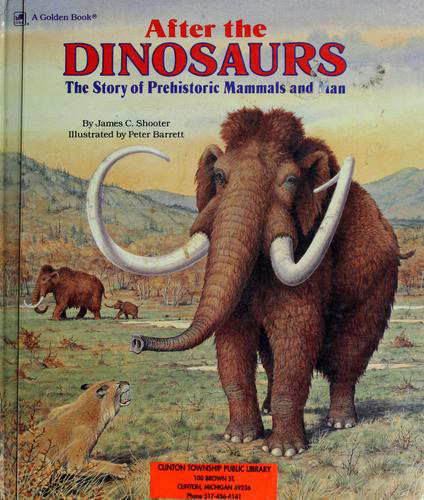
 The opportunity to write those books, by the way, had nothing to do with my brief association with Bernstein. While at Marvel, I'd met Thea Feldman, an editor who worked at Crown Publishers. She later moved to Golden Books. Apparently, from what she'd seen of my work, she thought I could write. Go figure.
Thea called and told me that GB wanted to do a Big Little Golden Book about ancient mammals, and suggested that I pitch a proposal (probably because I am an ancient mammal). I said, "Shouldn't you get a scientist to write that?" She said, "We get writers to write and scientists to check the facts." (The word "nitwit," left off of the end of her sentence, was understood). Okay. So, I pitched. My proposal, one of eleven offered, was selected by the publisher, Robin Warner. More about her, later.
I wrote the book. A scientist on staff at New York's Museum of Natural History, one Dr. Dingus—Dingus, I kid you not—fact-checked it. It slid by.
The Golden Books art director chose an idiot, I mean artist, to illustrate the book. The art director's husband was an artists' rep and, low and behold, the "artists" he repped got tons of work from his wife, no matter how incompetent or inappropriate they were. The art director woman had kept her maiden name, so no one in upper management knew she was feathering the family nest when she used, almost exclusively, the alleged artists that were her husband's clients. Everyone else knew about it.
The "art" for After the Dinosaurs sucked. Bernie Wrightson would have rocked it and won us a Caldecott Medal, but I didn't have a vote about the art, nor did the editor. Sigh.
(TOTAL ASIDE: Almost all children's book about creatures of any kind, prehistoric or otherwise, are "parade books." One damn critter after another. "Here's the Tyrannosaurus Rex. It lived 65 million years ago. It weighed seven and a half tons. It ate meat…." Turn the page. "Here's the Stegosaurus. It lived 150 million years ago…."
A parade. I tried, in After the Dinosaurs to give a sense of how the world and the critters evolved, what the history was. Nobody cared, except the editor, one brilliant woman, by the way, if you discount the fact that she thought I had a clue.)
After After the Dinosaurs, one Friday, Thea called me up, said some other turkey had let her down and asked me if I could write a book over the weekend. What? Write a book over the weekend? No. No way.
She said it was a Little Golden Book. An updated, new version of a classic, Baby Animals on the Farm. If she didn't have a manuscript Monday morning there would be consequences and repercussions.
I am familiar with consequences and repercussions.
I said, "How could anyone possibly write a book over a weekend?!"
She said, "It's a Little Golden Book, nitwit. 200 words, tops."
I, the nitwit in question, agreed to do it. But why me?
She said, words to the effect, that she knew I'd do it right, first try, edit-free copy. No time to fool around. No time to deal with even more nit-witty nitwits.
That seemed reasonable.
Those books didn't pay much up front—five grand for After the Dinosaurs (pathetic,considering the research involved) and a grand for the Baby Animals (not too bad for two days work)—but the royalties…! A testament to the power of Western Publishing's sales dominance at that time. The royalties from those two books, which arrived like clockwork twice a year for a looong time kept me alive.
Anyway….
In the auction for Marvel, MAP came in second to Perelman. Long story. More on that later.
As I said, no one would hire me….
I went to Bernstein and asked him if he would license the Gold Key characters to me so I could start a new comics company. He remembered me from our meetings. He was unaware (!) that Western owned comics properties (Magnus, Solar, et al). At first, he proposed starting a division of Western with me at the helm to publish comics.
His subordinates were not interested in comics. Rather than fight the internal tide, Richard said he would hold the characters for me until I raised money, started my own company and was ready to proceed. He said he was impressed by me, and would "bet on" me.
Bernstein/Western subsequently had offers from Marvel, DC, Dark Horse and others for the Gold Key characters. Per Bernstein, they held the characters for me for two years. Ask Mike Richardson.
Finally, with Winston Fowlkes and Steve Massarsky I founded VALIANT.
(P.S. Some months later, I hired, as an inker, Bob Layton, who was unemployed and persona non grata everywhere else at the time. The lie bandied about by Bob and other weasels that he was a "co-founder" of VALIANT is preposterous. Ask the Elf.)
Miracles and horrors ensued….
Cut to the days of Broadway Comics. We were trying to build something….
Meanwhile….
As previously mentioned, in 1996, Dick Snyder got control of what had been Western Publishing and changed the name of the company to Golden Books Family Entertainment. Snyder sold off some pieces of the former Western, mostly non-children's book publishing operations, and made a number of acquisitions en route to focusing the company on children's entertainment.
Among the acquisitions made was Broadway Video Entertainment, owners of Lassie, the Lone Ranger, all those puppet animation Christmas movies on TV every year and, oh, by the way, Broadway Comics.
And so, for Broadway Comics…along came a Snyder.
Suddenly we were part of Golden Books.
I met the Snyder at the company Christmas party. We spoke, briefly. He was very polite. And completely uninterested in Broadway Comics, me, or anything but getting the hell out of that obligatory appearance as quickly as possible.
And, as it turned out, getting the hell out of the comic book business as quickly as possible.
NEXT: Ugly Death


No comments have been added yet.
Jim Shooter's Blog

- Jim Shooter's profile
- 85 followers
Jim Shooter isn't a Goodreads Author
(yet),
but they
do have a blog,
so here are some recent posts imported from
their feed.

