I can't turn it off
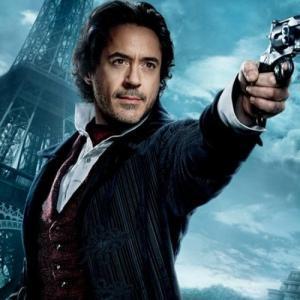
So we went to see Sherlock Holmes: A Game of Shadows a couple of nights ago. It was decent, if not amazing; it was more a straightforward action-adventure movie than a mystery, and the script was crammed with obviously deliberate Holmes-on-Watson shipping subtext, but the pace was cracking and the characters interesting. I liked the first one more, but this was okay.
Afterwards, though, there was a post-movie -dinner conversation about the fate of one character who is killed off early in the film (no spoilers – well, unless you count 'people die' as a spoiler). Everyone found the death unsatisfying and a waste of an interesting character, and a number of my friends speculated that perhaps the character faked his/her death, and wasn't really dead, and what had really happened was an elaborate ruse.
 I came back with my standard response to this sort of thing: 'Well, nothing 'really' happened. These are actors performing from a script, not real people, and nothing that's not up on the screen is part of the narrative. Unless there's a scene in which the death is shown to be a fake, there's nothing else to say.'
And this makes me sound like a boor with a stick up my butt, I know. That may in fact be true. Lord knows I can be a humourless git at times. But what I'm trying to say that is when I read a book or see a movie or whatever, all I see is the text; all I see is what's there in front of me. Because that's the thing that actually exists, that can be analysed and understood and picked apart, that's the thing that causes an intellectual/aesthetic/imaginative/indigestive reaction in me. It's an artefact that can be understood and/or appreciated for its own beauty.
But for many readers, there is the urge to extrapolate, to imagine further; to see the book/story/movie as a window into another reality about which statements can be made. This is the fanfic urge, the worldbuilding urge; the urge to see implications, to imagine the unseen scenes between the ones on screen/the page, to see the text as a partial glimpse of something larger.
And it's fundamentally an urge I don't understand. And my inability to understand that desire and that state of mind – to see a text as reportage rather than artifice – is something I often wish I could overcome. I think I'm missing something, because to me the book is only ever words on a page. Hopefully smart, beautiful, well-chosen and properly-punctuated words, words that make my brain race as I stitch together imagery and meaning from them… but still, I can't understand how you go outside the text, how you can ask whether what happened on the page/screen was what really happened.
Nothing really happened. Someone made it up. And I always feel that that's a much more amazing and wondrous thing that the notion that the author/creator is someone just channelling a reality that exists somewhere else.
If you like to imagine books as windows into another reality, one that can be envisioned and then examined… honestly, I kind of envy you. That's pretty cool. There are times when I'd like to turn off the constant analytic assessor in my head and believe, even if only for a second, even if only as a deliberate choice. But I can't, and when conversations turn to that, I get a bit incomprehending and should probably learn to be quiet.
I have a similar mix of incomprehension about, for example JK Rowling's claims that the character of Dumbledore in the Harry Potter novels is gay. (Disclaimer: I haven't read any of them, but I did hear about this in the news on a slow day a few years ago.) As I understand it, when criticised for not including any gay characters, she said that Dumbledore was gay but that she chose not to include any signs or suggestions within the text that that was the case. But that's fine, because the character has a reality, and this utterly-invisible reality is enough to deflect any criticism.

This is my Potter-truth
For me, that's the same as saying that Dumbledore was actually an animated chocolate golem, or fought crime as Batman between novels. Sure, it never came up in print, but if he can be gay without, y'know, being gay, then my theory that Harry is actually a sackful of ferrets perfectly pretending to be a human being is just as valid, because that's a reality that just doesn't happened to be mentioned in the text. And yet, if I say that loudly at Potter conventions, suddenly I'm the guy escorted from the building by security and beaten up in an alley by Hermoine cosplayers. Again.
Mind you, saying that you can't extrapolate from the text isn't the same as saying there's no such thing as subtext. Subtext is the foundation of meaning upon which a narrative rests; it's not overt, but it's still internal the text. Extrapolation, on the other hand, is external to the text; it's the reader/viewer bringing their own desires to the material and reshaping the narrative to fit. Which is an interesting process, and it's one I'd like to understand more, but it doesn't seem to be doable. This is the way my head is, and I can't turn it off; all I can do when I encounter a text is dissect it on its own terms. It can't be real for me; it can only be a crafted object.
But on the flip side, there's something great about taking books (and movies and plays and comics, yeah, but mostly books) on their own terms – as works of craft and art and imagination. For me, saying that all there is is what's on the page isn't a way of denigrating narrative, or saying that those who like to extrapolate are crazy/bad/wrong/Republican; it's a way of celebrating the text and the act of creating it. Text is a joyous thing; text is what you get when a (hopefully) passionate, inspired writer sets out to create a thing of beauty. To celebrate it for what it is, rather than what it can be inferred to be, is no different than celebrating the Sistine Chapel ceiling as a work of great artistry, skill and technique, rather than as an accurate depiction of God and, um, whoever the other guy is. Is it Adam? That would make sense, I suppose. But I don't need to know that in order to appreciate the power of the work, and I don't think we need to act like a narrative is 'real' to still acknowledge its power and its worth.
Invention is more fun than extrapolation. If only so we can argue that it was the Potter-ferrets that faked their death to throw Sherlock off their trail.