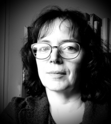
How do you count sheep you can't see?
 I've recently discovered a thing about how most other people think, remember and imagine. They actually see pictures inside their heads! When they think about an absent person or a place that holds happy memories, they conjure up an image of them. When they count sheep, they see sheep. When they're asked to visualise a situation or an object, they create a picture of it inside their mind. When they dream, it plays out in their mind like a film.
I don't do those things. When I remember an absent person or a place, I'll remember what was said and how I felt. I can remember visual details -- I'll know what we were wearing and where we sat in relation to one another -- but I don't store those details as images.
Meditation and CBT often use visualisation techniques, and these can sometimes work for me. For example, an Open University guide to exam stress suggests imagining yourself in the exam room as a way of preparing yourself for how you'll feel in that situation. I can imagine myself in an exam room and I can feel how I'd feel, but I don't see it as an image. Other types of visualisation wouldn't work for me because they use images to re-shape emotions. Instead, I work through emotions verbally and understand illnesses through research.
I don't often remember dreams, though I did keep a dream diary at one time. My dreams aren't visual at all: I know what's happening and how it makes me feel, but I don't actually see it. It's not like a radio play: there isn't a narrative, but there can be a story.
Oddly, I'm not particularly bad at recognising people's faces. It sometimes takes a moment to place someone if I'm seeing them out of context, but I don't think I'm worse than anyone else. If you showed me fabric or wallpaper swatches from my past, I'm confident that I'd be able to pick out wallpaper patterns and dress material I haven't seen for decades. I recently tried to find a picture of rabbits ice-skating that used to be on my bedroom wall when I was a child, and although it's a bizarrely frequent subject of art, I'm 100% confident that I haven't found the one I was looking for. I'm sure it was by Racey Helps, from the style, but also sure that it wasn't among Google's offerings when I looked. There is a picture of ice-skating rabbits by Racey Helps on Pinterest, and I know that's not the right one. There were more rabbits, and they were on a pond rather than a river. So I do have detailed memories of how things and people looked, but I don't store them as pictures that I can retrieve and re-examine.
Despite the image I've chosen for this post, I don't see my aphantasia as an inability or a disability. I see it as a difference. Anyone who does visualise is as different from me as I am from them. Like everyone, there are things I find easy and things I find difficult. I don't know whether the aphantasia accounts for some or all or none of that. It's just part of who I am.
Visualisation isn't an end in itself, it's a tool in remembering, imagining and processing different kinds of information and a technique in meditation and CBT. I can achieve all of those ends, but I do them differently. I remember verbally and emotionally, I imagine in the same way and if I need to visualise what I'm imagining or processing, I can use a pen and paper. If I want to remember a person or a place, I can remember how they made me feel and I can look at a photograph. I wouldn't be particularly helpful to police drawing up an identikit picture of a criminal, but I think I'd be as helpful as anyone else in picking them out of a line-up, and I suspect I'd be pretty good at remembering what was said. It's well known that eye-witness testimony can be unreliable, and the surprise that people express when they see old photos of unwise haircuts or fashion choices suggests that what they've might have as much to do with how they felt or what they believed as how they looked.
For me, counting sheep isn't any different to counting. If I'm having trouble getting to sleep, I tend to busy my brain with mindless verbal activities. The end result is the same. I still go to sleep.
If you're like me, you might be interested in the Aphantasia Network, which aims to make connections and support research.


No comments have been added yet.