David Cronenberg’s ‘Consumed’ – “Long live the new flesh”
“Here we are, Cronenberg Morty. A reality where everyone in the world got genetically Cronenberged. We’ll fit right in, Cronenberg Morty. It will be like we never even left Cronenberg World.” – Rick and Morty.
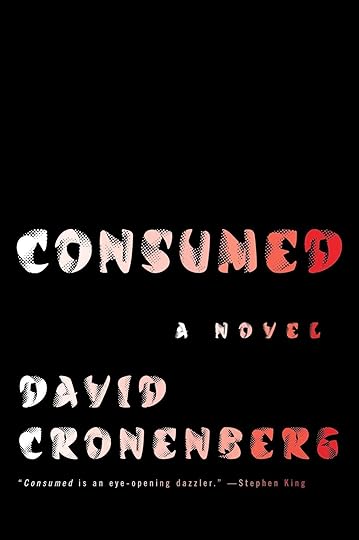
Stepping away from the director’s chair, Canadian director David Cronenberg’s first foray into fiction is about as much fun as any fan of his work would expect. Any artist synonymous enough with an element of popular culture to become its label – Dali, Picasso, Hitchcock – has offered something unique, maybe even beyond the pale. For Cronenberg, a director well-known as an exponent of body horror through films like The Fly and Videodrome, a change in narrative form gives him a chance to examine his interests through a non-cinematic lens, a shot at a narrative form that other directors such as Gus Van Sant, Ethan Coen and Wes Craven have taken with mixed results.
Being a fan of the director’s work since I saw (and recorded on VHS) a season of his films on the now defunct Bravo, probably my biggest surprise was it took me so long to get round to reading this. It was something I figured as a curiosity, the work of an artist tiring of sets, actors and schedules, who wanted something either less complicated (my bad). After all, Cronenberg has encountered more than his fair share of issues with censors down the years, with movies like his adaptation of J.G. Ballard’s Crash encountering media campaigns to have the film banned. And in fact, Consumed offers something far more complicated, serving more as a primer to Cronenberg’s film-based obsessions, containing nods to the aforementioned body horror, Asian exotica (Madame Butterfly), as well as alienation (The Fly, Dead Ringers), technophilia and fear of the future (Videodrome, The Fly, Existenz). Populated by the morose, the cynical, the freaky and the damaged, its selection of French philosophers – one of whom is convinced bugs live inside her, North Korean entomologists, hearing aide engineers, and sufferers of Peyronie’s disease with an unusual enjoyment in 3D printing makes for a concoction that regularly plays beyond the realms of reasonable narrative or character-based conventions. Into all this step two technophile journalists on the track of the most unusual of scoops – whether or not one of the aforementioned murdered French academic was also cannibalised by her now vanished husband. I don’t need to stick my neck out on this one and say that the book is divisive. The Good Reads website score (at time of writing) of 3.13 is testament to that.
Which means Consumed is not for everyone. What it is however, is a quintessentially Cronenbergian work which, if anyone else had written, would have led to accusations of imitation if not downright plagiarism. Fans like myself will find plenty to appreciate while those starting out in their Cronenberg journey can get a fair preview of what to expect in his oeuvre. For a director who spent years adapting authors for the screen – King, Burroughs, De Lillo, Ballard – Cronenberg’s decision to turn to the novel seems logical. It’s a next step for an artist who has been so adept at adapting other people’s work. And with his films already starting to receive the remake treatment with the upcoming Rabid from the Soska Sisters, how long might it be before someone works on an adaptation of Consumed? Rumour has it, it might even be the man himself.