What Is a Hero?
The panelist seemed super-human. She had drawn awed murmurs after
telling us at the indie writing conference in Orlando that she had written and
published over fifty romance novels. She was barely over twenty.
I was eager to hear what the prolific author was going to
say, especially when the moderator asked her a question I loved, “How do you
define a hero?”
As a novelist myself, I had read many definitions of a hero in
how-to-write books. Many were dry and technical: “A hero is the main character
of a story who struggles against overwhelming obstacles, usually for some
principle, ideal, person, or goal beyond the narrow scope of his or her own ego.
Heroes may be flawed but, in the end, they will always act according to their
conscience, even when it means risking everything, including, sometimes, their
lives.”
Although abstractly academic, the definition fit my own idea
of what a hero was. As an adolescent I had absorbed countless memoirs about individuals
who had hidden Jews in their houses
during the Nazi regime. I thought they were heroes because they had risked
their lives to oppose a cruel government; they were the essence of courage.
As I waited for the author to provide her own answer, she appeared
to look inward as if selecting her words carefully. At last she opened her
mouth and said: “Well, a hero, he’s gotta be good-looking. But not too
good-looking. He’s gotta be kind of rugged. He can’t look like, say,
Brad Pitt. Brad Pitt, now, he’s too pretty. A man, he’s gotta to be a man, you
know? Not mean. But not too nice either. He has to be, you know, dominant.
Personally, I like a five O-clock shadow.”
The room had fallen silent. I squirmed in my folding chair
and waited for someone to laugh. When no one did, I waited for the other romance
novelists to contradict her, to explain to her that heroism has nothing to do
with the way a character looks, and that a hero is more than just a sex symbol
with traits that happen to appeal to an author personally. I wanted to object,
too, that being dominant did not make someone a hero. Bullies and genocidal
dictators were dominant, too, but no one was awarding them the Nobel Peace
Prize.
I waited for someone to say a hero could be flawed,
unattractive, and even prone to cowardice, yet still pull off stunningly brave
acts during a crisis. I wanted
someone to say that everyone has the potential for courage, and that part of
why we love stories so much is that it helps us imagine how we might be brave
in the most devastating circumstances despite our childhood wounds, our
baggage, and innermost fears.
I felt certain that the second panelist, when questioned,
would shuffle the discussion onto a more sensible path. She appeared to be in her twenties, too, with
a fair complexion and long purple hair. When asked to define a hero, she said,
“Well, the main quality of a hero is he has got to be good. But not too
good. I mean, I have a strong personality and I do want a man who will
let me have my way most of the time, or I’ll get mad at him. But he can’t agree
with me all the time either, or I won’t respect him. But still, he has to be good.
You know how it is when you are with a man who has a good heart? You just feel
the goodness coming off him. You
just feel it. That’s what a hero is.”
The discussion continued in this manner. In my mind, I rehearsed what I had just learned about heroes:
Good-looking but not as pretty as Brad PittNice but not too nice but not mean eitherGoodness exudes from heroes in a mysterious way, and that is how you know they are good.
The replies the other panelists gave comported with what the
first two had said. No one even mentioned the female protagonists, although the
main character of a story is normally considered the “hero.”
I thought romance writers must live in an entirely different
universe from science fiction writers like me; their genre conventions must
have been much different. But a good story is a good story regardless of genre,
and I had to disagree with the definitions the panelists were giving.
Even the more familiar, technical definitions of a hero did
not quite satisfy me really. They seemed to be missing something vital. What
was a hero really, and why did we care about them so much? Why, in particular,
did I care about them?
A few weeks ago, at a comic book convention in Charlotte,
North Carolina called Heroes Con, I asked myself that question once again. I
wandered through the crowded signing room looking at brightly inked comic book
covers. I took in the flashy images of dauntless, grim-faced mega-men in
colorful spandex costumes. Bristling with muscles, they planted their boots
firmly on the ground, knees bent as if they had just leapt from the roof of a
ten-story building. They squared their shoulders. They balled their fists. Gorgeous
voluptuous women wearing revealing iron bikinis wielded crossbows while somehow
looking fierce and pouty at the same time.
The drawings were skillfully done, but something was missing.
The male heroes seemed like the kind the panel of romance
novelists at the convention in Florida had described as ideal. I had made fun
of the writers in my head for their clumsy definitions of a hero, but were the
messages conveyed by the comics really that different? The men struck dominant
poses, leaning forward, shoulders squared, all of them rugged, none of them
“pretty.”
All the characters looked so invulnerable. And maybe that
was the problem. There were no underdogs.
The reason I enjoyed The Game of Thrones television series was
because so many of the characters pursued ambitious goals despite apparent limitations
that should have disqualified them. Sometimes
they succeeded despite their weaknesses, or even because of them.
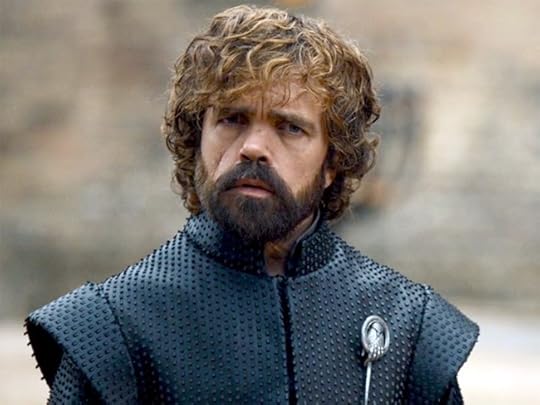
I loved watching the dwarf Lord Tyrion Lannister rises to
perilous and seemingly impossible challenges using wit, cunning, and courage, dispelling
any prejudice against him. Young and petite Daenerys Targerien is sold by her
brother, yet she charms, and falls in love with, the barbarian leader who has
bought her. She ultimately wins over the tribal army he leads and manages to
turn the harrowing situation into a win until she becomes a force to be
reckoned with in the battle to take the Iron Throne.
Game of Thrones has no monopoly on underdogs. They
are as old as David and Goliath, the tortoise and the hair, Rudolf the
Red-nosed Reindeer.
But there has to be more to a hero than being an underdog. A
ruthless dictator may emerge from humble origins and ascend to power with
something resembling courage. A hero does have to be “good” – although people
may disagree about what good means.
Author Maren Elwood in her book Characters Make Your Story tries to define a hero by what one is
not.
She says that a hero
must never be shown acting cruelly toward others, seeking revenge, flying off
the handle based on little provocation, or indulging in abject self-pity. The
implication is that these traits will cause readers to throw down the book in
disgust.
But even the most sensible sounding “rules” seem to have
exceptions. Two popular movies, Gladiator
and Kill Bill are stories in
which a hero is driven by revenge; the audience sympathizes with, and even
pulls for them because of the intensity of their suffering and the unfathomable
cruelty of their opponents.
Elwood goes on to say that readers of fiction hold the main
characters of the stories they read to a much higher standard of morality than
they do for themselves. Readers want their fictional characters to act in a way
that they like to imagine they would, not the way they really would act.
I remembered how, as a formerly bullied twelve-year-old, I had
marveled that my bullies enjoyed the same books I did. They pulled for
characters who had been abused, even though the bullies themselves were
abusers. They empathized with the suffering of imaginary people. They pulled
for characters who were “good” even if —
at least in my judgment — the bullies were not “good” at all.
Determining which behaviors are off-limits in heroes is not
enough to define what one is. In general, the fictional characters I admire,
however flawed they might be, are driven by love of something or someone to act
with courage.
However, sometimes heroes in books seem impossibly unselfish.
The courage to dash into fires to save tenants comes too easily to them. Part of me is constantly
asking, “Would I have acted as fearlessly in that situation as they did?” It is
an uncomfortable question because, too often, I am not so sure.
But I remember something one of my college literature
professors had said about the heroes of literature. He said, “Yes, literature is
filled with characters willing to risk their lives or be tortured for their
beliefs and principles. But should we worry because we might not be as brave as
they are in their situation ? I would like to think I would always do what was
right, no matter what the consequences. But honestly, if the punishment were
horrible enough, I would probably do some squirmy deed, if I had to, to escape
being beheaded, lynched, or tortured.”
He had made a good point. It is much easier to write a
dauntless hero into existence than it is to become one. So why did I or anyone
else bother making self-comparisons to fictional heroes anyway?
I think it has to do with one of the reasons we admire
heroes in the first place: they give us a vision of rising above our
limitations in order to honor what really matters to us.
The heroic literary figure speaks to the universal struggles
and limitations of being human. Life is hard and death is certain. Too often,
we feel helpless.
Our most cherished dreams evaporate like a morning mist.
Everything we care about the most, we are destined to someday lose. As much as
we try to control life, there are certain things that will always be beyond our
control.
It seems impossible to even master ourselves, our drives,
our obsessions, and our impulses. We fret about what others think. We live life
carefully, even when we have goals that we are passionate about. We feel
confused. We are indecisive. We are afraid.
A hero offers a glimpse of something different, something
that perhaps exists within all of us, a potential freedom from the strait
jacket of fear and the possibility of accomplishing something greater and more
lasting than just getting through the day.
A hero sees hope where others see despair. He sees opportunities
where others see impossibilities, even if the opportunity requires descending
into hell. But few of us want to descend into the nightmare of a torturous, uncertain
struggle, and it is sometimes hard to identify with anyone who does.
We like underdogs because through them we can start from a
familiar place of vulnerability and cross an imaginary bridge to strength, resolve, and freedom.
A hero is freer than most because he is willing to lose
everything for the love of a person, a principle, or an ideal, yet he never
becomes a rock without any feelings. A
hero might stand his ground even when a gun being pointed to his head, yet
still be afraid. What makes him free is that he insists in every situation,
upon preserving his right to make a choice.
The hero model offers a fantasy of how things could be
different, if only we were willing to be audacious enough to accept the
penalties and risks of true freedom.
Heroes should not be a cudgel for beating ourselves up
though. They are instead a window into another way to live, the tantalizing
possibility of what life might look like if we could set our fears aside and
live for what truly matters to us, even if it means losing the stable floor
beneath our feet and the illusions that make us feel safe.
Not every story features the kind of hero that speaks to the
love, fears, vulnerabilities, and suffering that come with being human. Stories
are about people striving to get what they want. But the fictional heroes that
mirror the real fears and potential courage that lie within every reader are
the ones most likely to endure.
The post What Is a Hero? appeared first on PASSIONATE REASON.