Be Prepared To Be Alone
“If what the imam is teaching is wrong,” a
community elder told me, “then why would Allah bless him with all these
followers?”
I was in my mid-twenties at the time, and I had
just begun my own spiritual journey of studying Qur’an and the prophetic
teachings and striving my level best to do what I sincerely believed Allah
required of me. Naturally, this meant that I had some beliefs and practices
that differed from those that were accepted in my Muslim community. However, those
around me did not view occasional disagreement with the imam as “natural” at
all. It was a dhulm (wrongdoing) against the imam—according to them—and
an arrogant affront.
“Who do you think you are?” they asked indignantly.
In their eyes, my duty was to blindly follow the community imam, and I had no
right to even think he was wrong, let alone voice these views publicly,
even if I didn’t mention him by name.
Even as the imam tried to change the Islamic rules
regarding who could marry whom (in this case permitting a disbelieving man to
marry a Muslim woman). Even as the imam tried to change the Islamic rules
regarding hijab (in this case permitting a woman to uncover so long as she
dressed “modestly.”). Even as the imam tried to change the Islamic rules
regarding who could enter Paradise (in this case claiming a pagan could be
Muslim in his heart). I was supposed to go along with it and never speak the
truth about what Allah said on these matters.
But I wasn’t willing to sacrifice my soul to
protect the fragile egos and spiritual insecurities of anyone, irrespective of
whether or not they were an elder, a friend, or a family member—or a religious
teacher, imam, or scholar.
As much as I genuinely loved and respected these people, I just wasn’t willing to go to Hellfire in seeking to protect their feelings and pride.
Thus, I continued to practice Islam in the way that
I sincerely believed Allah required of me, and I began to write and teach
others about authentic Islam, even when the Qur’an and prophetic teachings
disagreed with our community imam.
As a result, I was mocked and slandered (even
called Shaytaan himself), and many community members sought to publicize embarrassing
aspects of my personal life to prove to everyone how misguided and crazy I was.
It hurt like hell to see friends and loved ones so
willingly drag my name and reputation through the mud. But no matter how much this
hurt and distressed me, I knew that suffering eternal torment would hurt my
soul much more. So I prayed to Allah to bear with patience the torment of
people so as to protect myself from the torment of the Hellfire.
Shaytaan
Has More Followers Than Allah
Throughout my life I would continue to meet those
who used their religious title, number of followers, and even their Islamic “qualifications”
to change or reject the rules of Allah. Sometimes they portrayed these changes
as merely their opinion, other times they portrayed them as permissible Islamic
points of view. These changes included everything from who could marry whom to
who would enter Paradise after they died.
One self-proclaimed community activist and
religious teacher began teaching that women and women, and men and men could
get married—and she herself had recently come out as gay and “married” another
woman. Both of them were professed Muslims who wore hijab and were well-known
in the community where I lived.
During a series of conversations with her, she
defended her teachings by pointing to how many followers and supporters she
had, as I recently shared in a journal entry:
“People tell me they are inspired by me,” a woman once told me, trying to justify teaching that the Qur’an’s guidance on sexuality and marriage no longer apply in modern times. The more we talked, the more it became clear that she saw herself as a spiritual teacher offering solutions to Muslims whose sexual desires did not align with Allah’s teachings on halaal relationships.
This is an example of a problem-focused professed Muslim looking at the large numbers of people who “benefited” from her and followed her on social media as proof that she was on the right path.
However, in authentic spiritual teachings, right
guidance is soul-focused, not problem-focused, and is unaffected by how many
people follow it. Thus, whenever the believer is faced with a problem, he or
she looks to Allah’s Book and the prophetic teachings for answers—without adding
to, subtracting from, or adjusting these teachings to favor any particular
point of view or group of people.
Similarly, spiritual teachers, imams, and scholars
who are addressing problems (whether on a personal or community level) are also
soul-focused. In Islam, spiritual truth is never altered or rejected in solving
a problem—because following spiritual truth *is* solving the problem.
In this soul-focused system of Tawheed, how many
people agree with you, follow you, or claim to be inspired by you is completely
irrelevant.
Why? Because people being inspired by you doesn’t
necessarily reflect God’s pleasure with you. And it certainly doesn’t indicate
that you’re on a path to Paradise.
You might have thousands upon thousands of
supporters and followers on social media.
But keep in mind, Satan has more followers than
God. And we all know the end of that story.
Don’t let it be the end of yours.
They
Have a Right To Their Opinion?
Often when we are given the slightest sign of the obvious evil in our opinions or lifestyles, our ego and self-deception rush to our defense, telling us that we’re only “keeping it real,” that “I have a right to my opinion,” or whatever other excuse that allows us to hide our evil in the shadows of self-proclaimed truthfulness and sincerity.
You have a right to your opinion, you say? Yes, you
do. But when that “opinion” is related to a matter already addressed by our
Creator, our option for an “opinion” is nullified. Here is where we need to
honestly ask ourselves if our opinion is “just an opinion,” or if it is a
deeply rooted belief.
In Islam, beliefs are not theoretical; they are
directly connected to our actions and choices, and to how we understand and
interpret the actions and choices of others—and to what advice we give others
in making their own choices in life.
Yes, Allah allows us opinions connected to our own
personal choices (for a marriage partner, for example). However, when that opinion
begins to dictate how we label others’ halaal choices and how we give
general advice regarding what others “should” and “should not” do, then this is
no longer an opinion. It is a belief system. And the believer’s belief system comes
from the Book of Allah and the prophetic teachings—only.
Allah says what has been translated to mean, “It
is not for a believer, man or woman, when Allah and His Messenger have decreed
a matter that they should have any option in their decision. And whoever
disobeys Allah and His Messenger, he has indeed strayed in a plain error” (Al-Ahzaab,
33:36).
He also says, “And indeed We have explained in detail every kind of example in this Quran, for mankind. But, man is ever more quarrelsome than anything” (Al-Kahf, 18:54).
Regarding some of these people being scholars or “qualified”
imams when they have these opinions that contradict Islam, I share this journal
reflection:
Religious knowledge is rooted more in the heart
than in the mind. As such, when Allah speaks about the ‘ulamaa (people
of knowledge), He speaks about their fear of Him, not their accolades and
certificates from books, classes, and teachers: “It is only those who fear
Allah, amongst His slaves, who are ‘ulamaa” (Faatir, 35:28).
Thus, our classes and teachers—and accolades and
certifications—benefit us only insomuch as our hearts benefit us.
Reflect, O child of Adam, reflect!
Then repent and self-correct.
 READ NOW. CLICK HERE
Embrace
The Lonely Path
Be prepared to be alone.
If you sincerely want to meet Allah with emaan
in your heart, be prepared to be alone. This path you are walking is that of a
stranger—even amongst fellow Muslims.
Most people in this world, including many Muslims
(amongst laypeople and religious leaders), are not soul-centered. Thus,
whenever your beliefs and choices disagree with theirs—especially if you voice
it publicly—they immediately interpret it as a sign of disrespect, as some
hidden desire to gain attention or status, or as a dislike you have in your
heart toward them. They might even genuinely imagine your efforts to protect
your soul and that of others is some form of dhulm (wrongdoing) toward them.
This is because their spiritual mindset is rooted in personalities over principles instead of principles over personalities, and because their spiritual practice is dunya-centered and not soul-centered. Thus, they are utterly incapable of recognizing your sincere efforts to guard your soul from harm (and help other believing souls do the same), because soul-care is not concept that exists in their world.
In fact, they don’t even know what soul-care means. In their spiritual ignorance, they imagine that all that is required of the Muslim are some external rituals and claims of belief in Allah. They don’t realize that their opinions, their reactions to other people’s halaal choices, and the solutions they propose to matters already discussed by Allah and His Messenger (peace and blessings be upon him) all stem from the state of their own soul—and can actually harm or nullify their emaan, if they trespass certain bounds.
In this way, there will be many professed Muslims
who meet Allah without emaan in their hearts, and will not be excused or
forgiven for this.
That you understand the direct connection between
your opinions, choices, and teachings in the dunya and the state of your
soul—which determines your eternal life in the Hereafter—makes you a stranger
in this world.
So be prepared to be alone.
Yes, call others to this “lonely path” whenever you
can. But do not be distracted from protecting your own soul as you try so hard
to make them understand the gravity of theirs.
We live in strange times, dear soul, wherein we
have even spiritual teachers, imams, and scholars who do not understand the
meaning of emaan or the gravity of the soul. So while you must fulfill
your duty in calling others to this path, understand that *most* will not
respond—especially if they don’t see you as “qualified” or “knowledgeable”
enough to call others to this spiritual path.
Thus, it is crucial that you prioritize your own
soul-care over seeking their spiritual guidance.
Da’wah, whether to those unfamiliar with spiritual truth
or to Muslims who prefer this world over the Hereafter, is a delicate balance
between sincere, consistent inviting, and prioritizing your own soul and
well-being over anyone else’s.
May Allah protect us from ghuroor (self-deception), misguidance, and nullifying our faith while imagining ourselves to be believers.
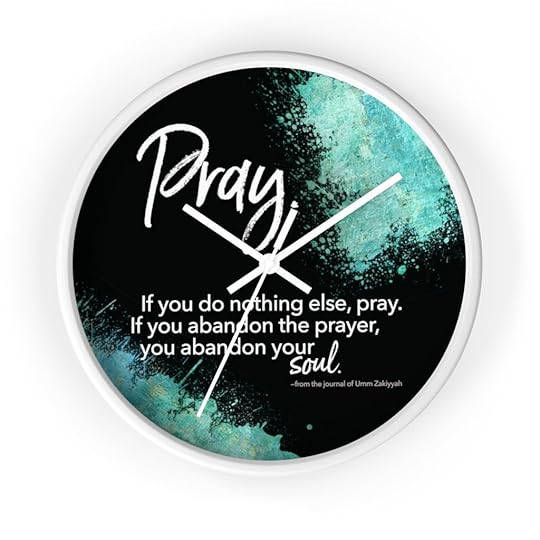 CLICK HERE
Umm Zakiyyah is the internationally acclaimed
author of twenty books, including the
If I Should Speak
trilogy,
Muslim Girl
, and
His Other Wife
.
In 2019, she launched
UZ Soul Gear
, a passion project fueled by her love of both art
and inspirational reflections.
UZSoulGear.com
offers apparel, wall
décor, and more, aimed at supporting and inspiring the soul-centered lifestyle.
The post Be Prepared To Be Alone appeared first on Umm Zakiyyah.