
Inside the Mind of a Troubled Leader
Srini Pillay, M.D. and Jim Selman

It is not easy to be a leader of any business.
Leader Challenges: CEOs are challenged by various factors including the governance structure and board composition, as well as the four factors pointed out by McKinsey senior partner Richard Dobbs and his colleagues: the rise of emerging markets, the accelerating impact of technology on the natural forces of market competition, an aging world population, and accelerating flows of trade, capital, people, and data.
Mindset Challenges: Given these challenges, the mind of a company leader is often overrun with self-doubt, fluctuating confidence, uncertainty and fears.
Traditional Approaches: Traditionally, we think of helping leaders by understanding and addressing the factors underlying these emotional states, but there are several problems with this approach: (1) There are too many possible “causes” of these emotional states. We do not really understand the mechanisms behind our emotions at any given time; (2) Getting leaders to talk about their emotions usually does nothing and may actually worsen the trauma that a CEO is experiencing. For example, among police officers who responded to a civilian plane crash, those who underwent debriefing exhibited significantly more disaster-related hyperarousal symptoms at an 18-month follow-up than those who did not receive the treatment; and (3) Reality is counterintuitive to what we would expect. For instance: People often do the opposite of what they are told. Some people dislike receiving a favor. Propaganda is frequently ineffective in persuading people. And the grass is often greener on the other side.
A New Approach — Existential Confidence: Instead of targeting a “cause”, asking leaders to debrief their challenges, or relying on reason alone to alleviate the troubles in the mind of a leader, we propose a new leadership model that will embolden leaders. This model is based on a way of being called “existential confidence”.
The term “existential confidence” (EC) refers to a way of being in which we trust the way we are. In this state, we believe that we are sufficient enough to deliver on promises that have not been delivered in the past.
In 1978, psychiatrist Benjamin Wolman explained that EC requires high self-esteem, confidence and morale. And in 2010, author David Grossman referred to EC as an optimism that would come from expecting to live your life in peace without the threat of violence and despair looming around every corner.
When we have EC, we drop our shields of defense and allow other people to see us fully, so that we can see them fully. And we also have a comfortable relationship with the mysteries of existence.
Essentially, existential confidence stems from self-actualization.
Components of Existential Confidence: So how do you develop this sense of self sufficiency, and what mindset shifts can help to foster it? To help leaders develop more boldly, we have identified 10 mindset shifts that leaders can use to change how they lead. Each of these has a philosophical, psychological, and brain-based foundation that will help leaders lead with greater boldness.
When you are a leader with EC, you lead more boldly when you do the following:
Create problems worth solvingLearn how to navigate without controlLead from possibilityLearn how to develop an actionable imaginationLead from the future — let the future use youUnderstand paradoxLearn to trust the process deeplyUse language to create your realityLet your commitments determine your realityRecognize that caring is the foundation for relationship and possibilityDifference between Traditional and EC Ways of Being: The table below illustrates how these competencies contrast with existing approaches.
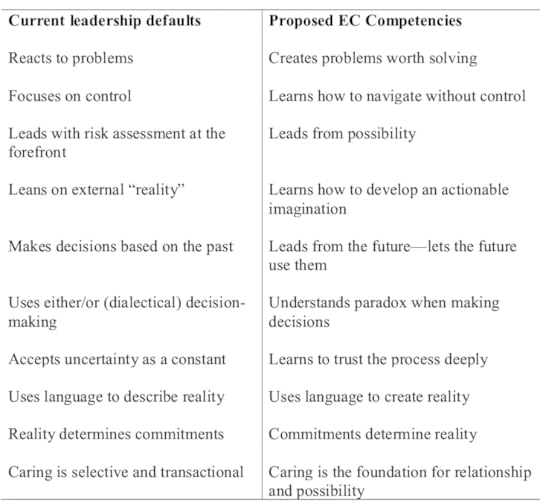
Each of these competencies is a radical shift from simply being a reactive leader. It places the leader in the driver’s seat, psychologically and strategically, but it also helps the “passengers” enjoy the journey.
After all, living with a knot in your stomach and a constant voice in your head that asks, “Will this really work?” is no way to lead a life. EC is a way of being that can embolden leaders as they deal with the daunting and changing realities of the business landscape and their lives.
We invite leaders to consider these ideas. In future blogs, we will propose the structures and practices associated with each of these principles to implement within an organization.

Inside the Mind of a Troubled Leader was originally published in Center for Existential Confidence on Medium, where people are continuing the conversation by highlighting and responding to this story.


Srini Pillay's Blog

- Srini Pillay's profile
- 15 followers

