
The Children Act by Ian McEwan
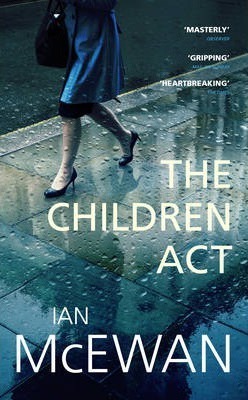
This review first appeared, in a slightly different form, in The Sunday Business Post in September 2014.
*
Is there a more straightforwardly readable literary novelist than Ian McEwan? His books are astonishing exercises in narrative control. He creates compelling situations: you read on, absorbed, dying to know what happens next. The prose is frictionless and often beautiful. But despite this immense readability, McEwan’s recent novels have been, in a global sense, unsatisfactory. It’s only when the book is done – when you put it away and start thinking about what you’ve read – that the flaws become visible. It’s as if McDonald’s served foie gras. A treat for gourmands – but you’re hungry half an hour later.
Partly this has to do with the hermetic isolation of McEwan’s characters. He writes exclusively about the English upper middle classes: neurosurgeons, mathematicians, composers, civil servants. He has always been commendably interested in getting inside the heads of non-literary characters – people for whom literature is not the central business of life. He wants to show us what it’s like to be a neurosurgeon, a mathematician, et cetera: and in an aesthetic if not a journalistic or biographical sense, he very often succeeds. His new novel, The Children Act, inhabits the life and career of Family Court judge Fiona Maye. As usual, the details are compellingly marshalled. McEwan can give us the shape of a judge’s inner world: the gossip, the regrets, the judgements composed in “almost ironic, almost warm” prose, written while “supine on a chaise longue.”
But the book feels hollow – and unpleasantly sealed off from reality. When it comes to characters who fall outside the hypercivilised penumbra of his preferred North London milieu, McEwan’s imagination falters. His ethereally bourgeois protagonists – with their Talisker whiskeys and their baby grand pianos on which they practice Bach partitas – float above the human fray, insulated unto abstraction by the sort of incomes that mean you are free to interrogate yourself at leisure about your values. If circumstances do compel McEwan’s characters to visit the foul rag and bone shop of the heart, they hold their noses and dive on in; but they are infallibly protected by the trappings of their class.
In Saturday (2003), Henry Perowne’s urbanely materialist daily round is disrupted by the intrusion of Baxter, a thug who invades Perowne’s family home and threatens to rape his daughter, Daisy. In one of the least believable scenes in recent fiction, Daisy distracts Baxter with a recitation of Matthew Arnold’s poem “Dover Beach,” allowing Henry and his son to push Baxter down the stairs. Henry then heads to the OR, scrubs up, and repairs the damage to Baxter’s brain, pro bono. The threat has been neutralised. Henry’s humanistic values have prevailed.
The drama of McEwan’s recent novels has come from violating (or seeming to violate) the cerebral self-regard of his protagonists. In The Children Act, Fiona Maye is called to rule on the case of seventeen-year-old Jehovah’s Witness Adam Henry. Adam suffers from leukaemia. The necessary medicines have eroded his white cell count. He needs a blood transfusion to give him a chance at life. But Jehovah’s Witnesses believe that accepting transfusions is prohibited by God. The hospital has petitioned the court for the right to administer transfusions. Fiona must decide if there is a legal basis to grant that right.
Naturally, Adam’s case – coinciding with her husband’s decision to leave her for a younger woman, from whom he expects “Ecstasy, almost blacking out with the thrill of it” – threatens to destroy the equilibrium of Fiona’s carefully-argued life. A visit to the rag-and-bone shop looms: “A professional life spent above the affray, advising then judging, loftily commenting in private on the viciousness and absurdity of divorcing couples, and now she was down there with the rest, swimming with the desolate tide.”
But – as in Saturday – the threat of violation is only a feint. At the end, the balance is restored. Fiona is reunited with her husband: “[T]hey would likely find a way of being back, more or less, with what they once had.” The real trauma occurs offstage, in those parts of the world where people don’t own baby grands or drink Talisker whiskey. But McEwan cannot take us to those places. His imagination refuses to let him believe in a world in which Bach partitas have no purchase, a world in which “viciousness and absurdity” are the rule, rather than the exception. In McEwan’s novels, Orpheus emerges smiling from the underworld with Eurydice on his arm. Loss is for the lower orders.
There is much beautiful writing in The Children Act (a coffee machine is “lit from the inside, brown and cream, as vivid in the gloom of the recess as an illuminated manuscript”). But this beauty serves only to furnish the monk’s cell of privilege in which McEwan’s characters have their straitened being. His novels fail the first test of realism: they leave out great raw chunks of human reality.


Kevin Power's Blog

- Kevin Power's profile
- 29 followers

