
Best practices for your writing success
We’ve heard the usual advice: write a certain amount of words daily. Keep a notebook to capture your ideas in one place. Write what you know. But what if some of the simplest things made for the best writing practice?
All this is good advice. And over time, I’ve seen that it’s the simplest practices that help make writing easy. I have used these myself and have witness students in my classes feel great success with these simple approaches.
Always apply my Adopt/Adapt approach. Adopt my suggestions and adapt them to suit you. If it’s not working, drop it and try something else.
 Set a timer. You have probably sat down to write and found yourself bopping all around your email and the internet. A timer is the simplest thing of all but the best way to hold your focus. Set a timer for 10-15 minutes to get focused bursts of writing in.
Use a reflection process. At the end of each writing session, jot three words to describe your experience of writing. Don’t overthink it; just free-associate your experience quickly and briefly. Keep a list of these to see what your writing gives to you.
Give your words critical distance. After you’ve written something, set it aside for a day or so. Give it space to breathe and for you to step out of writing mode and into reader mode. You will see much more with space between you and the writing.
Write early. We all have our biorhythms that work for us. Knowing when to do things is key, as Dan Pink describes in his book When. No matter what your preferred time of day, I suggest getting your writing in as early as possible. Most of the people I work with report that they have more focus and energy earlier in the day. The later in the day the writing happens, the more it feels like a chore. Do your writing early in the day and enjoy the victorious feeling that gives you all day long.
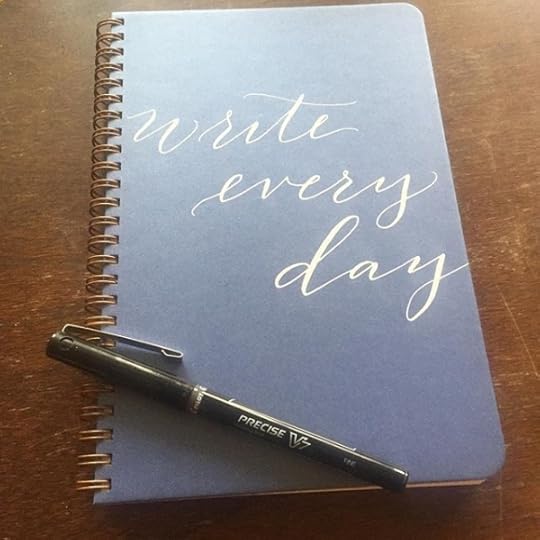
Keep it together. If you haven’t already, create a container for your writing. It could be a notebook or a digital file. Gather notes, drafts, ideas and images in one place for easy reference. It doesn’t matter how messy the contents are, just that you have one container for your work. Ideally, it will be portable so you can access it everywhere.
You can also use the notebook as a progress log or way to capture your process. Sometimes we need to hash out our thoughts about our process or record information about our writing sessions—yay, gold star! Or add up our word count. We can log our ups and downs and have a record of what works and what doesn’t for the next book we write.
I prefer to use a notebook, and one of my favorites is the Diary Flex by Hahnemühle, which is refillable. There is also the cool Make My Notebook, which allows you to customize your cover and interior pages, seen above.
There’s so much more I could say about developing a writing practice. In The Devoted Writer, we spend an entire month dedicated to designing and enjoying our writing practices. We begin this Friday, so check out all the details and reserve your seat here.
This is excerpted from my upcoming book, The Busy Woman’s Guide to Writing a World-Changing Book, out in spring 2019. Subscribe to Impulses for sneak peeks and insider insights.
The post Best practices for your writing success appeared first on Original Impulse .


