
We Make the Media – a recent speech at Freedom of Speech Online 2018
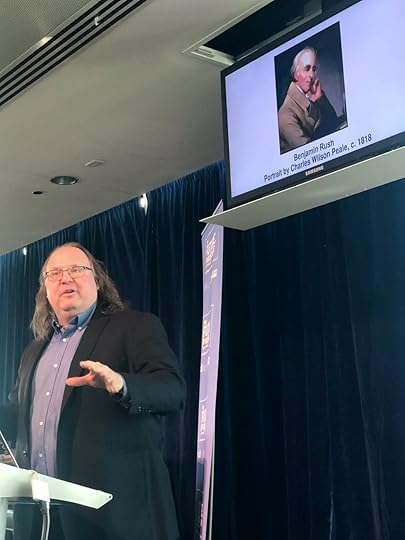
I was honored to give the opening keynote this Friday at the Future of Speech Online, held at the beautiful Knight Conference Center atop the Newseum in Washington, DC. A few friends asked whether I’d share the remarks online, so here’s my best attempt, from my notes. Apologies for the differences between this and the talk I actually delivered – the perils of live performance, y’all.
It’s become necessary at gatherings about the future of media to start by banning the “f” word, a word that gets a lot of play in Washington, especially on the President’s Twitter feed. But there’s lots to talk about in the world of dis- and misinformation, that complicated space where words online can lead someone to “self-investigate” a DC-area pizzaria with a rifle to ensure that it isn’t hosting a pedophile ring in its non-existent basement. Online words have consequences, and we’re still trying to understand whether those consequences include swaying elections in the UK, the US or Brazil, or whether recent political surprises have causes other than the media environment.
There’s lots of people trying to solve the mis/disinformation problem with technology, and because I hail from a lab where people manufacture novel artificial limbs, 3D print buildings and design satellites to monitor African environments that I’m coming with a set of new tech solutions. You couldn’t be more wrong, because I’m bringing something far more powerful: history.
When people invoke history in journalism, they’re often talking about the “golden age” of broadcast media, sometime between the end of WWII and Watergate. We had a few authoritative voices – Edward Murrow, Walter Cronkite – and less doubt, perhaps, about what had actually happened in the world. “And that’s the way it is,” like Cronkite liked to say.
That model of media was the result of a very specific moment in technology and in economics that has more to do with the advertising industry depicted in Mad Men than it does with any specific view of how media and democracy work together. A small number of businesses did the very expensive work of producing news and packaged it with advertising on some of the very few channels that could reach a large public, a limited number of print publications and a tiny handful of broadcast television outlets. Those few outlets held a near monopoly over attention and sold slivers of that attention to advertisers for vast sums of money, which is a great business model as long as you can maintain it.
That concentration of power in the hands of a very few outlets meant that media wasn’t very representative. News was largely a white, male space – if you were Black, Latinx, Asian, female, queer or any other identity, news was often a space that wasn’t very open to you. I don’t want to return to a vision of 1950s news, where so many voices were missing from the conversation, even if that conversation was more coherent than the one we encounter today.
Our media now is dramatically more representative, for the simple reason that there are very few structural barriers to expressing yourself, even if there are massive barriers to being heard by an audience. Movements like Black Lives Matter and the gun control protests led by survivors of the high school shooting in Parkland, Florida both leveraged the power of participatory media to be heard and to shift media narratives to stories that often go unreported. This, I would argue, is generally a good thing. But the results of this change (which An Xiao Mina terms the shift from “broadcast consensus to digital dissensus”) means media is more conflicted, confusing and hard to navigate than it was in the mid-20th century. For help understanding our current media, we need a different guide.
I propose Benjamin Franklin, the sort of guy we like to celebrate at MIT. We know him as a statesman, a diplomat and a scientist, but the job he held the longest was as postmaster, first as postmaster of Philadelphia in 1737 and finally getting fired from his position as postmaster general of the Colonies in 1774, when the British finally figured out that he was a revolutionary who could not be trusted. (The dude literally used to post his letters by writing “B. Free Franklin” – as opposed to “B. Franklin – free” – it took the British a while to catch on that this was political propaganda as well as a way of getting free postage.)
Ben was a hustler, an entrepreneur who took full advantage of the various opportunities his position opened, including giving plum patronage jobs to many of the men in his family. His most profitable synergy came from printing newspapers and using the post to distribute them. Early in his career, he’d had difficulty distributing his writings because the postmaster disagreed with their political content and refused to transmit them. Franklin put forth a policy that was both progressive and profitable – neutral carriage. Under his leadership, the job of the post was to deliver letters and printed materials, not to prevent their transmission. This fact, combined with the fact that US presses were not required to reserve “caution money”, huge sums that might be drawn on if a paper was successfully sued for libel, led the US towards a new form of public sphere: a distributed public sphere of mail and print.
When we talk about the public sphere as scholars, we’re usually referring to Habermas’s conception of the public sphere, which was rooted in conversation of wealthy elites in coffeehouses. This dynamic of face to face conversation shapes much of how we traditionally think of the public sphere working, but that’s not how the public sphere evolved in the US. The colonies were physically huge, and in imagining a political conversation that included both Boston and Charleston demanded a creative way of envisioning how political debate could unfold. More than any of the founding fathers, Franklin was responsible for the shaping of this new space for policial discourse.
The founding father who picked up the torch from Franklin as he took over Jefferson’s work as ambassador to France was Dr. Benjamin Rush, a professor and public health advocate whose arguments about the role of the post and the press in the Continental Congress led to the most important piece of legislation you’ve never heard of, the Post Office Act of 1792.
The Post Office Act established the right of the government to control postal routes and gave citizens rights to privacy of their mail… which was deeply undermined by the Alien and Sedition Acts of 1798, but hey, who’s counting. The low cost of mailing newspapers as well as the absence of stamp taxes or caution money, which made it incredibly prohibitively expensive to operate a press in England, allowed half of all American households to have a newspaper subscription in 1820, a rate that was orders of magnitude higher than in England or France.
But what may be most important about the Post Office Act is that it set up a very powerful cross subsidy. Rather than charging based on weight and distance, as they had before Franklin’s reforms, the US postal system offered tiered service based on the purpose of the speech being exchanged. Exchanging private letters was very costly, while sending newspapers was shockingly cheap: it cost a small fraction of the cost of a private letter to send a newspaper. As a result, newspapers represented 95% of the weight of the mails and 15% of the revenue in 1832. This pricing disparity led to the wonderful phenomenon of cheapskates purchasing newspapers, underlining or pricking holes with a pin under selected words and sending encoded letters home for the price of a paper rather than a letter.
But the really crazy subsidy was the “exchange copy”. Newspapers could send copies to each other for free, with carriage costs paid by the post office. By 1840, The average newspaper received 4300 exchange copies a year — they were swimming in content, and thanks to extremely loose enforcement of copyright laws, a huge percentage of what appeared in the average newspaper was cut and pasted from other newspapers. This giant exchange of content was subsidized by high rates on those who used the posts for personal and commercial purposes.
This system worked really well, creating a postal service that was fiscally sustainable, and which aspired to universal service. By 1831, three quarters of US government civilian jobs were with the postal service. In a literal sense, the early US nation was a postal service with a small representative government and a tiny military attached to it. But the postal system was huge because it needed to be — there were 8700 post offices by 1830, including over 400 in my home state of Massachusetts alone, which is saying something, as there are only 351 towns in Massachusetts.
The key thing to understand about this is that it’s not a happy accident that we ended up with a public sphere that worked this way. Our founders built and regulated the postal system in such a way that its function as a sphere of public discourse was primary and its role as a tool for commerce and personal communication was secondary. They took on this massive undertaking explicitly because they believed that to have a self-governing nation, we needed not only representation in Congress, but a public sphere, a space for conversation about what the nation would and could be. And because the US was vast, and because the goal was to expand civic participation far beyond the urban bourgeois, it needed to be a distributed, participatory public sphere. To be clear, this was far than a universal public sphere – the founders saw this as a space for propertied white men – but the infrastructures of post and mail created powerful tools for abolitionists, for newspapers that helped free black men connect across vast distances, that helped carry the case for women’s suffrage.
All that said, I’m not going to argue for a return to the press of the late 18th and early 19th century any more than I would argue for a return to Murrow or Cronkite. Franklin’s press was littered with advertisements to a degree we’d find disconcerting today – as much as 90% of the text in these papers were commercial in nature, helping explain why so many of these early newspapers were called The Advertiser. The press was partisan, to an almost absurd degree. It wasn’t a party press – the political parties of the time emerged from the press, rather than the other way around. You read Hamilton’s New York Evening Post, and that, more than anything else, identified you as a Federalist.
Oh, and the 18th century press was LOADED with fake news. I don’t just mean Franklin’s habit of inventing personas like Silence Dogood, who he created because his brother’s paper, the New England Courtant, wouldn’t publish his letters until he began using a pen name. Franklin’s papers ran stories accusing the British of paying Indians to scalp settlers, a slander that both helped sell papers and turn colonists against the British. (Yeah, that part doesn’t get much play in his autobiography for some reason.)
Worse was Sam Adams – you know, the beer guy – who was a notorious propagandist whose articles in the Boston Gazette led a mob to sack the house of Thomas Hutchinson, the governor of Massachusetts Bay. The folks who attacked his house – “They were old men, young men, and boys barely old enough to read, all of them jacked up on ninety-proof Sam Adams prose,” – believed Adams that Hutchinson was responsible for the hated Stamp Act, a tax on newspapers. Actually, Hutchinson was against the stamp act and had warned his superiors in England that the colonists would never accept this restriction on their speech. (This story is from Eric Burns’s wonderful book, Infamous Scribblers)
Mis/disinformation isn’t a new phenomenon in American civic discourse. Nor is a disputatious, partisan press that veers into propaganda. But these shortcomings where counterbalanced by a carefully constructed ecosystem where diversity and free, inexpensive flow of information helped counterbalance the excesses that otherwise might have plagued the system.
The public sphere of the mid-20th century was carefully constructed as well. It was shaped by a strong professional norm, the firewall between the business and journalism operations of a newspaper, which allowed news organizations to investigate the politically powerful, and even the corporations that funded them. The introduction of the Fairness doctrine in 1949 somewhat heavyhandedly tried to assure equal representation of opposing viewpoints in the media. And after FCC commissioner Newt Minow declared the emerging space of television a “vast wasteland” in 1961, the philanthropic community responded by building the Corporation for Public Broadcasting and building public media as we know it in America.
The point is not that any of these interventions might be the right medicine for what ails us at present, but that the shape of our media is a choice. The media environment we live in is the most powerful factor that influences our civic and political life, and that these environments aren’t inevitable – they can be shaped by policy and by norms, as well as by technology.
We seem to have a strange sense of powerlessness when it comes to coping with the contemporary media environment. After stepping down from his role as VP of growth for Facebook, How the Post Office Created America.


Ethan Zuckerman's Blog

- Ethan Zuckerman's profile
- 21 followers

