REVIEW: MY EXPERIENCES IN THE WORLD WAR by General J. Pershing.
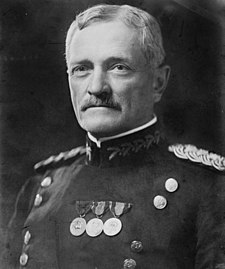
General of the Armies, John J. 'Black Jack' Pershing.
"Although observing statesmen and military men, others only vaguely, had sensed the situation as a menace of war, few seemed to appreciate that a resort to arms would involve practically the whole civilized world. Apparently none of the powers visualized what it would mean in its appalling destruction of human life, its devastation of countries, and in the suffering of populations."
This memoir with diary excerpts is a concise record of General Pershing’s experiences in his role in WWI, providing insight into the war told from the American perspective. It tells of his early life as a soldier, and events leading up to this war while the world sleepwalked its way into a catastrophe of indescribable proportions. No doubt, Pershing’s insights after this war helped shape the thinking of future American generals.
Pershing was unequivocal as to blame for this unspeakable tragedy which cost 20 million lives and wounded another 21 million.
"The details of what happened in the beginning are well known and the world has long since fixed the blame where it properly belongs—on the shoulders of the German Government of 1914."
He lists some of Germany’s atrocities and laments America’s lack of action in preparation for war:
"The invasion of Belgium was an open declaration of Germany’s attitude toward all neutral rights. If our people had grasped its meaning they would have at least insisted upon preparation to meet more effectively the later cumulative offenses of Germany against the law of nations, one of which was the sinking of the Lusitania."
Inaction played into the hands of Germany, she knew how long it would take the United States to put an army in the field.
Pershing comes off as modest and humane. In fact, he seemed to possess the patience of Job (for most of the time) and showed himself to be an astute politician in dealing with the French and British. I found it astonishing that both those powers tried to prevent Pershing from forming an American army. They felt that the millions of men being sent from the US, at the rate of 250,000 per month, should be fed into their own armies. Pershing was adamantly against this. He knew his men did not want to serve under any flag but their own. He also knew they would be slaughtered. The Allies had devised a system of defensive trench warfare as their mode of operation and training. Pershing was dead set against this.
"Trenches were not new to Americans, as both the Union and Confederate armies in the Civil War had used them extensively."
Pershing’s strategy was to fight aggressively on open ground and did not want his men trained exclusively in trench warfare. He also wanted his infantry to be well trained as crack shots with their rifles and was constantly frustrated by lack of training in these fighting techniques he’d specifically called for. Lack of preparation in aviation was dire and Pershing did not hold back as to his requirements to prosecute this war:
"The situation at that time as to aviation was such that every American ought to feel mortified to hear it mentioned. Out of 65 officers and about 1,000 men in the Air Service Section of the Signal Corps, there were 35 officers who could fly. We could not have put a single squadron in the field …"
When the general and his staff arrive in France, he was dumbfounded by the reception they received and there are many instances in the book where he tells of the emotion he felt and connection to the French people.
"The station was packed with people and the atmosphere seemed electrical with pent-up enthusiasm. The acclaim that greeted us as we drove through the streets en route to the hotel was a complete surprise. Women climbed into our automobiles screaming, “Vive l’Amerique,” and threw flowers until we were buried. It brought home to us a deep sense of the responsibility resting on America."
The Germans knew they only had a small window of opportunity to win the war before the Americans arrived with a force of more than 3 million men. After capitulation by the Russians at the Eastern Front, Germany rushed as many divisions as it could to the Western Front. Pershing began to understand the magnitude of the task before him. To form a properly trained army and air force from scratch was daunting. At last, the first Americans began to arrive and the French population was elated.
"This first appearance of American combat troops in Paris brought forth joyful acclaim from the people. On the march to Lafayette’s tomb the battalion was joined by a great crowd, many women forcing their way into the ranks and swinging along arm in arm with the men. With wreaths about their necks and bouquets in their hats and rifles. …Many dropped on their knees in reverence as the column went by."
But the clock was ticking. The next massive obstacle the general faced was getting his troops across the Atlantic. He points out that since the losses caused by the civil war American shipping was seriously depleted. The only way was for the Allies to use their ships for the purpose, but they were reluctant.
It is eye-opening, that is to say, what a great general has to think about in waging a world war—it’s not just a matter of charging off into battle. Pershing had to organize and manage: communications, first aid, hospital building, organization of the Red Cross and YMCA, shipping, road building, transportation (including railways), war material, lumber, horses and mules, billeting, morale, venereal disease, control of alcohol consumption, defense against poisonous gas, chaplains and religion, uniforms and cold weather gear, fuel, promotions, courts martial, justice and executions, the press and censorship. Pershing was hands-on with all these issues. For instance, he sent for specialists in forestry, lumbermen and 10,000 laborers for cutting down trees and setting up saw mills and building roads; railway engineers to organize railway transportation and repair of existing damaged cars and trains for movement of allied and American armies. Later, Spanish flu’ would occupy his mind and become a major factor, ultimately killing millions.
Pershing tells us about the use of poisonous gas which had been discussed at the Hague Conference in 1899 and to which Germany had subscribed to the agreement. But her armies dishonored this pledge, throwing humanity to the winds, becoming the first to use gas shells—which later they, themselves, must have regretted.
"The first gas attack had occurred on April 22, 1915, in the Ypres salient… What followed almost defies description … hundreds of men were thrown into a comatose or dying condition ..."
There were moments of great drama. When Pershing visited Beauvais to meet with the Supreme War Council the allies set upon him, insisting again and again that the American troops be allocated into the ranks of their own armies. He told them:
“ 'The time may come when the American Army will have to stand the brunt of this war, and it is not wise to fritter away our resources in this manner.' At this juncture, Lloyd George and M. Clemenceau, entered the room. Milner met Lloyd George at the door and said in a stage whisper behind his hand, 'You can’t budge him an inch.' Then all five attacked me with force. I said with the greatest possible emphasis, 'Gentlemen, I have thought this program over very deliberately and will not be coerced.' ”
There are references to ‘colored troops’. Pershing had commanded Americans of African descent earlier in his career and that was where his name ‘Black Jack’ Pershing originated. He’d commanded the ‘Buffalo Soldiers’ as they were called. This name was said to have been used by the Indians who respected them, finding them as ferocious as buffalo. Some black regiments went on to fight alongside the French and were highly decorated. A colored division, the 92nd, had been selected by the War Department for temporary service and training with the British armies, but their Military Attache in Washington protested. Pershing was surprised and wrote to Marshal Haig:
“May 5, 1918. “MY DEAR SIR DOUGLAS: …You will, appreciate my position in this matter, which is that these negroes are American citizens. Naturally, I cannot and will not discriminate against these soldiers."
Race comes up again in Pershing’s diary on June 22, 1919. Rumors are being spread and he hears about it when he talks to his men in the field.
"Colored soldiers highly incensed that false stories of their mistreatment are being circulated at home. …German propaganda was working overtime in the US to stir up trouble. …My earlier service with colored troops in the Regular Army had left a favorable impression on my mind. On the frontier and elsewhere, they were reliable and courageous … Exploits of two colored infantrymen some weeks ago in repelling much larger German patrol, killing and wounding several Germans and winning Croix de Guerre by their gallantry, has roused fine spirit of emulation among colored troops. … The only regret expressed is that they are not given more dangerous work to do. They are especially amused at the stories being circulated that the American colored troops are placed in the most dangerous positions, and all are desirous of having more active service than has been permitted them so far."
The Allies had doubts about the Americans, questioning their ability to fight as well as their own seasoned armies. The opportunity soon came to remove any reason for misgivings. The German attack of May 27th 1918 was made by thirty German divisions. It came as such a surprise that the French did not have time to destroy important bridges across the Aisne. American troops were rushed to Chateau-Thierry.
"The roads were crowded with French troops and refugees retreating in great confusion, many soldiers telling our men that all was lost. …Although in the battlefield for the first time, the Americans maintained their position and by their timely arrival stopped the German advance on Paris."
With the Americans in the fight, the tide was about to turn, but the shortage of horses and mules for hauling guns and war material was a continual problem and one gets the picture of the dreadful suffering of these magnificent creatures during man’s quest to kill one another.
"We were promised 80,000 of the 160,000 to be obtained through the requisition at the rate of 15,000 per month…These numbers, however, would still leave us with a large shortage …"
Extraordinary tales emerged after America’s first battles in the Chateau-Thierry/St. Mihiel region. Diary entry July 12, 1918:
"Took lunch with Harbord at Nanteuil-sur-Marne, where his brigade of the 2nd Division is resting. He told of a marine who had captured seventy-five German prisoners single-handed."
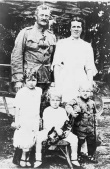
General Pershing, wife Helen
with three of their children.
There are touching moments, considering what Pershing had so recently endured: His wife and three daughters had died in a fire in San Francisco in August 1915. His black orderly had climbed through the window and rescued his son. During July of 1918, after his inspection of an aviation center, he went for a walk, which must have brought back heartbreaking memories.
"I visited the fine old pension in which I had spent two happy months with my family back in 1908. The beautiful garden, the shade trees, the swing, the children’s sand pile, all were the same, but now I was a stranger."
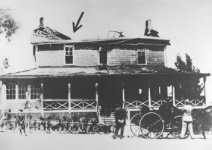
The Pershing home after the deadly fire of 1915
"The American troop build-up continued through 1918 at the rate of 250,000 per month. A cable made it clear that the War Department expected to have eighty divisions, or approximately 3,200,000 men, in France by July, 1919. The St. Mihiel victory probably did more than any single operation of the war to encourage the tired Allies. And initial moves of the German government to stop the fighting occurred at this time and without doubt because of the results of these four days of battle."
After fighting ceased, it was realized Germany was on its knees, no longer in a position to fight. Pershing had strong opinions about subsequent events.
"Instead of requiring the German forces to retire at once, leaving material, arms and equipment behind, the Armistice terms permitted them to march back to their homeland with colors flying and bands playing, posing as the victims of political conditions. … If unconditional surrender had been demanded, the Germans would, without doubt, have been compelled to yield, and their troops would have returned to Germany without arms, virtually as paroled prisoners of war. The surrender of the German armies would have been an advantage to the Allies in the enforcement of peace terms and would have been a greater deterrent against possible future German aggression."
Twenty years later, Germany resumed the war in its quest to be masters of Europe. I found this book factual and deeply interesting—a gold mine for researchers of the Great War from the American perspective.


No comments have been added yet.