How do materialists view metaphysics?
Materialists are very finicky knowers. For some arbitrary reason known only to themselves, materialists demand that all reality be reduced to the simplest of its manifestations: matter.
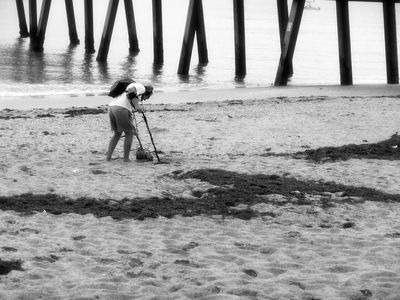
There are two consequences that follow from materialist willfulness, that are best illustrated by an example (adapted from The Realist Guide to Religion and Science, pp. 80-81). Consider if you went looking for objects at the beach and you decided beforehand that the only things you wanted to find were metal objects. You then gather your search tools—binoculars, telescope, microscope, and metal detector. After spending days combing the beach, you realize that only the metal detector is able to find metal objects. Also, during these days, your love of metal objects has grown to become an obsession.
Under the influence of your experiences and your obsession, you develop a new philosophy. The philosophy is very simple: metal objects are the only things that exist and metal detectors are the only useful tools. By this philosophy, you have reduced the totality of the beach to metal and the totality of investigative tools to metal detectors.
Materialists effectively do the same thing with reality. They are those whose obsession with matter has become so strong that they decide that matter is the only thing that exists. As a result, they take the investigative method that is best for understanding matter—the scientific method—and claim that it alone can discover anything about reality.
What consequences does this have for metaphysics? Well, metaphysics does not concern itself with matter. Its object of study is rather ‘being’ or reality as such. It wants to know the laws of reality as reality, not the laws of physical reality. But ‘being’ is outside of the scope of the scientific method, since that method is designed to measure and quantify physical bodies. ‘Being’ is not something physical and is not quantifiable.
As a result, materialists claim that the metaphysical concept of ‘being’ is useless, that metaphysics tells us nothing about reality, and its particular manner of investigating reality—the pursuit of ultimate causes by means of analogical concepts—is a waste of time.
What is ironic here is that the laws of science are only secondary to the laws of reality. In other words, one can only investigate laws for physical being if one first accepts the laws for being itself. For instance, before you can hold the principle that, for physical bodies, “every action has an equal and opposite reaction”, you must first admit that physical bodies exist and that they do not not exist at the same time. The latter is a law of metaphysics and comes before any laws of science.
By shooting down metaphysics, then, materialists end up shooting themselves in the foot. Their materialistic endeavors cannot be logically coherent unless they first admit the properties of being, something they refuse because those properties cannot be found by ‘material detectors’.
The most poignant literary depiction of the materialist mind, in my mind, is found in C.S. Lewis’s The Last Battle, chapter 13 (this is the last of the seven Narnia books). Lewis is depicting an apocalyptic scene where the good are being separated from the bad, according to their eternal destiny. The child Lucy spots some dwarves who are all huddled in a circle and are not advancing forward to the heavenly realm. Despite the fact that the entire atmosphere is luminous and the sun is shining brightly, they can only see a very short distance. Lucy and Eustace attempt to break up the dwarves’ circle and have them join in the enjoyment of the trees and flowers and the beautiful day. The dwarves persistently refuse the children’s perception of reality, being convinced that they are stuck in a dark stable.
Suddenly, Aslan appears. Lucy tearfully asks him to do something for the dwarves. “Dearest,” said Aslan, “I will show you both what I can, and what I cannot, do."
“Aslan raised his head and shook his mane. Instantly a glorious feast appeared on the Dwarfs’ knees: pies and tongues and pigeons and trifles and ices, and each Dwarf had a goblet of good wine in his right hand. But it wasn’t much use. They began eating and drinking greedily enough, but it was clear that they couldn’t taste it properly. They thought they were eating and drinking only the sort of things you might find in a stable. One said he was trying to eat hay and another said he had a bit of an old turnip and a third said he’d found a raw cabbage leaf. And they raised golden goblets of rich red wine to their lips and said ‘Ugh! Fancy drinking dirty water out of a trough that a donkey's been at! Never thought we'd come to this.’”
After this, Aslan remarks to Lucy, “You see. They will not let us help them. They have chosen cunning instead of belief. Their prison is only in their own minds, yet they are in that prison; and so afraid of being taken in that they cannot be taken out.”
Such is the materialist plight. They look out on a reality luminous with ethereal beauty, our God-haunted earth and skies. But they refuse to notice any of it but the plainest and most ordinary things. Where reality is most lit up, there they only find darkness. Where reality is most glorious, there they see nothing at all.
Clearly, there is no need for them to so brutally truncate reality. To begin to see reality in its full light, however, they must be willing to allow room in life for more than matter and the scientific method.