The Road To Świebodzin
On July first, Marie and I made our way home after three weeks in Europe. We had started out on a side trip to Scotland, before joining a Rhine river cruise in Amsterdam. I could not resist, despite it being a cold and rainy day, dropping into the city to visit the sites where my trilogy began. After all, the story began with the body of Ted Barber being fished out of the canals there.
While our tour down the Rhine was wonderful, our real adventures began when we departed the longboat in Basel, Switzerland about eight days later. After some sightseeing, Marie and I rented an underpowered Ford 5-speed and drove out of Basel, past Zurich into the magnificent alpine scenery around Bregenz, Austria. You will note as we progress in this blog a theme of revisiting scenes from my latest novel “War of the Nocturne’s Widow”.
Bregenz sits on the lower shores of Lake Constance and is surrounded by mountains as it separates Switzerland from Germany. It is a breathtaking city. We enjoyed sitting in on rehearsals (preparing for Carmen) for their outdoor Opera house , where the stage floats upon the Bodensee (the local name for Lake Constance). We couldn’t resist taking the cable car to the top of the Pfänder, a mountain overlooking the lake with fabulous vistas of Switzerland’s Alps as well as the Bodensee itself.
[image error]Marie and I in the Pfander above Bregenz, Austria
Our second day took us via ferry to Lindau, Germany for a wonderful Saturday on the Lake. After which, we departed the Bodensee for our drive along Germany’s famed Autobahn system. Our little 5-speed got us there, as the Audis, Porsche and S-Class Mercedes snapped by, often forcing each other out of the fast lane.
[image error]Nuremberg charm
Our destination was Nuremberg. Again, a major setting in my last novel, I have always been drawn to Nuremberg, as it has a dark side of its history tied to the Third Reich and its eventual downfall. The medieval section, like so much of Europe, has been painstakingly rebuilt after World War II. We spent a significant amount of time in Albrecht Dürer square, where the castle looms overhead and the walls of the city stand.
[image error]
After our time in Nuremberg, it was off again to test our skills along the Autobahn as we drove onto Berlin. After dropping our luggage at the hotel, we drove past Karl Marx Alee to the Alexanderplatz to drop off the 5-speed.
[image error]Berlin’s Alexnaderplatz
From there we walked through the Alexanderplatz, and past Museum Island to revisit the Kupfergraben district along the Spreekanal. This site in the last novel kicked off the climatic conclusion. We also found a world class Asian restaurant nearby, at which we dined frequently having by then had plenty of German fare.
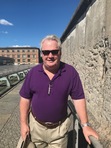
[image error]At the remaining portion of the Berlin Wall
As an author, I find Berlin to be a most fascinating city. It has multiple dark sides of its history, most recently the far right excesses of the Nazi regime, followed by the far left excesses of the Communist German Democratic Republic. The Wall, The Stasi, The Gestapo, The SS – opposite venues of man’s hostility to his fellow man.
I am a strong believer in the adage that one must respect history, especially the excesses of the human race, so that these are never repeated. Unfortunately, the politically correct world of today is inclined to whitewash these periods of darkness by tearing down all references to them. This is a mistake in my view. I was pleased to see that today’s Berlin recognizes its past, and displays it, as shameful as it was.
We interrupted our stay in Berlin for an overnight trip to Poznan, Poland. We passed through Frankfurt an der Oder, as we crossed the river into Poland. The change in the topography was dramatic as now small towns dotted rolling fields as we progressed into Poznan.
[image error]Poznan ’56 Remembrance Monument
We had unintentionally scheduled a trip on the anniversary of the 1956 Poznan uprising. The Soviets and Communist puppet Government brutally cracked down on striking workers, months ahead of a similar uprising in Budapest, Hungary that was also violently quelled. These events were among the first to show the world the tenuous hold that the Soviet Union had upon its satellite states.
In this beautiful town, perhaps the expression of the local people in God was the most wonderful site. “Jeszu Ufam Tobie” was very visible in town squares, which translates to “Jesus, I trust in you”. These are a people who have had their right to worship their God taken from them for decades if not centuries.
Along the route back to Berlin the next day, this observance was reinforced in the small country town of Świebodzin. Here, arising from a makeshift pedestal is, arguably, the tallest statue of our Lord on Earth. The Christ the King Statue of Świebodzin rises 33 meters above the landscape, one meter for each year of Christ’s life. To see this 100 foot-plus high statue stretching above the quiet plains of northern Poland reminded me that this country has its priorities right. They remember the oft horrible history they have been forced to endure, but let not this fate shake their faith in God.[image error]