The Joy of Cooking for One: How to Scale Down a Recipe Using Middleschool Math
In this blog post, I am going to share the shocking discovery I’ve made by eating alone for two weeks….
If you live in a one-person household, and if you cook for yourself only, I owe you an apology: For years and years I’ve developed, written and featured (on my blog, newsletter and books) recipes that serve four to eight people. There are five people in my family, I grew up in a family of six….. when I was in culinary school, all the recipe we used served between four and twelve.
Let’s just say I am used to creating recipes, and cooking from recipes, that serve several people.
Today I realized just how wrong this was of me. My kids have been in DC with my husband for the last two weeks and my eating has gotten…. Relaxed. I have whipped up a few easy things (a quick Keto chicken bowl made from some leftover rotisserie chicken and avocado and some greens, and a piece of salmon that was waiting for someone to cook it). But I haven’t done any of what I call “real cooking.”
The crockpot has not been in use. The convection oven, the food processor, the blender, even my chef knives, have been untouched for the last 10 days.
Following a recipe geared for six people simply felt like too much work. Plus, with just me in the apartment, I wasn’t buying the amount of food I usually do, so I didn’t necessarily have the six cups of this and three cups of that, which traditionally-scaled recipes require.
Sure, I could have gone ahead and just made a delicious looking recipe, but what about the leftovers. Ahh, the leftovers…. And here is where I hang my head in shame: I have had a few clients in the past hesitate about cooking one of my larger recipes. When I told them to halve the recipe, they still hesitated, saying even when halved, the recipe would be more food than they needed.
To which I answered: Just freeze the leftovers for another time, or pack them for tomorrow lunch.
I am hanging my head in shame.
In my defense, I adore have cooked food in the freezer because I can defrost it and quickly feed hungry teenagers. And I love having already-prepped food I can use for tomorrow’s lunch because it saves me a ton of time.
But I also understand one particular client’s comeback: “Stephanie, when you’re just one person, your fridge is already overflowing with leftovers for tomorrow’s lunch. And your freezer is already packed tight with frozen leftovers. I don’t want to cook a recipe and have leftovers.”
In honor of you, I will be adding a ton more single-serving recipes.
But I also want to share how easy it is to scale down “non-baked goods” recipes. (Recipes for baked goods can be tricky—the amount of eggs and leavener, such as baking powder, baking soda or yeast—work in ratio to flour and liquid and other ingredients, so simply dividing a recipe by two or three or four will not always create a usable blueprint. More on that here.)
You absolutely can find an online converter, but it’s always good to learn a skill the old fashioned way first so you can enjoy a basic understanding of how it works. Note: This formula below can be used for imperial or standard (two names for the system that Americans use) and metric (what most everyone else uses) measures.
Ready to learn? Let’s do this!
The formula is: number of servings you want ÷ number of servings in recipe = your magic number. In the case of our sample original recipe below, this would be 1 (the number of servings we desire) ÷ 4 (the servings given by the original recipe) = 0.25 (our magic number)
Multiply the ingredient amounts in the original recipe with your magic number to get your final scaled down measurements.
For instance, do you see how the amount of watermelon called for in our original Watermelon Gazpacho recipe below calls for 2 cups? Multiply 2 x 0.25 and you 0.5, or a half a cup. See how the original recipes calls for 3 tablespoons of lime juice? Multiply 3 x 0.25 and you get 0.75, or ¾ of a tablespoon.
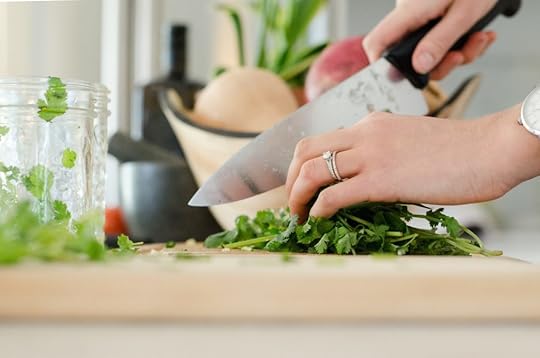
There will be numbers that are just too fiddly for you to deal with. What, for instance, will you do if a recipe asks for 1-3/8 cup of something? Most modern recipes don’t ask for such odd measures, but if you do come across something similar, just round up or down to the nearest normal number and multiply that by 0.25.
This rounding up or down also goes for hard-to-divide ingredients, such a single egg. If you have a recipe that you’d like to scale down and it calls for a single egg, I’d beat the egg and use half of it. All the while assuming the recipe would work just as well and taste just as good.
Lastly, whenever you scale down a recipe that requires the oven or stove, there is no need to change the temperature for the scaled recipe. Reducing the size of the pan or baking dish you use for your smaller recipe— for example, if the recipe called for a 13 x 9-inch pan, use an 8-inch square pan—can help ensure the scaled recipe only needs as much cook-time as the original. But still, I like to hang around the kitchen just in case your new
Here is a scaled recipe in real life, my Watermelon Gazpacho. The original recipe is up top, and the single-serving rewrite, is below it.
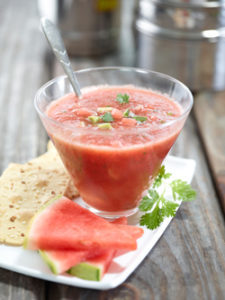
WATERMELON GAZPACHO: The Original Recipe
Makes 4 servings
Gazpacho fans, this one’s for you! You’ll notice there’s no tomato in this one. Instead, watermelon steps into the starring role. And no, this isn’t a sweet, dessert-style soup, it’s a tasty savory dish, great for helping you stay cool and getting all your antioxidants on sweltering summer days. It is very yummy!
2 cups 1/4-inch-diced red watermelon (remove seeds)
2 cups orange juice
2 tablespoons extra-virgin olive oil
1 seedless cucumber, diced into 1/4-inch cubes
1 small red or yellow bell pepper, seeded and diced into 1/4-inch pieces
1 small onion, preferably a red onion, diced into 1/4-inch cubes
2 medium garlic cloves, minced
1 small jalapeno pepper, seeded and minced (optional)
3 tablespoons fresh lime juice
2 tablespoons chopped fresh cilantro
Salt and freshly ground black pepper
Optional: 1 or 2 chopped scallions for garnish
* Process 1/2 cup of watermelon, along with the orange juice and oil, in a blender or food processor until pureed.
* Transfer to a medium bowl, along with remaining ingredients. Season with salt and pepper to taste.
* Refrigerate until ready to serve. (Can be made several hours before serving.)
* Optional: Garnish with chopped scallions before serving.
WATERMELON GAZPACHO: The Scaled Down Version
Makes 1 serving
1/2 cup 1/4-inch-diced red watermelon (remove seeds)
1/2 cup orange juice
1/2 tablespoon extra-virgin olive oil
¼ of seedless cucumber, diced into 1/4-inch cubes
¼ of a small red or yellow bell pepper, seeded and diced into 1/4-inch pieces
¼ of small onion, preferably a red onion, diced into 1/4-inch cubes
½ of a medium garlic clove, minced
¼ of a small jalapeno pepper, seeded and minced (optional)
¾ of a tablespoon fresh lime juice
¾ of a tablespoons chopped fresh cilantro
Salt and freshly ground black pepper
Optional: ¼ to ½ of a scallion, chopped for garnish
* Process 2 tablespoons of watermelon, along with the orange juice and oil, in a blender or food processor until pureed.
* Transfer to a medium bowl, along with remaining ingredients. Season with salt and pepper to taste.
* Refrigerate until ready to serve. (Can be made several hours before serving.)
* Optional: Garnish with chopped scallions before serving.