
Hey, Read My Manuscript!
This piece first appeared in The Sunday Business Post in June 2016.
*
All writers start out bad. This is one of those immutable laws against which there can be no appeal. James Joyce, aged 18, wrote a dismal pastiche of Henrik Ibsen entitled A Brilliant Career, which – with a Dedalian flourish – he dedicated “to my own Soul.” Gustave Flaubert, before he embarked on Madame Bovary, devoted five years to the composition of a chaotic 800-page historical fantasia called The Temptation of St. Anthony. And – to descend, rather precipitously, the ladder of literary merit- I spent much of my twenty-second year writing a 400-page supernatural thriller set in a fictionalised version of my secondary school – a farrago blended of equal parts John Fowles, David Lynch, and my own naive incompetence. Everybody starts out bad. That’s just the way it is.
But there are always people who think of themselves as exceptions. Toby Litt, writing in The Guardian recently, asked “What makes bad writing bad?” and concluded that the culprit is often a naive exceptionalism. “Bad writers,” Litt reckons, “often believe they have very little left to learn, and that it is the literary world’s fault that they have not yet been recognised, published, lauded and laurelled. It is a very destructive thing to believe that you are very close to being a good writer, and that all you need to do is keep going as you are rather than completely reinvent what you are doing.”
As a sometime teacher of Creative Writing, I found this poignant. Broadly speaking, the good students in a Creative Writing workshop are the ones who realise, epiphanically, that they must junk every word they’ve ever written and start again, as if from scratch. The less good students – the sad majority – are the ones who endlessly resubmit the same piece of work, glancingly rehashed, secure in the knowledge that they’re getting better. (They’re not.)
More poignantly still (to me, at least), Litt complains about a quandary familiar to all professional writers. “It’s possible that you’ve never had to read 80,000 words of bad writing. The friend of a friend’s novel. I have. On numerous occasions. […] The friend of a friend’s novel may have some redeeming features – the odd nicely shaped sentence, the stray brilliant image. But it is still an agony to force oneself to keep going.”
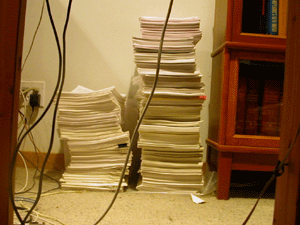
I know that agony. Once the world starts thinking of you as “a writer,” they begin to arrive in your inbox: the manuscripts. The long-meditated, completely unreadable manuscripts. I might mention the retired gentleman who sent me his 120,000-word philosophical treatise on why young people today are so frightening and strange. Or the aspiring chronicler who forwarded me his novel about an Australian family in which everybody loved each other and the long-cherished dynastic secret was that the pater familias hadn’t been murdered, he’d just died by accident. These manuscripts vary widely in subject matter and tone, but they tend to have one thing in common: they are all, without exception, preternaturally boring – of interest only to the writer, if even then.
I never know what to do with these manuscripts. Clearly, an honest response (“This is terrible”) is out of the question. And I’m usually too busy to offer a nuanced critique (which would be a waste of time anyway). Sometimes, shamefully, I ignore them. Occasionally, I send along some vague words of encouragement – keep writing, keep reading! But either way, I experience a twinge of guilt. Because I’ve been there – I’ve done it, too: I’ve imposed my terrible manuscripts on professional writers and asked for their help. Writing has always been a kind of guild, in which the elders help their juniors, who then pass along the favour. Isn’t this what I should be doing? I reassure myself by saying that good writers will find their way with or without my help, such as it is, and that bad writers will get nowhere even if I move the pillars of heaven to help them. But the whole thing remains a discomfiting crux – a situation in which it is almost impossible to act in good faith.
So please, for the love of God, don’t send me your manuscript – unless, of course, you happen to think it’s really, really good.


Kevin Power's Blog

- Kevin Power's profile
- 29 followers

