
On That Simpsons Blog Post [UPDATED]
Since I posted it back in February, this piece on the decline of The Simpsons & the show’s hatred of Lisa has been attracting a fair amount of attention & commentary. In fact, as of today, it’s been viewed over 135,000 times, a datum that causes me to think to myself: There it is, Kev. The most popular thing you’ll ever write, and nobody paid you a cent for it. But – as Tony Soprano might say – whaddaya gonna do?
A sincere thank you to everyone who shared the piece and to everyone who took the time to comment on it. I’m thrilled and delighted that a piece I wrote mostly by accident (I didn’t really mean to watch all 629 episodes of The Simpsons in a month; it just sort of happened) has struck such a chord.
I should say at the outset that I think the piece’s popularity has much less to do with anything I contributed and much more to do with the fact that The Simpsons means so much to such a huge cohort of people. Anyone born in the 1980s or 1990s, after all, has pretty much absorbed The Simpsons the way 18th century aristocrats used to absorb the Roman poets. We speak Simpsons, we 80s and 90s kids. We use Simpsons quotes and allusions all the time – to make a point, to solidify a friendship, to make each other laugh. Often, we do this without even pausing to think about the specific derivation of what we’re saying. Case in point: my wife arrived home from work the other day, and as she was taking off her coat I said, “We found this one swimming naked in the Fermentarium.” “I AM THE LIZARD QUEEN!” she replied at once. This was what we said instead of, “Hi, how was your day?” I’d be willing to bet that there’s a million other couples out there who do the same thing. So The Simpsons is deeply important to us. I didn’t set out to find fault with the show; I watched the whole thing because I love it (and I still love it, in spite of everything). All I did was turn around and look at something that had been a part of my life for as long as I could remember, and try to see it afresh. I’m amazed that so many of you found value in my doing that. So again, thank you.
I’m going to try to address a few of the points that have been made about the post in the comments and on social media. (If you commented on the post and your comment never appeared, this is because you are a troll, and while you may be a wonderful and empathetic person in your day-to-day life, your online behaviour lacks both wonderfulness and empathy, & I have responded accordingly.) Here, in no particular order, are a few of the major points that have come up.
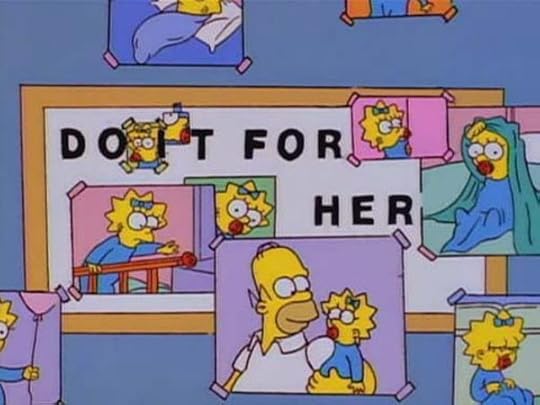
You say that Golden Age Simpsons wasn’t really about character. I couldn’t disagree more. What about Mr. Bergstrom? What about “Do It For Her”?
I should probably have clarified this point. For its first three seasons or so, The Simpsons was actually a pretty standard, warmhearted American sitcom, in which we’re meant to like the characters and be moved by their fairly trivial sufferings. And the show never fully abandoned this strain of warmhearted, mainstream sitcommery – in fact, it returned to it, in a weird, heartless, going-through-the-motions way, in its post-Golden Age period. But I would submit that if The Simpsons had never evolved past this stage in its development – if it had never become the surreal, absurdist comedy it became during its true Golden Age (let’s say from Season 5 to Season 10) – then I think it would never have become the show that we know and cherish, and we would not be having this conversation right now. At its purest – in “Itchy and Scratchy Land,” or in “Bart Vs. Australia,” or in “Homer Vs. the Eighteenth Amendment”, to take the first three examples that come to mind – The Simpsons moved way beyond standard sitcom character arcs and “Awwww!” moments and started doing something far more nihilistic and preposterous. If you love The Simpsons, I would humbly suggest, it is these episodes that you love. That’s My Two Cents, anyway.
Charlie Brown Never Kicks the Football
A lot of people have raised the point that Peanuts embodies a similar dynamic of aspiration and disappointment to the one I discovered in The Simpsons, and that this dynamic is often at the heart of successful comedy. I’m afraid I can’t really say much specifically about Charlie Brown et. al.: I grew up in Ireland, where Peanuts isn’t really a thing. But I do grant that a dream-crushing dynamic is often at the heart of good comedy. However, I think that The Simpsons, taken as a 629-episode aggregate, starts to go beyond this standard comedic strategy into more sinister, even pathological territory. Lisa’s punishments are often not really funny at all, as when every cat she tries to love is killed, or when she’s genuinely heartbroken about not being able to attend Cloisters Academy, or when – in “Boy Meets Curl” (Season 21 Episode 12) – she becomes addicted to collecting Winter Olympics pins and suffers meaninglessly as a result. In fact, these examples indicate exactly what I mean: it isn’t funny that Lisa keeps experiencing grief and loss in “I, (Annoyed Grunt)-bot,” and it isn’t funny that she doesn’t get to go to the school she desperately needs to go to in “Lisa Simpson, This Isn’t Your Life,” and it isn’t funny that Lisa sells her dress to buy more Olympics pins and winds up weeping on the street. Lisa’s grieving face, at the end of “Lisa Simpson, This Isn’t Your Life,” isn’t a punchline; it’s meant to move us. But it doesn’t move us in the “Awwww!” sort of way – i.e. the way it’s supposed to. Instead, it makes us uncomfortable, because we’re watching a genuinely warm & hopeful character having her dream deferred for the hundredth time.
Stretched out over 29 years, Lisa’s suffering accrues a weird sort of extra-textual gravity that doesn’t really have anything to do with what the writers of the show might have consciously intended. Once or twice it might be funny to see a warmhearted character rejected when she tries to make a friend; if you show this happening two dozen times or more, over three decades of episodes, it starts to say something troubling about how you see that character, and about the society you live in. This is why I used the words “punish” and “cruel” about the show’s treatment of Lisa. Her suffering is so repetitive, and so meaningless, that after a while it stops making an overtly satirical point about the frustrations of being an intellectual in our society and starts making an unconsciously grim point about how we as a society treat intellectuals, women, and women intellectuals.
The Simpsons is a Satire. It Exposes the World As it Really Is; Lisa’s Suffering Makes a Satirical Point about the Society We Live In.
Actually I think The Simpsons is only incidentally a satire. This is why I described it as an absurdist comedy in my original post. Individual episodes of The Simpsons are inarguably satirical – the key example might be “Homer Badman,” which satirises PC hysteria about sexual harassment and media overreaction to trivial news stories. And even in the post-Golden age period, individual jokes are unquestionably satirical (“You make a very adulterous point, Senator”). But generally speaking, The Simpsons – especially during the Golden Age – wasn’t really a satirical show. Satire typically exposes moral and intellectual faults to ridicule by exaggerating them to ludicrous extremes. It is generally more interested in making a programmatic moral point than it is in making you laugh. South Park is a satire – Trey Parker and Matt Stone have a set of clear political and moral values that enables them to discern what is wrong with certain trends and ideas. The Simpsons, which has cycled through many writers and many showrunners, has never had a coherent political and moral stance from which to satirise American culture. It seems to be broadly liberal – it dislikes Fox News, and so on. But to the extent that The Simpsons does have an implicit set of moral values, it is actually highly conservative: family is the most important thing; educated cosmopolitan types can’t be trusted; God punishes hubris; bullies are a part of the natural order; the stupid majority is always right; etc etc. To take one example: in “She of Little Faith” (Season 13 Episode 6), Lisa rejects Christianity. The rest of the family – and the rest of the town – are appalled, and try, rather cruelly, to manipulate Lisa into rejoining the church. Here is an opportunity for the show to suggest that people can live meaningful lives without religion – or, at the very least, to suggest that tolerance is preferable to unthinking zealotry. But instead, the show insists Lisa must have some kind of religion, so she becomes a Buddhist. The Simpsons can’t really imagine a life genuinely free of religious belief – because it thinks the majority is always right. Again and again, Marge’s narrow-minded, ill-informed, kneejerk religiosity is held up as the show’s idea of the proper path in life. Lisa’s independence must be carefully coralled. If The Simpsons owned up to this particular view of things, then it might qualify as a satire. But since it doesn’t, it remains a comedy that fails to acknowledge or understand its own reactionary assumptions. Or so I would suggest.
Shut Up, Meg
I’ve read a fair number of comments suggesting that Family Guy‘s treatment of Meg echoes The Simpsons‘ treatment of Lisa. I think to conflate the two is something of a category error. Family Guy works by invoking racist, homophobic, misogynist, and anti-Semitic jokes in a frame of cheap irony, allowing it (on the one hand) to make crass and offensive jokes about women, minorities, Jews, and queer people, and (on the other) to frame those jokes as ironic parodies of the kind of jokes that horrible people tell in earnest. The show’s abuse of Meg is of a piece with this. Taken as a whole, Family Guy says less about how society treats women specifically and more about America’s deep unease about the fact that it is a mixed-race society. One way to cope with the fact of human variety is to laugh at it in a joyous spirit. Another way is to nervously make cruel jokes about minorities. Family Guy is a lowbrow show. It takes the second route while claiming to take the first. Even the most dismal Simpsons episode is warmer and more sophisticated. The two shows aren’t really doing the same thing at all.
Ted Cruz!
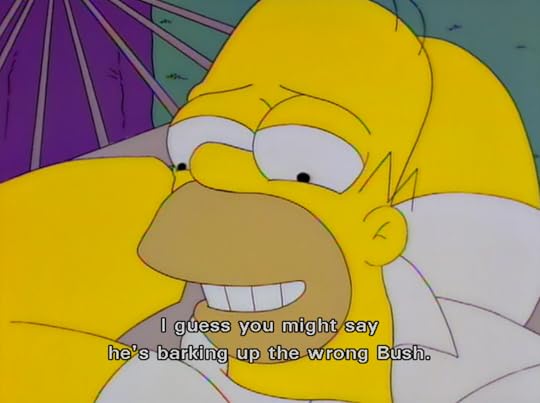
I did indeed catch reports of Ted “Toad of Toad Hall” Cruz’s remarks at CPAC back in February, to wit: “The Democrats are the party of Lisa Simpson and Republicans are happily the party of Homer, Bart, Maggie and Marge.” The thing is, I think he’s absolutely right. On some basic level, Cruz has intuited that post-Golden Age Simpsons consistently punishes excellence and rewards crassness, ignorance, and stupidity. In this, post-Golden Age Simpsons is exactly like the contemporary Republican Party. Let us not forget that the GOP in the 21st century has been able to field, as its lone “intellectual,” one Paul Davis Ryan, a man who once looked like merely the creepiest counselor at a summer camp for girls, but who now (after a year as Trump’s lickspittle) looks like the mortuary assistant at his own funeral. For attempting to appear “smart” (with his PowerPoint presentations and his thousand-page “tax plans”), Ryan has had the moral and intellectual shit beaten out of him by the rest of Trump’s GOP. You’d almost feel sorry for him. But not really.

(Image credit: @isikbreen)
6000 Words?!? Are You Out of Your Mind?!
To the vocal minority who complained that the post is too long, I say: The internet has ruined your ability to concentrate, Sir or Madam, and you should direct your complaints to the man responsible for inventing the internet in the first place, former president Al Gore.
“That’s Just, Like, Your Opinion, Man”
Indeed it is, Sir or Madam! Indeed it is. In fact, some people might say that “presenting an informed individual opinion” is the whole point of criticism to begin with. It seems rather strange that I would need to explain this to you, an adult person who has presumably read works of criticism before. But it takes all sorts!
You Clearly Have a Feminist Bias.
That’s one way of looking at it.
“Your Twitter bio is cringe, how can all your opinions be correct, you smug liberal dolt”
I’m afraid I don’t have time to teach you the rudiments of irony, my friend, but I wish you every happiness in life – truly I do. Life isn’t easy for anyone, and I hope that abusing strangers on the internet has brought you some measure of peace.
“u should kill yourself”
No, I don’t think I will, actually. Thanks for reading, though!
[UPDATE] Hey, What About The Recent Controversy Over Apu Being a Racial Stereotype?
Yeah. I mean, Apu is a racial stereotype. There are plenty of racial stereotypes in The Simpsons. As an Irish person, I generally enjoy the show’s representations of Irish people (“Whacking Day was originally started in 1924 as an excuse to beat up the Irish!” “Aye, ’tis true. I took many a lick. But sure ’twas all in good fun!”). But Irish people are white Westerners. I completely understand Hari Kondabolu’s argument, in The Problem with Apu, that Apu has not served Indian people particularly well, over the years. The current debate is about the show’s response to Kondabolu’s critique. In the most recent episode, “No Good Read Goes Unpunished” (Season 29 Episode 15), Marge tries to rewrite an offensive book she loved as a child, and finds that she has destroyed its magic. I’ll let the New York Times describe the key scene:
At one point, Lisa turns to directly address the TV audience and says, “Something that started decades ago and was applauded and inoffensive is now politically incorrect. What can you do?” The shot then pans to a framed picture of Apu at the bedside with the line, “Don’t have a cow!” inscribed on it.
Just so we’re all on the same page, here’s what happens in this scene: Lisa, the show’s embodiment of progressive liberalism, is made to say “Fuck off” to a progressive/liberal critique of the show. The Simpsons may or may not be obliged to respond to Kondabolu’s argument about Apu (we can argue about that). But it’s incredibly depressing that it chose to respond in such a dismissive, reactionary way.
And that it should choose Lisa to deliver the key speech: that’s incredibly depressing, too.

[UPDATED UPDATE] Early in “No Good Read Goes Unpunished,” Lisa is shown reading With No Apologies, the memoirs of Arizona Senator and 1964 presidential candidate Barry Goldwater. “He opposed the religious right,” Lisa notes, approvingly. Of course, Goldwater also believed that the US should drop nuclear weapons on the North Vietnamese and suggested that the only problem with the John Birch Society was nutty leadership. I’m starting to think we’re being trolled.


Kevin Power's Blog

- Kevin Power's profile
- 29 followers

