
New is Scary... But Scary Can Be Good
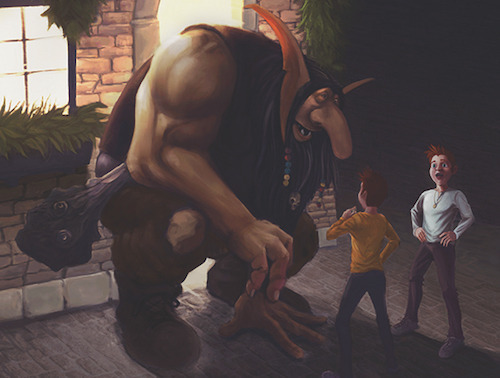
Camp NaNoWriMo is a time to try out new, different, and fun types of writing. Today, author Tilia Klebenov Jacobs shares what she learned from trying her hand at an entirely new kind of story:
After publishing two crime novels, I decided to write something my kids were allowed to read.
They were in elementary school at the time, so I decided to pen a quick middle-grade fantasy, giving me a chance to trot out the carnivorous marshmallows I had invented in eighth grade, and to give my bad guys names like Princess Abattoir and Count Wilhelm Scream. My book would be short and fast-moving, with an emphasis on plot. How hard could it be?
Hahaha.
Writing Casper and Jasper and the Terrible Tyrant was difficult and frustrating and took much longer than anticipated—and I’m glad I did it. This is not only because I am (reasonably) pleased with the result, but also because there is much to be gained by trying something new and unnerving. I found pros and cons, and rediscovered the simple truth that regardless of genre, good writing is good writing.
The ProsDoing something new means you are challenging yourself artistically.
Don’t worry about being viewed as a dilettante: many well-regarded authors excelled in a variety of styles. Edgar Allen Poe didn’t just write horror; he also wrote poetry, short stories, literary criticism, early science fiction, and is even credited with creating detective fiction. Madeleine L’Engle is best known for YA fiction, but she also wrote memoir, poetry, ruminations on her deeply felt faith, and a picture book starring the love of her life, Franklin the poodle. J.K. Rowling of Harry Potter fame has written a gritty crime series (under the pen name Robert Galbraith) set in modern-day England that contains not a scintilla of wizardry, other than perhaps the magic of her prose.
Writing in a new genre may expand your audience.
My religiously conservative mother-in-law has supported my literary career with gusto, buying multiple copies of my books and gifting them to friends and libraries; but she has been so distressed by the amount of cursing in my first two books that I can only imagine her turning the pages with tongs. I was pleased to assure her that my upcoming book is pocked by precisely one “gosh dang it” and one “shucky darn.” Sighs of relief were breathed all around.
The ConsIt’s hard.
In my crime fiction, I do my best to craft conflicted characters whose dialogue is both modern and believable. Neither of these skills was particularly helpful in my current endeavor. How odd, you say; surely characters are characters, and plot is plot. And you are correct. The difficulty lies in the diverging demands of the genres.
My first book, Wrong Place, Wrong Time, is a hostage drama played out by people who all believe themselves justified. I like to think they are groping through a dense fog of moral uncertainty for much of the book.
Fantasy, by contrast, is characterized by a sharp division between good and evil. Motivations are often minor, and, as in fairy tales, characters tend to be psychologically and morally straightforward. The witch in “Hansel and Gretel” is hungry; stepmothers are jealous of youth and beauty; princes are besotted with same. We need nothing more. Since my fantasy novel was in that mold, I found myself constantly trimming my characters, stripping away anything extra in terms of psychology, motivation, and backstory. I came away from this process impressed by how little one actually needs.
The OverlapIn the end, good writing is good writing.
As you grow and develop as a writer, the process is almost guaranteed to become easier for the simple reason that you develop a skill set. Soon you intuitively know what works and what doesn’t, even if your editor occasionally needs to refresh your memory with howls of anguish in the margins. Some principles for reliably good prose are:
To quote The Elements of Style, “A sentence should contain no unnecessary words, a paragraph no unnecessary sentences, for the same reason that a drawing should have no unnecessary lines and a machine no unnecessary parts.” ‘Nuff said.Dialogue should reveal character and advance the plot. It must be consistent with the personalities of the speakers, and be varied enough that the reader can tell who is speaking without being told, at least most of the time.
Individual scenes should move the story forward. If a scene has no purpose, either give it one or cut it (for now) from your story.
Having now written three books, I can say that some come more easily than others. This one was not easy. But it was rewarding, and as it lurches through the publication process and I await its arrival in all its paginated goodness, I can say this: I really hope my kids like it.

Tilia Klebenov Jacobs is the author of Wrong Place, Wrong Time and Second Helpings at the Serve You Right Café as well as numerous short stories. Tilia is a reviewer for IndieReader.com, and a judge in the Soul-Making Keats Literary Competition in San Francisco. She serves on the board of Mystery Writers of America. When she is not writing, Tilia teaches classes for prison inmates. Her next book, Casper and Jasper and the Terrible Tyrant, will be published in the spring of 2018. Visit her website athttp://www.tiliaklebenovjacobs.com/.
Top illustration for Casper and Jasper and the Terrible Tyrant by Matt Tames. Visit his website, Facebook, or Instagram.


Chris Baty's Blog

- Chris Baty's profile
- 63 followers

