My Interview With Urban Fantasy Author, C.L. Schneider
Hi C.L. Schneider,
Thank you for taking the time for an interview, and welcome to my blog.
Regardless of how folks say, “You can’t judge a book by its cover,” great book covers are the first impressions for readers looking to discover new authors, and in a way, the initial handshake before gaining more insight about what’s on the inside of the book. Your incredible covers definitely snap the attention for fantasy/sci-fi readers and demand a closer look to your worlds and adventures inside. Who does your cover art?
My cover artist is Alan Dingman. Alan is a portrait artist and illustrator whose work history includes St. Martin’s Press, The NY Times, Rolling Stones, and Simon & Schuster (where he currently works) as well as privately commissioned portraits and murals. Alan illustrated Stephen King’s 3D pop-up book, The Girl Who Loved Tom Gordon. Multiple books of his design have hit the New York Times Bestseller List.
I’m lucky enough to know Alan and his family personally. We met over ten years ago when our oldest children became friends at a park. Aside from being a talented artist I admire, I consider Alan a close friend.
Covers have always been extremely important to me as a reader. When I decided to self-publish, I refused to skimp on the cover. I knew Alan had the talent I was looking for, so I approached him with my ideas for Magic-Price. I extended an offer to hire him on the side, and was thrilled when he accepted. Alan’s covers continue to be beyond my expectations.
I often tell my college English students that anyone can choose to be a writer, but usually it’s the other way around. Writing, as a profession, chooses us to become authors because we have no choice but to get the stories onto the page. Did you know at an early age that you wanted to be an author?
I’ve been writing for as long as I can remember. As a young girl, I wrote poetry and short stories (mostly murder mysteries). When my favorite characters in TV shows or movies were heading a direction I didn’t like, or didn’t dive deep enough into an area I wanted them to explore, I’d write my own script. Fan fiction wasn’t a thing at the time, but that’s basically what I was doing. I put together commercials and news reports and made my poor family sit down and listen as I sat behind a cardboard desk and ‘reported’ the news.
By the time I was sixteen, I’d abandoned my dreams of growing up to be a spy or a famous actress, and was dead-set on becoming a published author. I grew up in a family of readers, and my dad was more than happy to buy me a typewriter to pursue my dream. I sat up a card table in the living room and went to work on my first novel. I wrote in a notebook in school, when I was supposed to be paying attention, and then came home and typed at night. The result: a 600-page post-apocalyptic behemoth entitled, A Twist of Fate.
The itch to make my dream a reality was hard to ignore at that point. More than anything, I wanted to see my book on a shelf. Unfortunately, life got in the way. It wasn’t until many years later when my children were old enough to be in school full time, that I was truly able to devote myself to a writing career.
What authors influenced you the most early in life?
Some of my early literary influences were: Margaret Mitchell, C.J. Cherryh, Jennifer Roberson, Marion Zimmer Bradley, the Bronte sisters. The later influences of Jim Butcher and Simon Green, were instrumental in teaching me how to write first person.
What book are you currently reading?
I usually have several going at one time. Right now, I’m currently reading: Recreance, an epic fantasy by H.G. Chambers, A Work in Progress, a thriller by Rocky Rochford, and the 1st book in a paranormal series, The 11th Percent by T.H. Morris.
Since publishing my own book, I have read indie authors almost exclusively. It wasn’t a conscious decision really, I just discovered this whole other world of books and authors, and have had no reason to look elsewhere.
What inspired The Crown of Stones trilogy?
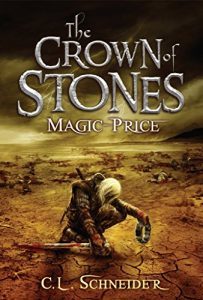 Illustrator: Alan Dingman
The Crown of Stones Trilogy was inspired almost entirely by the creation of my protagonist, Ian Troy. I was a huge reader as a child. I was lucky enough to have access to a wide variety of genres and spent many hours losing myself in story after story. In creating Ian, I set out to pay homage to some of the characters I fell in love with growing up. I wanted Ian to walk in two worlds, to be both good and bad, a cowboy and an outlaw, a hero and a monster; valiant yet broken; vulnerable enough to suffer, yet resilient and courageous enough to fight the odds. I wanted a tortured soul, a true anti-hero whose greatest strength—magic—was also his greatest weakness. As Ian’s character become more complex, the story developed around him.
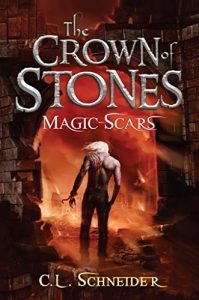 Illustrator: Alan Dingman
My other inspiration was a chunk of amethyst that had been sitting on my bookshelf for years. I’d always wanted to write a story about a deadly magic hidden inside the stone. I knew a little about new age magic and crystal healing, and liked the idea of Ian being able to tap into and manipulate the energy inside a stone. I had a working title then: The Amethyst Crown. Once I started my research and learned more about the variety of stones and their uses, I saw a gold mine of ideas. I realized I didn’t want to limit Ian to one stone and one kind of magic. I developed an entire magic system with nine different type of magic-users and using a large variety of stones. As my magic system developed, the storyline evolved. Suddenly Ian’s entire magic-addicted race (the Shinree) were born. The crown itself grew from one stone to nine, and the title changed to The Crown of Stones.
Your descriptions for the scenes in your books are effectively visual. Please tell us about how you create such vividness?
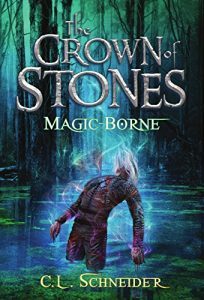 Illustrator: Alan Dingman
Thank you! Writing in first person takes me deep into the minds of my characters. It allows me to step into the scene with them, to feel like I’m experiencing it as them.
I strive to wholly visualize what my characters are seeing, hearing, tasting, and smelling. By weaving those elements into the narrative and dialogue, I do my best to bring the readers into the scene with me.
You indicate that as a mother, you’re a referee to two sons. Finding time to write as a parent is often difficult. Describe your typical writing day and how much time you get to write each day.
I’m very fortunate to be able to write full-time. But, being home all day doesn’t mean I spend all that time writing. The usual housework, shopping, errands, school activities, and the like., all need to get done. If none of that is pressing, I sit down at my desk as soon as the kids leave for school. How much time I spend writing each day, versus email, promoting, working on blurbs, covers, etc., depends on what else is on my to-do list. Self-published authors wear a lot of hats. Distraction and interruption are the norm. With that in mind, on a typical day, I spend a minimum of three to four hours on my current work in progress, whether it’s writing, rewriting, or editing. Some days I sit down at 7:30 and don’t stop until it’s 2 in the afternoon and I’m starving! Other days, I’m lucky to squeeze in an hour.
When my kids were little, I learned how to write in small bursts. I couldn’t not write, so I squeezed it in; five minutes here, ten minutes there. It was incredibly frustrating at the time not to have large blocks. But it taught me how to fall in and out of a scene or a character’s head quickly. So, on the days when I do have a long list of errands or the kids are home sick, I can still squeeze something in. Even if it’s only revising a single paragraph. I’m a firm believer in writing something every day. If that something is only a sentence, it’s one more sentence than I had yesterday.
How long does it typically take for you to write the first rough draft?
Longer than it should! It varies. Summer is harder with the kids home from school. But, I admit, I’m not a fast writer. I find it incredibly tempting to go back and fix a scene in the draft that I know isn’t flowing right. I try to resist, but it’s a sickness