Some Tests: Macauley’s Trial
 [image error]
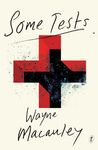
Wayne Macauley is one of Australia’s greatest ironists. He writes from within the great bubble of Australian society in order to reveal the soapiness of that bubble. Some Tests is Macauleyan irony in its purest form, and the soapiness is everywhere.
Some Tests is also Macauley’s most Kafkaesque work, a comparison which Macauley himself could not complain of, for Kafka runs thick through all his work since his adaptation of “The Hunger Artist” in the early 80s.
Some Tests is in fact a kind of mirroring of Kafka’s The Trial. His heroine, Beth Own, a nemesis of Joseph K.: Macauley changes the sex of the protagonist; the personality is inverted; K. is arrogant and pseudo-cynical, but Beth is polite and complacent; where K. struggles to resolve the procedure against him, Beth Own has a passive, existential acceptance of what is going forward. But the most disturbing thing (for Australians) about this comparison, is that Macauley makes his Kafkaesque style work just as well in the Melbourne suburbs as it does in Kafka’s Prague; and it makes just as much sense in 2017 as it did in 1915.
But how can that be? What similarities can there possibly be between Melbourne in 2017 and Prague in 1915?
Of course, the central theme – death – is universal. It is not an Australian question but the human condition that is under scrutiny here. Some Tests brings the death theme that is in The Trial right into the foreground. Kafka’s universe is grey whereas Some Tests is full of pastel-toned primary colours. There is always an arrogant tension in The Trial where everything seems utterly incomprehensible, and everyone appears hell-bent on making everything more difficult and complicated than it should be, but Some Tests is tuned with the sweetest, polite people, full of understanding and always helpful. Yes, things are moving in an illogical manner, and things do seem more complicated than it should be, but the Australian bubble is a very soapy place with as many illogical trials as Kafka’s universe, and that is what Macauley’s irony reveals.
Yet perhaps the greatest unifying element between The Trial and Some Tests, is the ubiquitous nihilism that permeates both suburban Melbourne and bureaucratic Prague. Both K. and Beth are looking for an explanation and both Kafka and Macauley know that such an explanation is impossible in a system that is deeply nihilistic.
Macauley is also focussing on society within the biopolitical world, as Foucault called it, in which the State controls not only our social life but takes possession of our control over our physical bodies as well. Of course, biopolitics wasn’t invented by Foucault, he just put a term to the phenomenon, and Kafka’s society suffered from the same malaise on different levels, but the idea of biopolitics is probably more unsettling in the so-called democratic world and the perfect societies like Melbourne’s suburbia.
In the sense of perfection, Some Tests turns Melbourne into a new set for Huxley’s Brave New World. Australia is the lucky country, think Australians, but there is something existentially wrong in the Utopia they live in. So wrong that the Utopia is really a Dystopia. The suburbs of Some Tests sits at Fukuyama’s The End of History and Beth Own is a personification of Nietzsche’s Last Men. Beth’s world is a polite and nice place to be in, but nothing else. Struggle is not really struggle anymore, for there is no authentic purpose behind the struggle, and that creates an existential vacuum that turns the paradise into a purgatory. Beth Own has a lovely family, but that is not enough. She is really biding her time until death comes. She might as well get it over and done with as quickly as possible. Within the nihilistic scenario, we have to think of Beth Own as happy with her fate.