
Why Do I Keep Repeating Myself by Author K A Servian
We have author K A Servian sharing with us about why we keep repeating ourselves. She has a new book, The Moral Compass (Shaking the Tree Book 1).

K. A. Servian on the web:
Website Facebook Twitter Instagram Author Page
Why do I keep repeating myself?
Have you ever noticed that as a writer you tend to have your ‘go to’ words and phrases that you inadvertently repeat over and over? (see, I just did it there. I said repeatand over and over, they mean the same thing and I could easily lose one).
Sorry, I got distracted, back to the subject - My repetition issue seems to revolve around physical reactions to stress and danger. I don’t know how many times my poor characters have churning stomachs, grit their teeth, bite their lips or widen their eyes - far too often.
It’s a bad habit and a very difficult one to break. Even though I review each of my manuscripts several times before sending them to an editor, they still seem to be rife with repetition. I’ve found that the trick is first to be aware of the culprits (keep a list if necessary) and to use the ‘find’ function to search for and delete them. I inevitably find that after a slash and burn session; the writing is better which makes me wonder why I put those words and phrases in in the first place.
Several common forms of repetition sneak into our writing without our even noticing. How many times have you written - She shook her head. “No, I didn’t do it.”You’ll note that the character has used two ways to say no, first she shook her head and then she said the word. Once is enough. She shook her head. “I didn’t do it.”
Then there are those naughty words like just and very that have a habit of sneaking in. Most of the time they add nothing to the writing. All they do is up the word count. It’s a good idea to search and delete them.
Repeating proper names is another issue that crops up all the time. I used to do it a lot until a mentor pointed it out and advised me that it is necessary to use a character’s proper name only once in a paragraph. The rest of the time, pronouns such as he or she or some other way to identify the character will do.
Another one to watch out for is elegant variation (a term created by H W Fowler, author of Modern English Usage). This is when we search the thesaurus for another way to say the same thing without repeating a word. Daniel read the last line of the book then placed the tome on the table and stood up. In this instance, we could easily replace tome with it. Daniel read the last line of the book then placed it on the table and stood up.
There are many other examples of repetition, but, at the risk of repeating myself, I won’t go on. I will wind up by saying that not all repetition is bad. There are instances when it is used as a literary device to emphasise a point or make a joke.
“Nory was a Catholic because her mother was a Catholic, and Nory’s mother was a Catholic because her father was a Catholic, and her father was a Catholic because his mother was a Catholic, or had been.” Nicholson Baker, The Everlasting Story of Nory
In this example, repetition has been used for humour and rhythm to great effect. But be wary of overuse. A device like this will work once or twice in a novel, but more than that and it loses it’s impact.
Okay, I’ve confessed, what are you repetition sins?
The Moral Compass (Shaking the Tree Book 1)
Florence lives like a Princess attending dinner parties and balls away from the gritty reality, filth and poverty of Victorian London.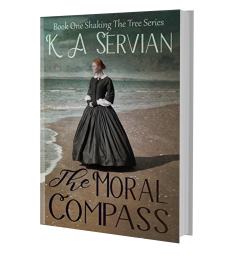
However, her world comes crashing around her when her father suffers a spectacular fall from grace. She must abandon her life of luxury, leave behind the man she loves and sail to the far side of the world where compromise and suffering beyond anything she can imagine await her.
When she is offered the opportunity to regain some of what she has lost, she takes it, but soon discovers that not everything is as it seems. The choice she has made has a high price attached and she must live with the heart-breaking consequences of her decision.
This novel is part one in the 'Shaking the Tree' series.
Buy on:
Amazon Kindle Amazon Paperback
Amazon Aus Amazon UK

K. A. Servian on the web:
Website Facebook Twitter Instagram Author Page
Why do I keep repeating myself?
Have you ever noticed that as a writer you tend to have your ‘go to’ words and phrases that you inadvertently repeat over and over? (see, I just did it there. I said repeatand over and over, they mean the same thing and I could easily lose one).
Sorry, I got distracted, back to the subject - My repetition issue seems to revolve around physical reactions to stress and danger. I don’t know how many times my poor characters have churning stomachs, grit their teeth, bite their lips or widen their eyes - far too often.
It’s a bad habit and a very difficult one to break. Even though I review each of my manuscripts several times before sending them to an editor, they still seem to be rife with repetition. I’ve found that the trick is first to be aware of the culprits (keep a list if necessary) and to use the ‘find’ function to search for and delete them. I inevitably find that after a slash and burn session; the writing is better which makes me wonder why I put those words and phrases in in the first place.
Several common forms of repetition sneak into our writing without our even noticing. How many times have you written - She shook her head. “No, I didn’t do it.”You’ll note that the character has used two ways to say no, first she shook her head and then she said the word. Once is enough. She shook her head. “I didn’t do it.”
Then there are those naughty words like just and very that have a habit of sneaking in. Most of the time they add nothing to the writing. All they do is up the word count. It’s a good idea to search and delete them.
Repeating proper names is another issue that crops up all the time. I used to do it a lot until a mentor pointed it out and advised me that it is necessary to use a character’s proper name only once in a paragraph. The rest of the time, pronouns such as he or she or some other way to identify the character will do.
Another one to watch out for is elegant variation (a term created by H W Fowler, author of Modern English Usage). This is when we search the thesaurus for another way to say the same thing without repeating a word. Daniel read the last line of the book then placed the tome on the table and stood up. In this instance, we could easily replace tome with it. Daniel read the last line of the book then placed it on the table and stood up.
There are many other examples of repetition, but, at the risk of repeating myself, I won’t go on. I will wind up by saying that not all repetition is bad. There are instances when it is used as a literary device to emphasise a point or make a joke.
“Nory was a Catholic because her mother was a Catholic, and Nory’s mother was a Catholic because her father was a Catholic, and her father was a Catholic because his mother was a Catholic, or had been.” Nicholson Baker, The Everlasting Story of Nory
In this example, repetition has been used for humour and rhythm to great effect. But be wary of overuse. A device like this will work once or twice in a novel, but more than that and it loses it’s impact.
Okay, I’ve confessed, what are you repetition sins?
The Moral Compass (Shaking the Tree Book 1)
Florence lives like a Princess attending dinner parties and balls away from the gritty reality, filth and poverty of Victorian London.

However, her world comes crashing around her when her father suffers a spectacular fall from grace. She must abandon her life of luxury, leave behind the man she loves and sail to the far side of the world where compromise and suffering beyond anything she can imagine await her.
When she is offered the opportunity to regain some of what she has lost, she takes it, but soon discovers that not everything is as it seems. The choice she has made has a high price attached and she must live with the heart-breaking consequences of her decision.
This novel is part one in the 'Shaking the Tree' series.
Buy on:
Amazon Kindle Amazon Paperback
Amazon Aus Amazon UK


No comments have been added yet.


