
“Don’t let me drown” - rescuing characters in literature

What are your thoughts on characters being rescued in literature? Sure, the physical rescue scene can be pretty emotion-provoking, if done right, but is that all there is to it? Do you remember a particular rescue scene in a film or a book that made you think beyond the beauty of the moment? One of mine is, “He saved me in every way a person can be saved.” That’s one of my favorite quotes. Does anyone know where it’s from?
Hint
I’ve been fascinated with rescue themes in fiction my whole life, and I’ve had so much fun exploring them in literally hundreds of books, since I was a teen. There are a few categories, with examples only from classic literature, where I saw them first (many many modern books have done these themes more than justice):
Man saving woman (best examples: Pride and Prejudice, Daniel Deronda, most of Shakespeare’s plays.)
Woman saving man (best examples: Jane Eyre, Beauty and the Beast themed stories, anything by Thomas Hardy.)
Man saving man (best examples: Two Years Vacation by Jules Verne, Great Expectations, A Little Life (most recently), too many to count in modern fiction really.)
Woman saving woman (best examples: Anne of Green Gables, Sense and Sensibility, most of Oscar Wilde and D.H. Lawrence.)
Man/woman saving everyone (best examples: Robin Hood, The Chronicles of Narnia, Lord of the Rings a.s.o…)
The thrill of reading the physical act of the rescue, the adrenaline rush of the heroics, the suspense, the relief… All that flood of emotion, the thought that someone CARES enough to save someone else… That’s what’s amazing, in my opinion. That’s why some of us (readers and writers included) are addicted to the rescue theme.
Setting aside the cliches, the overused tropes (see K drama - but still, we LOVE it, amirite?) and all of the potentially dangerous/misleading messages of a damsel-in-distress situation or just the idea that someone needs to be rescued, deep down inside we all know that it’s true. We all need to be saved. From a bad day, from a tough situation, from a deep issue. From ourselves, sometimes, even if it’s just for five minutes, when we’re freaking out over something. Of course, in real life, more often than not, it’s not going to happen.
No one is coming to rescue us. We just pick up our pieces and carry on as best as we can.
And there’s a fierce beauty in that inner strength, the independence of rescuing ourselves.
But at the same time, we are rescued. That person who gave us their seat, that guy who smiled as he was serving our latte, that kind person on the internet who reblogged our post and said they liked what we said(wink). Our mom, our sister, our friend. Our boyfriend/girlfriend, our neighbour. People who take care of us, who care about us, who bring a smile to our face when it seems impossible to laugh.
We might take these little rescues for granted, but they are beyond priceless.
We wouldn’t have made it this far without them. We might feel the need for something more, for more support, for more love, for more rescue, but the truth is, whoever has made it past their first week of life, has been cared for. So that’s you and me. And we should be grateful for that. I know I am.

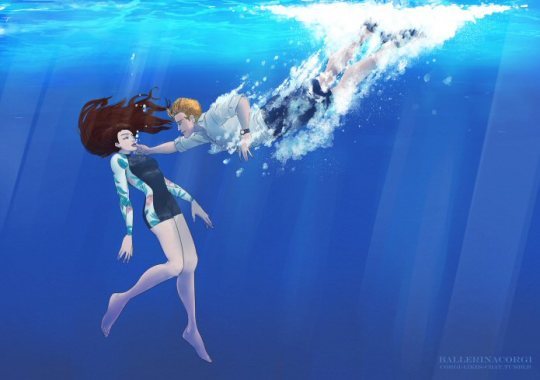
Lose Me, my latest book, is a story about a stunt girl, Ari, and a British actor, Wes (aka Mr Darcy). In the first 3 chapters, a traumatic event happens: Ari nearly drowns, and Wes, much to his dismay, is the only one who sees her, and thus has to (reluctantly) save her. Now, apart from this being a fun way for me to bring the sea into the story as a secondary character, to get Wes out of his comfort zone (and for them to meet, although technically they had already met before), I never gave much thought to what this rescue scene did for my story in the bigger picture.
It was only after rereading the darned book for 100 times, and getting a TON of feedback from my betas, that I realized: there was so much more to it than the dramatic charge of the moment.
It was the moment that the strongest character (Ari, a stunt girl, who can do anything from ride fast motorcycles to high diving to fake car crashes) becomes vulnerable. And in that, this is the starting point of her story, not to mention her character’s arch. From that moment on, she just continues getting sucked in further and further into the abyss.
“Am I still drowning, even if I was pulled from the water?” - Ari in Lose Me.
Because, without the characters’ weaknesses, what would all the stories be about? And of course, a weakness automatically means that you need help. Now, in some stories the characters get help and get better. In some others they don’t. And in some very very special stories, the characters end up receiving help from a person even weaker than they are, the most unlikely character to rescue them.
The person who you’d think most liable to drown, becomes the hero. That’s what’s known as character development. Aka, a good story.
I am not going to pretend I know what I’m doing as an author here, but I do know good writing when I read it (I’ve been a reader for a longer time than I’ve been a writer). And the truth is, I’ve never read a good book, or followed a really really good story as a film, cartoon, series, or whatever, that didn’t include some kind of rescuing on a major scale.
I think, in their essence, that’s what all our stories are, in the end: the need to reach something higher than what we have. And the people/places along our journey that help us reach that. In my book (see what I did there? Pun, anyone? No?) that’s called rescuing.
Art by the amazing and talented @corgi-likes-chat (commissions open)
You can read the rescue scene of Lose Me. along with the first 3 chapters at my website, mcfrankauthor.com


