Voices in the Ocean
Voices in the Ocean, by Susan Casey 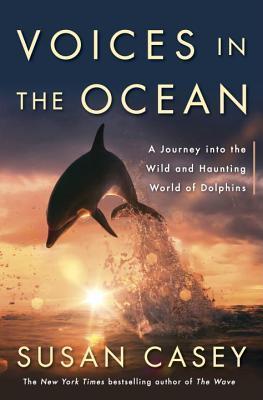 Blurb:Since the dawn of recorded history, humans have felt a kinship with the sleek and beautiful dolphin, an animal whose playfulness, sociability, and intelligence seem like an aquatic mirror of mankind. In recent decades, we have learned that dolphins recognize themselves in reflections, count, grieve, adorn themselves, feel despondent, rescue one another (and humans), deduce, infer, seduce, form cliques, throw tantrums, and call themselves by name. Scientists still don’t completely understand their incredibly sophisticated navigation and communication abilities, or their immensely complicated brains. While swimming off the coast of Maui, Susan Casey was surrounded by a pod of spinner dolphins. It was a profoundly transporting experience, and it inspired her to embark on a two-year global adventure to explore the nature of these remarkable beings and their complex relationship to humanity. Casey examines the career of the controversial John Lilly, the pioneer of modern dolphin studies whose work eventually led him down some very strange paths. She visits a community in Hawaii whose adherents believe dolphins are the key to spiritual enlightenment, travels to Ireland, where a dolphin named as “the world’s most loyal animal” has delighted tourists and locals for decades with his friendly antics, and consults with the world’s leading marine researchers, whose sense of wonder inspired by the dolphins they study increases the more they discover. Yet there is a dark side to our relationship with dolphins. They are the stars of a global multibillion-dollar captivity industry, whose money has fueled a sinister and lucrative trade in which dolphins are captured violently, then shipped and kept in brutal conditions. Casey’s investigation into this cruel underground takes her to the harrowing epicenter of the trade in the Solomon Islands, and to the Japanese town of Taiji, made famous by the Oscar-winning documentary The Cove, where she chronicles the annual slaughter and sale of dolphins in its narrow bay. Casey ends her narrative on the island of Crete, where millennia-old frescoes and artwork document the great Minoan civilization, a culture which lived in harmony with dolphins, and whose example shows the way to a more enlightened coexistence with the natural world.Okay, so I pre-ordered this books because it sounded really interesting and because I've been ferreting out books about dolphins whilst researching my own book, Red Days, however, it took me a while to actually get around to reading it. I'm so glad I finally read it though! It was so interesting and well written. Although it didn't tell me anything new about the Taiji dolphin slaughter, which my book is about, there were so many other things to learn about - I should mention I've done a fair bit of research about the Taiji slaughter, so for someone who didn't already know about it there is a wealth of information. I was also interested, though horrified, to learn more about the Soloman Islands, since it seems like people, myself included, are mainly focused on the situation in Taiji since the making of The Cove and I haven't seen much written about the Soloman Islands. However, although heartbreaking and depressing at times, it was also balanced with uplifting stories about dolphins who've befriended humans and people battling to save these hugely empathetic, intelligent animals. I also discovered several scientific papers which I'm not interested in looking into and hopefully getting my hands on copies. This is a really valuable read. If more people read books like this perhaps we have a chance of saving our oceans and the creatures that live in them before it's too late... My favourite quotes from 'Voices in the Ocean': 'Water has secrets. It is the element we fathom the least, and we love it and fear it and take it for granted all in equal measure.' "The only way that humans in the mass will respect any other species, apparently, is the ability to beat them in warfare.' 'He is the wildest of creatures, who will never get the chance to be wild.' 'In the dolphins' nomadic undersea world, solitude equals vulnerability, so a lone human in the water must seem to them in dire need of assistance.' 'Of course we'll find them among us: they have nowhere else to go.''Taiji is not just an animal rights issue; it's an issue of human rights.' '... all this was stupid, everything that went on at the cove, the entire arrogant, selfish relationship we had with these animals and with all of nature, as though every bit of life existed only for our purpose.' 'The fact that they have co-habited the ocean and not destroyed themselves really speaks to the fact that they have figured out a way to do this in a way we haven't.' 'Researchers around the globe are coming to the same conclusion - we are not the only beings who matter - and new ideas are stirring about how the startling depth and breadth of other creatures morally obliges us to act humanely towards them.' 'Our oceans are the bloodline of our world.' 'When something precious is at stake, why not slow down and consider the options, not just for yourself but for, .... a future you will never see?' 'We forgot our responsibility. And we forgot that we are as equal as any living thing within the chain. There's no hierarchy in this. ... We are part of the same family: living things. All the rest is just totally fucking bullshit.' '... if you can't be transparent about what you're doing, then perhaps you shouldn't be doing it.' '... if one individual can cause that much damage, then one individual can cause that much good.' 'We believe in domination: nature is ours to do with as we please. There is nothing we aren't willing to tamper with, even our own genetic code.' ' "We think we have understood everything," philosopher Thomas Berry wrote. "But we have not. We have used everything." '
Blurb:Since the dawn of recorded history, humans have felt a kinship with the sleek and beautiful dolphin, an animal whose playfulness, sociability, and intelligence seem like an aquatic mirror of mankind. In recent decades, we have learned that dolphins recognize themselves in reflections, count, grieve, adorn themselves, feel despondent, rescue one another (and humans), deduce, infer, seduce, form cliques, throw tantrums, and call themselves by name. Scientists still don’t completely understand their incredibly sophisticated navigation and communication abilities, or their immensely complicated brains. While swimming off the coast of Maui, Susan Casey was surrounded by a pod of spinner dolphins. It was a profoundly transporting experience, and it inspired her to embark on a two-year global adventure to explore the nature of these remarkable beings and their complex relationship to humanity. Casey examines the career of the controversial John Lilly, the pioneer of modern dolphin studies whose work eventually led him down some very strange paths. She visits a community in Hawaii whose adherents believe dolphins are the key to spiritual enlightenment, travels to Ireland, where a dolphin named as “the world’s most loyal animal” has delighted tourists and locals for decades with his friendly antics, and consults with the world’s leading marine researchers, whose sense of wonder inspired by the dolphins they study increases the more they discover. Yet there is a dark side to our relationship with dolphins. They are the stars of a global multibillion-dollar captivity industry, whose money has fueled a sinister and lucrative trade in which dolphins are captured violently, then shipped and kept in brutal conditions. Casey’s investigation into this cruel underground takes her to the harrowing epicenter of the trade in the Solomon Islands, and to the Japanese town of Taiji, made famous by the Oscar-winning documentary The Cove, where she chronicles the annual slaughter and sale of dolphins in its narrow bay. Casey ends her narrative on the island of Crete, where millennia-old frescoes and artwork document the great Minoan civilization, a culture which lived in harmony with dolphins, and whose example shows the way to a more enlightened coexistence with the natural world.Okay, so I pre-ordered this books because it sounded really interesting and because I've been ferreting out books about dolphins whilst researching my own book, Red Days, however, it took me a while to actually get around to reading it. I'm so glad I finally read it though! It was so interesting and well written. Although it didn't tell me anything new about the Taiji dolphin slaughter, which my book is about, there were so many other things to learn about - I should mention I've done a fair bit of research about the Taiji slaughter, so for someone who didn't already know about it there is a wealth of information. I was also interested, though horrified, to learn more about the Soloman Islands, since it seems like people, myself included, are mainly focused on the situation in Taiji since the making of The Cove and I haven't seen much written about the Soloman Islands. However, although heartbreaking and depressing at times, it was also balanced with uplifting stories about dolphins who've befriended humans and people battling to save these hugely empathetic, intelligent animals. I also discovered several scientific papers which I'm not interested in looking into and hopefully getting my hands on copies. This is a really valuable read. If more people read books like this perhaps we have a chance of saving our oceans and the creatures that live in them before it's too late... My favourite quotes from 'Voices in the Ocean': 'Water has secrets. It is the element we fathom the least, and we love it and fear it and take it for granted all in equal measure.' "The only way that humans in the mass will respect any other species, apparently, is the ability to beat them in warfare.' 'He is the wildest of creatures, who will never get the chance to be wild.' 'In the dolphins' nomadic undersea world, solitude equals vulnerability, so a lone human in the water must seem to them in dire need of assistance.' 'Of course we'll find them among us: they have nowhere else to go.''Taiji is not just an animal rights issue; it's an issue of human rights.' '... all this was stupid, everything that went on at the cove, the entire arrogant, selfish relationship we had with these animals and with all of nature, as though every bit of life existed only for our purpose.' 'The fact that they have co-habited the ocean and not destroyed themselves really speaks to the fact that they have figured out a way to do this in a way we haven't.' 'Researchers around the globe are coming to the same conclusion - we are not the only beings who matter - and new ideas are stirring about how the startling depth and breadth of other creatures morally obliges us to act humanely towards them.' 'Our oceans are the bloodline of our world.' 'When something precious is at stake, why not slow down and consider the options, not just for yourself but for, .... a future you will never see?' 'We forgot our responsibility. And we forgot that we are as equal as any living thing within the chain. There's no hierarchy in this. ... We are part of the same family: living things. All the rest is just totally fucking bullshit.' '... if you can't be transparent about what you're doing, then perhaps you shouldn't be doing it.' '... if one individual can cause that much damage, then one individual can cause that much good.' 'We believe in domination: nature is ours to do with as we please. There is nothing we aren't willing to tamper with, even our own genetic code.' ' "We think we have understood everything," philosopher Thomas Berry wrote. "But we have not. We have used everything." '


No comments have been added yet.