An interview with Jim Moran
Hello, and thank you for reading my little post. I have just come in from the garden where I'm trying to make sense of the jumble of bits of wood that are supposed to come together to create a playhouse on stilts. Unfortunately there are no instructions, not even a picture of what it is supposed to end up looking like!
Still, the garden is looking spectacular. Most of the daffodils are over, but the bluebells are out in force. And we have bluetits nesting in one of our boxes :)
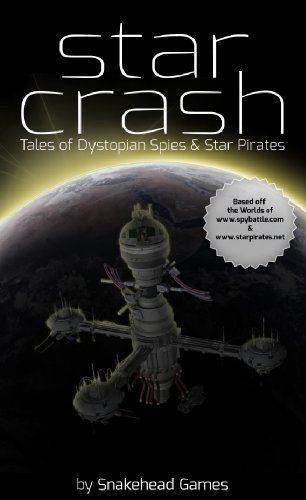
Anyway, enough of my troubles. Today I am interviewing Jim Moran, author of 'I am 8Bit' (a short story in Star Crash, Tales of Dystopian Spies & Star Pirates).
What advice do you have for the revision process?
I have two pieces of advice. Many have probably heard this advice before, but I think it’s important enough that it bears repeating.
1) Get somebody else to critique your book. Not just read it, or even proofread it, Critique it. Don’t get your mom, or your best friend, or anybody else with a motivation to spare your feelings. Find a person who knows what “critique” means. Preferably several people, who can give constructive criticism.
2) Don’t take constructive criticism personally. I can’t emphasize this enough. Go ahead and disagree with a critique. Argue a point. Explain yourself to your reader, because this is one of the few chances you get to do that. But don’t take it personally. It’s hard to do. This is your work that you made. I get it. But you won’t ever get better if you won’t allow anybody to point out what might be holding you back.
Oh, I hear you on that one. I love the critiquing process. I usually aim for each chapter to have been critiques by at least six people. Not every one will have read the whole book, but I do get a couple who go all the way through and can spot long-term plotting and consistency things.
Do you think that giving books away free works and why? My series opener, Independence, is free acroos most platforms and it pulls in a lot of readers, but I've heard people who it doesn't work for.
I can’t speak from personal experience, but I’ve certainly heard success stories. To me, it seems like if I can give Book 1 to generate interest for Book 2... well, either it works, and folks buy Book 2 (and possibly 3 and 4) or it doesn’t work, in which case they probably won’t be interested in the series anyway.
Speaking of which, I imagine that such a method is more successful for a series of books, rather than a collection of otherwise unrelated stories. The first one’s free, and all that.
Are there any writing techniques or tropes that you just can’t stand?
A few.
One that I find particularly irksome is when something arbitrarily bad happens to a character. Like, it doesn’t have anything to do with that character’s growth, it doesn’t further our understanding of the world, it doesn’t affect the plot, it’s not because of the plot... it’s just some random piece of bad luck. Only it’s not really "luck" because the author put it in there on purpose. But if it’s in there without a reason to be, it just comes off as some kind of contrived "woe is me" element, only there to elicit a reaction from the readers and nothing more. It’s just meaningless angst that takes me out of the story.I was reading a book recently where, towards the end of the book, the main character’s sister is killed. And it’s played up as a big emotional deal. But (and hey, maybe I just missed it) there was no reason for the sister to die. Nothing with respect to the narrative, anyway. The emotion fell flat, because all I could think was "why did this just happen?"And yeah, I get it. Random bad things happen to good people in real life. But if I’m reading about real life events, that’s not an issue for me. When the events I’m reading about have been created for enjoyment... well, I just don’t enjoy this kind of contrivance.
Do you remember the first story you ever read, and the impact it had on you?
Yes. Marvin K. Mooney Will You Please Go Now, by Dr. Seuss. I could (and did) read that book backwards and forwards.
Of course, I was so young, I don’t really remember what kind of impact it had on me. I do have a vague recollection that saying "Mooney K Marvin" over and over and over and over and over and over again could irritate the ever-loving snot out of people. Literacy begets power, I suppose.
And finally, what motivated you to become a writer?
Technology.
My mom had an old typewriter, and I was fascinated by the mechanics of it. Then she showed me how to actually put words on paper, so of course I had to put words on the paper. Strictly hunt and peck stuff. Later, when I was six or seven, we got an Apple IIe computer. Using a computer then was not like using a computer now; there was a lot of command-line stuff. We didn’t even know what a “mouse” was. Even some of the games required writing, and I mean more than just writing nasty things about somebody on the Oregon Trail tombstone. We had a lot of those old Infocom games, like Zork and Planetfall. Text-based stuff, and it was captivating. Around the second grade, I learned how to actually program a little bit. I also discovered my first word processor on the Apple IIe, though I forget what it was called. It could do things like CUT and PASTE. Highlight, underline, and put in italics. I could even print it out on this angry Dot Matrix printer. Crazy. Since I was using the keyboard so much, I wanted to learn how to type faster. At school, we had an Apple IIe lab and a lot of learning programs, including Sticky Bear Teaches Typing. I learned the home row from Sticky Bear while my classmates were trying to ford the Blue River. Come on, guys. It’s twenty feet deep in the middle. Conditions are not going to improve. So I learned how to leverage computers from a young age. I learned how to communicate fast and well. And I learned how to create things. I enjoyed creative writing exercises in school, and I read a ton. But that was the extent of things for a long time. I’d always had a passing interest in writing. I discovered early on that, regardless of content, if a message was polite, well-structured, and readable, it stood out and above at least 50% of the noise. I would right little testimonials to companies, and sometimes I’d get coupons or gift certificates. I won a one-off writing contest that I only spent a couple of hours on. Little bits and pieces, but I never really considered myself a writer. I still don’t, I suppose. Right now, it might be closer to call myself a writing enthusiast. But if there was anything that inspired me to graduate to enthusiast, it’d be the online writing group I found. They were a good bunch of folks that didn’t know me well enough to know that I wasn’t really invested in things. So they just assumed I was. When I realized that these fellows, all serious about writing, thought it was perfectly reasonable to treat my writing seriously... that’s when my regard for such endeavors started experiencing some serious shifts. That shifting hasn’t settled yet. What fun!
Thank you so much for taking part. I wish you well with your work.




No comments have been added yet.