
Most Startups Still Believe They Need A Dot-Com Domain, But That Is Changing
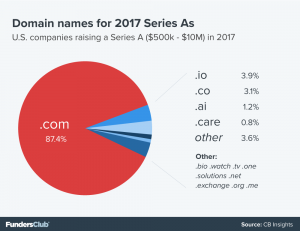
The latest Series A funded companies still heavily favor dot-com domains. But it’s different at Y Combinator.
Nearly every startup founder has undergone a torturous process that invariably includes whiteboards, hours of late-night bantering sessions, and days spent typing potential domain names into a browser. Even with all of that, startups often end up with names unfit for their industry or their purpose.
Why do lucid, reasonable people end pinning their companies with ridiculous monikers? Because most people feel that owning a dot-com domain for their company is non-negotiable. With that in mind, founders shoehorn their companies into all kinds of domains and names to make the dot-com requirement work.
Is this wise—would it be better to leave the desired dot-com domain to the squatter who is sitting on it and simply go with desiredname.io or some variation thereof?
There are differing opinions on this, and there are some indications that overall attitudes—which once tilted toward dot-com at any cost—are beginning to change.
Some people, including Paul Graham, who , still think that startups should prioritize getting a dot-com domain.
Not having a dot-com, he wrote back in August 2015, “signals weakness.”
He re-endorsed that point of view to me, via Twitter, recently. He added that a dot-com domain is probably even more important for SaaS and b2b companies because their mission is to look as legitimate as possible in a business setting, which is harder to do from an alternative domain.
Candace Caldwell, who leads up naming at Simple Truth, a creative marketing agency, thinks that startups are better off finding a memorable name that makes sense and fits the company’s business, even if it means settling for an alternative domain extension such as .io or .co.
At FundersClub, we dug up the domain names of U.S. companies that have landed Series A funding of between $500,000 and $10,000,000 during 2017. With the help of CB Insights’ database, we determined that 87.4% of this cohort had settled on a dot-com domain. That data is offered with my added comment that some of these names weren’t intuitive or subjectively good, they clearly had been conjured as a way to get a dot-com URL.
The stats at Y Combinator are a bit different, however.
You can see the downward progression of dot-com domains at Y Combinator in a piece at FundersClub. We also graphed out all the domain extensions for the Winter 2017 batch at YC.


Christopher Steiner's Blog

- Christopher Steiner's profile
- 21 followers

