
I wrote this piece for WORLD magazine's website. Since a shortened version was published,...
I wrote this piece for WORLD magazine's website. Since a shortened version was published, here's the full piece. If you like debate on the issue of feminism, there is quite a discussion going on over at WORLD about it.
Is Anti-Feminism Anti-Intellectual? How a college history class made me think twice about gender roles //Hannah Farver
My womanhood was liberated when I went to college. No, it's not a story of "girl-meets-birth-control" or some awakening of feminine mystique within.
I was in history class. We were reading the 1955 commencement address at Smith College given by Adlai Stevenson. Adlai, a diehard liberal and once-upon-a-time presidential candidate, told the bright-eyed crème de la crème of America's educated women: "I think there is much you can do…in the humble role of housewife." He said their education was preparation for the "primary task" of homemaking.
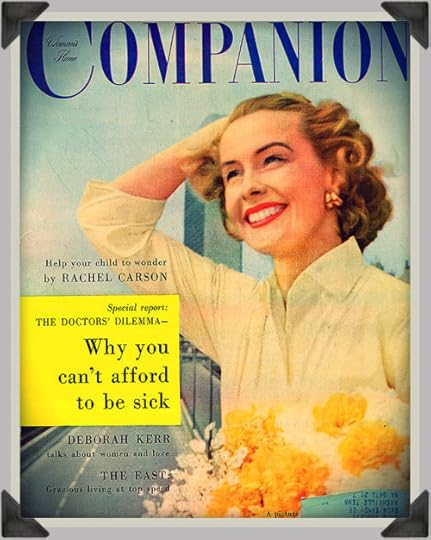
Those aren't out-of-context quotes taken from some old speech. Smith College is elite, and the alma mater of famous feminists like Betty Friedan and Gloria Steinem. Adlai's words were so broadly accepted, the Woman's Home Companion reprinted them in their September 1955 edition.
Why is that significant? Why was it that as I sat at a desk, shivering beneath the AC vents in my Northern Virginia college, this antique speech so captured me?
Adlai Stevenson proved male and female roles are not inherently regressive. See, I have long fought the sneaking suspicion that no educated, thinking person would give traditional male-female roles a second glance.
Here's the reality check I caught like a sucker punch: up until the 1960's, you would be hard-pressed to find an educated, thinking person who did not give credence to traditional gender roles in Western Civilization. While there were fringe feminist voices, their arguments had not gained mainstream traction.
Adlai was a Unitarian Universalist, old school Democrat whose New Deal liberalism would put most modern so-called liberals to shame. He wasn't pro-tradition. He wasn't cozy with evangelicals. Yet he cheered on purposeful femininity as a life preserver for Western Civilization.
Dr. Robert Spinney, a historian with a B.A. from Harvard and Ph.D. from Vanderbilt, emphasized that Adlai was at his essence a politician. He wouldn't have said anything taboo from a commencement podium. In fact, Adlai only echoed the Catholic essayist, G.K. Chesterton, from decades previous.
Chesterton had read the women's suffrage movement like tea leaves. Realizing that the traditional role of women would soon be questioned, he defended it, saying that a wife's calling was intended "to be the red heart of a man's house and that hearth for which…a man should die."
That said, Chesterton admitted that women have had a tough track record in history. This victimization of women, which became the rallying cry of feminism, is a reality with no expiration date. Chesterton acknowledged it in the 19th century, but it has never been more true than now:
According to the New York Times' Nicolas Kristof in his bestseller, Half the Sky, "more girls have been killed in the last fifty years, precisely because they were girls, than men were killed in all the battles of the twentieth century."
I heard a hundred times growing up that women in a pre-feminist world were treated like ornaments. But a glancing survey of Christina Aguilera's neckline on The Voice tells me the same is true of today. Women are still objects. Internationally, women are still targeted by gender-specific abortions and sexual slavery. Feminism didn't fix the problem. So what exactly did feminism do?
Feminists sought to erase gender altogether.
"Darwin's ideas changed everything, because implicit in Darwinian ideas is 'strong is good, weak is bad,'" Spinney said. No one wanted to champion "the weaker sex," so feminists changed their rhetoric, stepping away from femininity.
"The only perceived difference between males and females [became] sexual characteristics. Women are now objectified in terms of sexuality; they have nothing unique to offer men except for sex ." Trying to ease the plight of women, feminism made objectification mainstream.
While the practical application of gender roles may be up for debate, it is not unreasonable to ask if we were better off with tradition.
Smith graduates of 1955 were expected to be happy at home. They spent big bucks on college educations just to marry, have kids, and train those kids to preserve Plato and Kierkegaard. The home was considered a perfectly legitimate calling warranting the highest academic preparation.
What is the point here? To bash everything feminism ever brought to our culture? To revere tradition for tradition's sake?
Not really. What hit me in this history lesson was awe. The original intent of femininity is different—both from womanhood a la Gloria Steinem and womanhood according to Maxim. It's far grander, more purposeful and necessary than either paradigm would ever suppose. It's greater even than the limitations we place upon it in a post-feminist world. The calling for women is, essentially, heroism. As Chesterton put it, "In other words, there must be in every center of humanity one human being upon a larger plan; one who does not 'give her best,' but gives her all."
[Many thanks to Dr. Robert Spinney for his tremendous research and for challenging his students to think ever more deeply on history.]


Hannah Farver's Blog

- Hannah Farver's profile
- 12 followers

