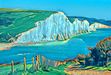
A View Of The Sea
The couple at the next table were arguing - anyone could see that. Not
that they raised their voices, but the woman had the bleached look and
tense mouth of one under chronic strain, and her eyes, although
carefully made up, looked slightly puffy and reddened, as if she had
recently cried. The man had his back to Rachel, so she could only see
longish, slightly graying light-brown hair over the collar of a red, tartan
jacket, but the shoulders were hunched with belligerence and he
seemed to loom over his companion. The woman flinched at something
he said, then lifted her coffee-cup, but her hand trembled and she
replaced it in the saucer. Attempting to seem normal, she glanced round
the café, briefly caught Rachel’s eye, then looked away. Not that there
was anything much to look at. Someone, a long time ago, had tried to
give the premises a jaunty, nautical atmosphere. The rough plaster walls
were hung with bad paintings of galleons and scooners in full sail, glass
floats festooned the wooden panelling, and plastic lobsters trailed
dejectedly from decorative nylon nets. Rain streamed down the two
small windows, and as the tables emptied, nobody came to clear the
dirty cups, although a woman buttoned tightly into an overall was leaning
on the counter looking out at the wet cobbles.
Sarah would be here in half an hour. They should have arrived at the same time,
so that they could go to the cottage together, but as usual Sarah was running
late. Rachel wanted to go, but having been drenched once, didn’t want
to be drenched again; when Sarah arrived they could go
there together in her car. The last of her fellow customers left,
putting umbrellas up against the downpour, leaving Rachel alone with
the unhappy couple. She ordered tea and cake, killing time, and wishing
she had brought a book. The angry hunched shoulders and the woman’s
distressed face were between her and what view there was of the street
outside; to avoid appearing to watch them she must crane her neck and
feign interest in the terrible selection of ship-paintings.
After a few moments she turned back to her tea and cake but found
the woman now staring at her with unsettling intensity, her face ashen.
Rachel couldn't help but look back; the woman seemed to want to tell
her something. The man in the red jacket turned in his chair suddenly,
meeting Rachel's gaze, and clearly furious. He shoved his chair back,
slammed some money on the counter, and took the woman by one arm,
almost pulling her out of her chair. The door slammed behind them, and
they left Rachel feeling shaken by the enounter: the fear on the woman's
face, the rage on the man's. She closed her eyes and took a few deep
breaths, then heard the little bell tinkle over the cafe door again as Sarah
came in.
"I'm so sorry!" she said, hugging Rachel. "I let Chips out for a run in the
park and he wandered off. Shall we go?"
Then the sisters stood back from each other, and looked each other up
and down.
"Did you copy me, or did I copy you?" asked Sarah, and Rachel grinned back.
Both women were wearing longish dark-blue coats with fur collars, tan
leather boots, and a white scarf.
"We've done it again!" Rachel laughed.
Chips, Sarah's ancient dog of uncertain breed, was asleep on the back
seat of Sarah's car, and the sisters drove a mile out of the village to
where their cottage clung to the rocks above the pebbly beach. As
children, their parents had rented this cottage for two weeks each
summer, and now, every year at the beginning of October, the sisters
returned for what Rachel's husband, Nick, called their 'annual chat-fest.'
It had become a tradition ever since both sisters married, and moved to
opposite ends of the country. For all their startling similarities and
closeness, they now led very different lives: Rachel with her part-time
jobs, three demanding teenagers, and her husband struggling to keep
his engineering business afloat; Sarah, describing herself as "childfree",
with her charity work and her adoring husband who did something
involving IT which Rachel didn't understand but which seemed to bring in
more money in a month than she and Nick made in a year. The men
didn't get on. And Sarah had Chips, who was jealous and snappy around
Rachel's boisterous children. So now, the sisters packed all their talking
and laughing at private jokes into one off-season week each year, not
caring that the weather was unpredictable, each returning to her own life
recharged, having made contact with her roots once more.
Unpacking was the first thing which made them laugh - every year they
would find that they had each brought a case full of clothes which were
the same designs and colours, the main difference being that Rachel's
were the budget version of her sister's expensive holiday wardrobe.
Rachel had always loved the view from her bedroom here.
She had the room she had used when she was a child, facing directly
over the rock-strewn beach and the old broken stone jetty. While she put
her clothes away, she looked out, saw a flash of red, and was depressed
to see that the couple from the café were walking on the beach, the man
still in his red tartan jacket. Rachel could see that the door to the old
motor-home parked beyond the jetty was open, spilling a little light into
the gloomy afternoon. So that was where they were staying.
The isolation of the cottage was what had attracted the sister's parents to this
place so long ago; most people chose to go to the caravan park on the
cliff above the long stretch of sandy beach, and left this little rocky corner
undisturbed. Rachel hoped the couple would move on soon. Even
through the closed window, above the sound of the waves, she could
hear the man shouting, and although she couldn't make out the words,
she could see the woman cringing beneath the verbal assault, like a
whipped dog. She thought of Nick, so tolerant and gentle with his family
no matter how stressed and tired he was, and of Sarah's Liam, who
adored his wife, and thought how lucky they had been. Then Sarah
came in to ask if Rachel remembered how to turn the heating on, and
Rachel put the unhappy couple out of her mind.
As they always did, the sisters slipped comfortably into a routine; each
morning, before breakfast, Rachel would drive into the village to buy
their food for the day, while Sarah took Chips for a short walk along the
beach. For the first two mornings, Rachel found herself reluctantly face
to face with the couple, who were never apart despite their obvious
unhappiness. Trapped in the queue at the corner-shop, she was unable
to move away, despite feeling the woman's eyes on her face, the
pleading and tension palpable, seemingly at breaking-point, so that
Rachel felt guilty for not helping her. But how could she say or do
anything? The woman never spoke, just stared in recognition, as if being
ignored by an old friend, and at some point, the man, a look of
suppressed fury on his face, would turn his glare on Rachel, as if
accusing her of interfering. She couldn't even tell Sarah about the
couple; Sarah had never seen them, and, unlike Rachel, whose impulse
was always to avoid confrontation, Sarah would undoubtedly have felt it
was her duty to do all she could to defend a woman who was clearly
being abused. But Rachel was acutely aware of how isolated the cottage
was; if they provoked the man in any way, he may come there, and he
was obviously unhinged. If he attacked them, they couldn't call the
police, because, so close to the sea, their mobile phones had no signal.
So Rachel simply started going to the shop half an hour earlier, leaving
Sarah pottering around in the kitchen making coffee, and kept a wary
eye open for the flash of the red jacket.
For two days, to her relief, she didn't see the couple, although the
motorhome remained on the strip of land close by the jetty. The sisters
spent their days slowly, visiting remembered childhood haunts, and
talking. The stony beach was uninviting because the weather remained
grey and cold, so only Sarah walked by the sea, when the elderly Chips
needed his few minutes of exercise before slumping exhausted onto his
bed by the radiator. But before going to bed, Rachel would turn out her
bedroom light and look out at the motor-home, it's windows lit, and
shiver, wondering what private hell the woman was enduring in that
confined space.
On the fifth morning, she was returning from buying the day's groceries,
and heard a brief shout, quickly muffled. She had almost reached the top
of the dune of bleached seashells which were washed up by each high
tide, and she saw the couple standing on the old jetty. The woman was
holding something up high, and as if in slow motion, Rachel saw her
bring her arm down, and the man fall onto the half-covered stones in the
water below. Paralysed, Rachel saw him, face down, unmoving rather
than struggling to stand up again. The woman hurried down to his side
as if to help, but instead, she glanced furtively all around the empty bay,
and even at a distance Rachel could see that the expression on her face
was one of pure triumph. In her hand, she still clutched the rock she had
struck him with. And then, as so often before, her eyes met Rachel's,
and Rachel knew she had been seen and recognised. The woman, no
longer cringing, but standing tall with determination, stepped toward
Rachel while the body of her tormentor moved gently among the green
rocks and the seaweed.
Rachel knew she had to reach the cottage, to stop Sarah from going out,
to keep her sister safe. She dropped down below the level of the bank of shells so
she couldn't be seen, left the bags of shopping and ran,
sliding and losing her footing in the shells, her ankles twisting on the
pebbles, heading for the path to the cottage, and safety.
She ran upstairs heart bursting, hoping to find Sarah still waiting for her to return, but
found the note by her bedroom door, saying Sarah had taken Chips for
his walk.
And through the bedroom window Rachel could see her sister
who was more than a sister, more than a friend: the other half of herself,
her identical twin, making for the jetty with the old dog trotting behind
her, and turning, smiling, to greet the woman intent on keeping the
secret of a man's death, who was walking toward her, still clutching the
rock in her hand.


that they raised their voices, but the woman had the bleached look and
tense mouth of one under chronic strain, and her eyes, although
carefully made up, looked slightly puffy and reddened, as if she had
recently cried. The man had his back to Rachel, so she could only see
longish, slightly graying light-brown hair over the collar of a red, tartan
jacket, but the shoulders were hunched with belligerence and he
seemed to loom over his companion. The woman flinched at something
he said, then lifted her coffee-cup, but her hand trembled and she
replaced it in the saucer. Attempting to seem normal, she glanced round
the café, briefly caught Rachel’s eye, then looked away. Not that there
was anything much to look at. Someone, a long time ago, had tried to
give the premises a jaunty, nautical atmosphere. The rough plaster walls
were hung with bad paintings of galleons and scooners in full sail, glass
floats festooned the wooden panelling, and plastic lobsters trailed
dejectedly from decorative nylon nets. Rain streamed down the two
small windows, and as the tables emptied, nobody came to clear the
dirty cups, although a woman buttoned tightly into an overall was leaning
on the counter looking out at the wet cobbles.
Sarah would be here in half an hour. They should have arrived at the same time,
so that they could go to the cottage together, but as usual Sarah was running
late. Rachel wanted to go, but having been drenched once, didn’t want
to be drenched again; when Sarah arrived they could go
there together in her car. The last of her fellow customers left,
putting umbrellas up against the downpour, leaving Rachel alone with
the unhappy couple. She ordered tea and cake, killing time, and wishing
she had brought a book. The angry hunched shoulders and the woman’s
distressed face were between her and what view there was of the street
outside; to avoid appearing to watch them she must crane her neck and
feign interest in the terrible selection of ship-paintings.
After a few moments she turned back to her tea and cake but found
the woman now staring at her with unsettling intensity, her face ashen.
Rachel couldn't help but look back; the woman seemed to want to tell
her something. The man in the red jacket turned in his chair suddenly,
meeting Rachel's gaze, and clearly furious. He shoved his chair back,
slammed some money on the counter, and took the woman by one arm,
almost pulling her out of her chair. The door slammed behind them, and
they left Rachel feeling shaken by the enounter: the fear on the woman's
face, the rage on the man's. She closed her eyes and took a few deep
breaths, then heard the little bell tinkle over the cafe door again as Sarah
came in.
"I'm so sorry!" she said, hugging Rachel. "I let Chips out for a run in the
park and he wandered off. Shall we go?"
Then the sisters stood back from each other, and looked each other up
and down.
"Did you copy me, or did I copy you?" asked Sarah, and Rachel grinned back.
Both women were wearing longish dark-blue coats with fur collars, tan
leather boots, and a white scarf.
"We've done it again!" Rachel laughed.
Chips, Sarah's ancient dog of uncertain breed, was asleep on the back
seat of Sarah's car, and the sisters drove a mile out of the village to
where their cottage clung to the rocks above the pebbly beach. As
children, their parents had rented this cottage for two weeks each
summer, and now, every year at the beginning of October, the sisters
returned for what Rachel's husband, Nick, called their 'annual chat-fest.'
It had become a tradition ever since both sisters married, and moved to
opposite ends of the country. For all their startling similarities and
closeness, they now led very different lives: Rachel with her part-time
jobs, three demanding teenagers, and her husband struggling to keep
his engineering business afloat; Sarah, describing herself as "childfree",
with her charity work and her adoring husband who did something
involving IT which Rachel didn't understand but which seemed to bring in
more money in a month than she and Nick made in a year. The men
didn't get on. And Sarah had Chips, who was jealous and snappy around
Rachel's boisterous children. So now, the sisters packed all their talking
and laughing at private jokes into one off-season week each year, not
caring that the weather was unpredictable, each returning to her own life
recharged, having made contact with her roots once more.
Unpacking was the first thing which made them laugh - every year they
would find that they had each brought a case full of clothes which were
the same designs and colours, the main difference being that Rachel's
were the budget version of her sister's expensive holiday wardrobe.
Rachel had always loved the view from her bedroom here.
She had the room she had used when she was a child, facing directly
over the rock-strewn beach and the old broken stone jetty. While she put
her clothes away, she looked out, saw a flash of red, and was depressed
to see that the couple from the café were walking on the beach, the man
still in his red tartan jacket. Rachel could see that the door to the old
motor-home parked beyond the jetty was open, spilling a little light into
the gloomy afternoon. So that was where they were staying.
The isolation of the cottage was what had attracted the sister's parents to this
place so long ago; most people chose to go to the caravan park on the
cliff above the long stretch of sandy beach, and left this little rocky corner
undisturbed. Rachel hoped the couple would move on soon. Even
through the closed window, above the sound of the waves, she could
hear the man shouting, and although she couldn't make out the words,
she could see the woman cringing beneath the verbal assault, like a
whipped dog. She thought of Nick, so tolerant and gentle with his family
no matter how stressed and tired he was, and of Sarah's Liam, who
adored his wife, and thought how lucky they had been. Then Sarah
came in to ask if Rachel remembered how to turn the heating on, and
Rachel put the unhappy couple out of her mind.
As they always did, the sisters slipped comfortably into a routine; each
morning, before breakfast, Rachel would drive into the village to buy
their food for the day, while Sarah took Chips for a short walk along the
beach. For the first two mornings, Rachel found herself reluctantly face
to face with the couple, who were never apart despite their obvious
unhappiness. Trapped in the queue at the corner-shop, she was unable
to move away, despite feeling the woman's eyes on her face, the
pleading and tension palpable, seemingly at breaking-point, so that
Rachel felt guilty for not helping her. But how could she say or do
anything? The woman never spoke, just stared in recognition, as if being
ignored by an old friend, and at some point, the man, a look of
suppressed fury on his face, would turn his glare on Rachel, as if
accusing her of interfering. She couldn't even tell Sarah about the
couple; Sarah had never seen them, and, unlike Rachel, whose impulse
was always to avoid confrontation, Sarah would undoubtedly have felt it
was her duty to do all she could to defend a woman who was clearly
being abused. But Rachel was acutely aware of how isolated the cottage
was; if they provoked the man in any way, he may come there, and he
was obviously unhinged. If he attacked them, they couldn't call the
police, because, so close to the sea, their mobile phones had no signal.
So Rachel simply started going to the shop half an hour earlier, leaving
Sarah pottering around in the kitchen making coffee, and kept a wary
eye open for the flash of the red jacket.
For two days, to her relief, she didn't see the couple, although the
motorhome remained on the strip of land close by the jetty. The sisters
spent their days slowly, visiting remembered childhood haunts, and
talking. The stony beach was uninviting because the weather remained
grey and cold, so only Sarah walked by the sea, when the elderly Chips
needed his few minutes of exercise before slumping exhausted onto his
bed by the radiator. But before going to bed, Rachel would turn out her
bedroom light and look out at the motor-home, it's windows lit, and
shiver, wondering what private hell the woman was enduring in that
confined space.
On the fifth morning, she was returning from buying the day's groceries,
and heard a brief shout, quickly muffled. She had almost reached the top
of the dune of bleached seashells which were washed up by each high
tide, and she saw the couple standing on the old jetty. The woman was
holding something up high, and as if in slow motion, Rachel saw her
bring her arm down, and the man fall onto the half-covered stones in the
water below. Paralysed, Rachel saw him, face down, unmoving rather
than struggling to stand up again. The woman hurried down to his side
as if to help, but instead, she glanced furtively all around the empty bay,
and even at a distance Rachel could see that the expression on her face
was one of pure triumph. In her hand, she still clutched the rock she had
struck him with. And then, as so often before, her eyes met Rachel's,
and Rachel knew she had been seen and recognised. The woman, no
longer cringing, but standing tall with determination, stepped toward
Rachel while the body of her tormentor moved gently among the green
rocks and the seaweed.
Rachel knew she had to reach the cottage, to stop Sarah from going out,
to keep her sister safe. She dropped down below the level of the bank of shells so
she couldn't be seen, left the bags of shopping and ran,
sliding and losing her footing in the shells, her ankles twisting on the
pebbles, heading for the path to the cottage, and safety.
She ran upstairs heart bursting, hoping to find Sarah still waiting for her to return, but
found the note by her bedroom door, saying Sarah had taken Chips for
his walk.
And through the bedroom window Rachel could see her sister
who was more than a sister, more than a friend: the other half of herself,
her identical twin, making for the jetty with the old dog trotting behind
her, and turning, smiling, to greet the woman intent on keeping the
secret of a man's death, who was walking toward her, still clutching the
rock in her hand.


No comments have been added yet.