
Writing About Faith without Getting Preachy
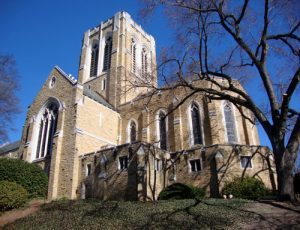 I had the privilege to talk about The Lost Book of the Grail at St. Philip’s Cathedral in Atlanta, Georgia this past Sunday morning. Let me say right off the bat that, although the novel is set in a cathedral and there is a lot of ecclesiastical history and activity within its pages, I made a concerted effort to be sure the book was not preachy in any way. While its characters sometimes struggle with issues of faith or worship, the book takes no authorial stance on these issues. I’m not trying to tell my readers what to believe or what not to believe. I think I succeeded in this effort because I heard recently from a reader who told me she almost didn’t buy the book. She is not a Christian and not a fan of organized religion. However, on advice of a friend, she read the book and told me she enjoyed it very much.
All that being said, the book does, necessarily for its setting in an English cathedral community, take up issues of faith and belief here and there. I think some of these spots might make for good discussions in book clubs (or in churches for that matter), and I pointed the more obvious spots out to my audience at the cathedral on Sunday. I present them here without comment—other than the foregoing and the following! Because these are out of context, it’s important to remember that they are the words and ideas of characters, not the author (it’s easy to get those confused). I don’t necessarily agree with all that my characters think and say—that’s part of what makes them interesting to me. Anyway, whether or not you have read The Lost Book of the Grail, these excerpts might make for some interesting conversations—but please don’t let them scare you away. There are also about 300 pages in which the characters are not talking about religion; they’re just having a rip roaring adventure.
_____
The argument that had engrossed Arthur and Gwyn on their first meeting had gone something like this: The dean did not understand how Arthur could come to services at the cathedral nearly every day yet profess he didn’t actually believe in the doctrines of the Christian church. Arthur argued that the dean should be pleased to have nonbelievers in her pews—what better place for nonbelievers? Arthur guessed her argument stemmed not so much from the apparent inconsistency of his beliefs and his actions as from her assumption that a nonbeliever in the pews was a rare bird. But Arthur suspected it was not nearly as rare as Gwyn thought, or perhaps wished. He imagined that any number of regular attendees, especially at the main Sunday morning service, if put to the test about their reasons for darkening the doors of the cathedral on a regular basis, might say all sorts of things about music and preaching and architecture and fellowship, but would very carefully skirt around the issue of faith.
The beauty of Evensong—the voices of the choir ringing off the ancient stones of the cathedral—did not make Arthur believe in God, but it did make him want to believe.
“You know, Arthur,” said Bethany, “you can decide to believe. That’s all it takes sometimes is a decision.”
He always felt moved when he entered the cathedral—such a space, with its soaring vaults and ancient arches, could never seem commonplace to him. But he usually felt the history of the building—from the Saxons to the Normans, from one bishop to the next, from the Reformation to the Civil War—the wonder of Barchester Cathedral to Arthur was the way it connected him to a thousand years of the past. Tonight’s feeling was different. Tonight the cathedral felt mysterious and laden with . . . well, Arthur supposed, laden with religion. In his unbelief, he thought much more about the political and artistic history of the cathedral than about the fact that for more than a millennium, people of faith had poured forth that faith on this spot. Tonight, Arthur felt as if he were swimming in a pool of that ancient belief.
“You’re so confident, aren’t you,” said Arthur. “It amazes me how you just don’t have any doubt.”
“Oh, God, Arthur, is that what you think?” said Bethany. “That believing means not having any doubt? Of course I have doubt. Every time I turn on the news and see man’s inhumanity to man I have doubts about God; every time I read some scholarly article about the ‘legendary’ King Arthur I have doubts about the Grail; and God knows I have serious doubts about love. But doubt is what makes belief and love gritty and dirty and complicated and worthwhile and life changing.”
“I wish I could have your faith. I wish I weren’t so weighed down by reason.”
“Faith doesn’t replace reason, Arthur,” said Bethany. “Faith begins where reason leaves off.”


 newest »



It was actually relatively easy for me to identify with Arthur's attendance of Compline, since if I lived within walking distance of a cathedral, I'm fairly sure I would also want to witness such beautiful music as often as possible.