Ham and Enos: The First Two Chimps in Space
Before any man can claim legacy on spaceflights, there are chimps like Ham and Enos.
Everyone knows that the first person who landed on the moon’s surface is the American astronaut Neil Alden Armstrong. But did you know that Ham and Enos have orbited the Earth before any man had?
In fact, there have been a number of unsung heroes who went to space. There are several batches of selected animals—monkeys, chimps, dogs, mice, cats, squirrels, rabbits, etc.—that have been sent into space as test subjects.
It was at the height of the Cold War when the Soviet and America were competing over technological supremacy, specifically over which country can send a living entity into space and bring it alive back to Earth.

Initial space launches have aimed to collect data about a living organism’s survival chance in extended periods of weightlessness. Successful missions include obtaining data about the effects of swift acceleration on prone or seated position, evaluating biological response in space, and getting passengers back home alive and well. Most failures are due to technological malfunction or fatality due to impact.
Among the successful operations, those of Ham and Enos are most renowned. These space chimps have paved the way for further space research. And before any man can leave a legacy on spaceflights, air force chimpanzees like Ham and Enos had already made one—there was Ham before Alan B. Shepard Jr. and Enos before John Glenn.
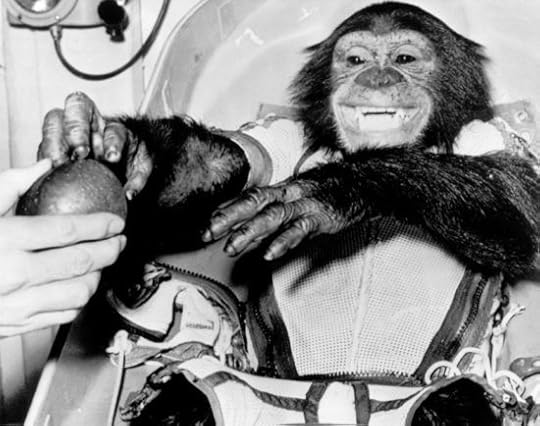 Image 1: Ham
At the age of three, Ham, originally named No. 65, boarded the Mercury Redstone rocket on January 31, 1961. The suborbital flight reached an altitude of 157 miles in 5,857 miles per hour within 16.5 minutes. Ham lived through 6.6 minutes of weightlessness in space. After a thorough medical examination, Ham was moved to the Washington Zoo where he lived alone for 17 years. He was later relocated to North Carolina Zoological Park where he died. Ham’s remains, excluding his skeleton that the Armed Forces Institute of Pathology examines to this day, were entomb in front of the International Space Hall of Fame in New Mexico.
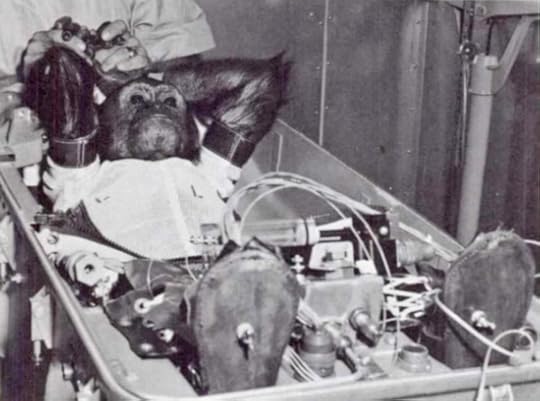 Image 2: Enos
On November 29, 1961, Enos boarded a Mercury Atlas rocket and became the first living thing to successfully orbit the earth twice. That time, the mission’s goal was to test the physical and mental abilities of animals in orbit. Though trained to answer oddity problems by avoidance conditioning (chimps get electric shocks to the soles of their feet for every wrong answer), Enos received a total of seventy-six shocks due to technical malfunction. His flight ended after two rounds (planned originally three) around the orbit. When he landed back to Earth, he was trapped in the capsule for more than three hours with damaged physiological sensors and wrecked belly panel. He died in less than a year later.
Science has proved a number of things and continues to unfold more discoveries through space research. Along this, ethical questions continue to arise. Is the pursuit of technological supremacy justifiable at the expense of moral neglect? Should animals continue to suffer and die for human experiments?
References
Madrigal, Alexis. 2011. “The Horrible Thing That Happened to Enos the Chimp When He Orbited Earth 50 Years Ago.” Accessed February 13, 2017. https://www.theatlantic.com/technology/archive/2011/11/the-horrible-thing-that-happened-to-enos-the-chimp-when-he-orbited-earth-50-years-ago/249241/.
National Aeronautics and Space Administration. n.d. “A Brief History of Animals in Space.” Accessed February 13, 2017. https://history.nasa.gov/animals.html.
The post Ham and Enos: The First Two Chimps in Space appeared first on Picky The Marvelous Chicken.