The Dolphin in the Mirror
The Dolphin in the Mirror by Diana Reiss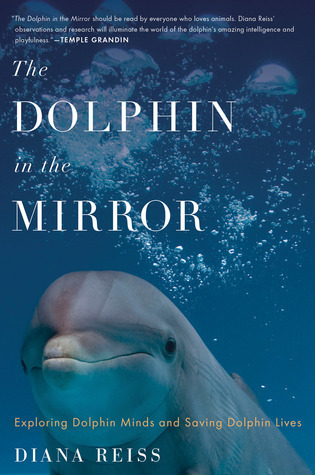 Blurb:For centuries, humans and dolphins have enjoyed a special relationship, evident not just in mythology and folklore but in many documented encounters. Diana Reiss is one of the world’s leading experts on dolphin intelligence, and her decades of research and interactions with dolphins have made her a strong advocate for their global protection. In The Dolphin in the Mirror, Reiss combines her science and activism to show just how smart dolphins really are and why we must protect them.Dolphins are creative and self-aware, with distinct personalities and the ability to communicate with humans. They craft their own toys, use underwater keyboards, and live in complex societies in the seas. And yet some nations continue to slaughter them indiscriminately. This story of Reiss’s encounters and research with dolphins is both a scientific revelation and an emotional eye-opener, revealing one of the greatest intelligences on the planet and exposing our terrible mistreatment of the smartest creatures in the sea.This book was fascinating. In this day and age I don't know how anyone can deny that dolphins are intelligent, but it was really interesting to read the steps taken to prove it. The mirror test was especially interesting, as well as the dolphin mimicry, deception and time-out. Diana Reiss tells it so that you really feel as if you get to know the dolphin.This was a very helpful book for me because my next novel is about dolphins and it really helped me to understand more about these creatures. I liked that the author listed the websites where you could watch clips of some of the experiments yourself. It was a little slow in places and had expected a little bit more about 'Saving Dolphin Lives', as it says on the cover, but the authors views on the Taiji slaughter and dolphins in captivity at the end were very interesting and thoroughly thought-out. And that last sentence... Wow, it was just so powerful. This book gave me a lot to think about and I'd definitely recommend this book to anyone with even the most fleeting interest in these amazing creatures.My favourite quotes from 'The Dolphin in the Mirror':'People rally to save individuals They seem to want to save individuals more than they want to help entire populations.'' "To the dolphin alone, beyond all other, nature has granted what the best philosophers seek: friendship for no advantage." ''As the force of human activity moved to the beat of domination over the Earth, as natural resources were seen more and more as ours to exploit, rather than protect, dolphins moved from being sacred to being mundane, just another resource to be exploited for our material benefit.'' "They have acted benignly and in many cases affectionately towards us. We have systematically slaughtered them. Little reverence for life is evident in the whaling industry - underscoring a deep human filing." ''Know Thyself, each and every one of us. Know Thyself as a species with privileges and responsibilities on this Earth, responsibilities to recognise and honour the inherent value of other species.''It made me wonder not whether humans could communicate with other animals but whether humans could communicate with other humans.''When we think about dolphins being smart, we tend to think about intellect in the realms with which we are familiar, things that we humans do. These incidents of cuing tell us that these creatures are smart in ways that ordinarily we don't even consider.''We have to ask ourselves whether we would even recognise an intelligence in another species that is radically different from ours.''... on the planet Earth, man has always assumed that he was more intelligent than dolphins because he had achieved so much - the wheel, New York, wars and so on - whilst all the dolphins had ever done was muck about in the waters having a good time. But conversely, the dolphins had always believed that they were far more intelligent than man - for precisely the same reasons.''Do animals think?, is the wrong question. It should be, How do animals think?''It is worth at least a wistful thought that someday the (dolphin) may talk to us and we to him. it would break, perhaps, the long loneliness that has made man a frequent terror and abomination even to himself.'
Blurb:For centuries, humans and dolphins have enjoyed a special relationship, evident not just in mythology and folklore but in many documented encounters. Diana Reiss is one of the world’s leading experts on dolphin intelligence, and her decades of research and interactions with dolphins have made her a strong advocate for their global protection. In The Dolphin in the Mirror, Reiss combines her science and activism to show just how smart dolphins really are and why we must protect them.Dolphins are creative and self-aware, with distinct personalities and the ability to communicate with humans. They craft their own toys, use underwater keyboards, and live in complex societies in the seas. And yet some nations continue to slaughter them indiscriminately. This story of Reiss’s encounters and research with dolphins is both a scientific revelation and an emotional eye-opener, revealing one of the greatest intelligences on the planet and exposing our terrible mistreatment of the smartest creatures in the sea.This book was fascinating. In this day and age I don't know how anyone can deny that dolphins are intelligent, but it was really interesting to read the steps taken to prove it. The mirror test was especially interesting, as well as the dolphin mimicry, deception and time-out. Diana Reiss tells it so that you really feel as if you get to know the dolphin.This was a very helpful book for me because my next novel is about dolphins and it really helped me to understand more about these creatures. I liked that the author listed the websites where you could watch clips of some of the experiments yourself. It was a little slow in places and had expected a little bit more about 'Saving Dolphin Lives', as it says on the cover, but the authors views on the Taiji slaughter and dolphins in captivity at the end were very interesting and thoroughly thought-out. And that last sentence... Wow, it was just so powerful. This book gave me a lot to think about and I'd definitely recommend this book to anyone with even the most fleeting interest in these amazing creatures.My favourite quotes from 'The Dolphin in the Mirror':'People rally to save individuals They seem to want to save individuals more than they want to help entire populations.'' "To the dolphin alone, beyond all other, nature has granted what the best philosophers seek: friendship for no advantage." ''As the force of human activity moved to the beat of domination over the Earth, as natural resources were seen more and more as ours to exploit, rather than protect, dolphins moved from being sacred to being mundane, just another resource to be exploited for our material benefit.'' "They have acted benignly and in many cases affectionately towards us. We have systematically slaughtered them. Little reverence for life is evident in the whaling industry - underscoring a deep human filing." ''Know Thyself, each and every one of us. Know Thyself as a species with privileges and responsibilities on this Earth, responsibilities to recognise and honour the inherent value of other species.''It made me wonder not whether humans could communicate with other animals but whether humans could communicate with other humans.''When we think about dolphins being smart, we tend to think about intellect in the realms with which we are familiar, things that we humans do. These incidents of cuing tell us that these creatures are smart in ways that ordinarily we don't even consider.''We have to ask ourselves whether we would even recognise an intelligence in another species that is radically different from ours.''... on the planet Earth, man has always assumed that he was more intelligent than dolphins because he had achieved so much - the wheel, New York, wars and so on - whilst all the dolphins had ever done was muck about in the waters having a good time. But conversely, the dolphins had always believed that they were far more intelligent than man - for precisely the same reasons.''Do animals think?, is the wrong question. It should be, How do animals think?''It is worth at least a wistful thought that someday the (dolphin) may talk to us and we to him. it would break, perhaps, the long loneliness that has made man a frequent terror and abomination even to himself.'


No comments have been added yet.