Animals in Space Research
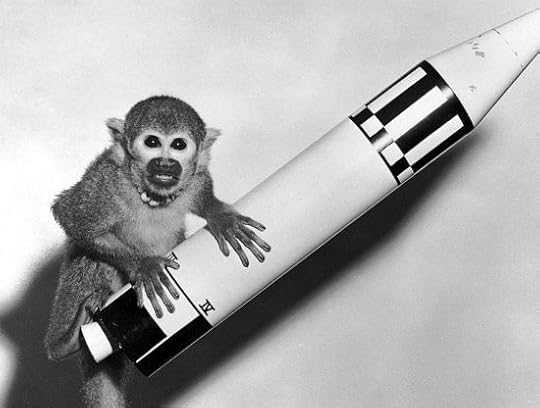
Astronaut and mission commander Neil A. Armstrong, in his Apollo 11 mission, was the first human to walk on the moon’s surface on July 20, 1969, along with lunar module pilot, Buzz Aldrin. But did you know that a rhesus monkey named Albert II was the first mammal to come before the men, launching successfully into space on June 14, 1949? Albert reached a distance of 83 miles.
For decades now the Russian and American aeronautics and space administrations have worked with rats, mice, fruit flies, pigs, and dogs to find answers to important researches for neuroscience, immunology and disease, musculoskeletal, cardiovascular, and sensory motor studies. Animals have taken part in the advancement of space and biological study years before humans have.
In fact, a good thirty-two monkeys have already entered space. They range from chimpanzees, squirrel monkeys, to macaques. In the 1950s, as the United States worked with monkeys, the Soviet Union placed their trust in dozens of our friendly, four-pawed canines. The first space dog was named Laika. Laika orbited earth on board Sputnik 2, a small satellite, on November 3, 1957. Sadly, Laika died in the flight due to stress and heat. Soviet Sputnik 5 (August 19, 1960), however, was successfully able to return home dogs Belka and Strelka alongside a gray rabbit, forty-two mice, two rats, and fruit flies.
More Russian space dogs such as Veterok and Ugolyok made their presence in space. The two orbited for twenty-two days before landing on earth on March 16, 1966. Veterok and Ugolyok still hold the record for longest space flight for dogs.
Animals were only supposed to be substitutes to test the suitability of environment in space for human habitat, but when proven their biological systems could withstand space environment, humans followed. In fact, even the French launched the first and only cat Félicette to space. She survived, having reached an altitude of 100 miles with electrodes implanted in her skin.
By the year 1968, as aeronautic technology continued to advance, the Soviet Union launched Zond 5, a spacecraft filled with biological payload. It carried plants, seeds, bacteria, wine flies, mealworms, and two tortoises. Zond 5 is also recognized as the first spacecraft to circle the moon. When astronauts began landing on the moon by 1969, more biological payloads were carried on board. They included spiders, turtles, rabbits, fishes, jellyfish, algae, and amoebae.
There have been many protests to animal testing, but unfortunately, experiments continue to be conducted, which involve stress and pain for these creatures. Radiation exposure, bone fracture studies, partial gravity/hypergravity studies are some common experiments done on space animals . In the year 2004, a NASA-sponsored report concluded with a statement on animal research, stating it is “an integral tool for understanding and ameliorating the known and yet-to-be-discovered impacts of spaceflight upon the human body.” Moving forward to the future, hopefully harm-free experiments will render both animals and humans more beneficial to various areas for research.
References:
Dohrer, Elizabeth. “Laika the Dog & the First Animals in Space.” Space.com. September 25, 2012 (accessed January 10, 2017). http://www.space.com/17764-laika-first-animals-in-space.html.
”Space Research.” Neavs.org. Accessed January 10, 2017. http://www.neavs.org/research/space.
The post Animals in Space Research appeared first on Picky The Marvelous Chicken.