
The Many Paths to Transition
“What’s your transition plan?” has got to be the most common question that gets asked in the post-scarcity activist groups I’m in, with the implied suspicion that similar to Boris and Nigel’s Brexit plan, it simply doesn’t exist. Of course there are glaring differences between Brexit and giving up money (Mexit?), the most obvious being that there’s no referendum scheduled on it in the near future. Nevertheless, the transition plan, or more accurately, several potential transition plans to a post-scarcity society have already been set in motion. It’s just sometimes hard to see them as such, since it’s impossible to lay out these plans in full, owing to too many unpredictable variables. The plans are mostly guesswork, taking the first small steps through the darkness.
People in post-scarcity movements tend to fall broadly in two categories: a) those who believe it will happen through gradual changes b) those who believe something major will change rapidly once critical mass is reached. You can further divide into two more groups: a) working for change within the existing system (RBE-minded political parties and lobby groups) b) building a new society alongside the old one to make it obsolete (Buckminster “Bucky” Fuller, The Venus Project, eco-communities). Most of the time, these different groups go along doing their thing, but sometimes they clash in heated arguments, even blaming the other groups of either not doing enough or hindering progress. Maybe it’s time to look deeper into the logic behind each viewpoint to understand each other’s train of thought a bit better.
The Gradualists
The main idea here is that society has a lot of inertia and people change slowly, sometimes requiring several generations. For example being gay was considered wrong through most of society for a long time. Only recently did it become accepted and appreciated in progressive countries. Yet the work here is not complete: in many nations it’s still dangerous to be gay, and even where it’s not, there’s often more subtle discrimination happening. But the overall mindset is moving in the right direction, and hopefully one day this will be a non-issue everywhere.
Likewise, people have hopes high for gradual adoption of renewable energies and advances in electric motors and batteries.
The problem many people see here is that we don’t have much time to solve environmental issues. There’s the danger of resting on the laurels after small victories. Also, some changes are difficult to make if you’re the only one doing so – you often need large groups to agree to do the right thing together.
The Paradigm Shifters
This is what many groups are aiming for by running education campaigns to show that we’ve already got all the resources we need to provide a good standard of living for every person on this planet. The hope is that once enough people know this, and get the dialogue started on how to change it, we’ll reach a tipping point and can start working together to sort out this mess.
Cons: until the critical mass is reached, nothing changes in the physical world. So in a way, both gradual change and paradigm shift require time. The difference lies in these questions: if things improve by a little bit, do people stop their activism? Do some people even care at all until things get really bad? Will people be able to continue activism if things get really bad and they’re more worried about basic survival? Will people be able to cope with a sudden revolutionary change? Which route is quicker and which route has fewer casualties? I don’t think anyone can prove it either way, so we may see these two mindsets continue to clash. All I can suggest is for the gradualists to keep pushing for little improvements and for the paradigm shifters to keep sharing the big picture truth one person at a time, while appreciating the work the other camp is doing. Often by helping one cause, you’re helping the other anyway.
The Politicians
A topic of much contention these days is whether to engage with the existing political structure or ignore it. Money, connections, PR and control of mass media affect and corrupt all elections so much so why even bother? Many groups argue that it’s worth trying anyway – to get the message out there, to push for gradual changes, to offer a protest vote (and gauge the public’s interest in alternative models), and possibly once the critical mass is reached, to offer a peaceful way to transition within the existing structures. One factor that speaks in favour of engaging with politics is that many ideas that were previously not talked about have now become more mainstream, such as the fact that private banks create money as debt. While Bernie Sanders didn’t become the Democratic Party candidate, he got a lot of airtime and support.
Of course, candidates straying too far from status quo threaten the establishment and thus get subjected to a whole host of character assassinating smear campaigns. Politics is nasty and it’s understandable that many in the activist circles want nothing to do with it.
The Buckyists
Whether within or without cities, alternative systems of resource access have been popping up. From community energy, food shares and Freecycle to off-the-grid communities, people have taken matters to their own hands to provide for themselves and their community and starve the beast just that little bit. Third Industrial Revolution enthusiasts believe that the advance and cheapening of technology will make producer-consumers of everyone and capitalism will slowly fade away.
Critics here will point out that land and other means of production are still expensive, especially in cities, and though people in well-off countries can pool money and acquire their own, it’ll still be inaccessible for many many. Until a shift in either money creation and distribution, or reforms in ownership occur, this will not be an option to everyone. Not to mention that rural communities are lacking some of the comforts city life provides, so it’s not always ideal.
Clashes do occur on this spectrum as well, but there really isn’t much reason for it. Buckyists can ignore politics and go on with their business. Reformists can ignore Buckyists because they’re a small minority and focus on the low hanging fruit who still have faith in politics, just not the mainstream candidates.
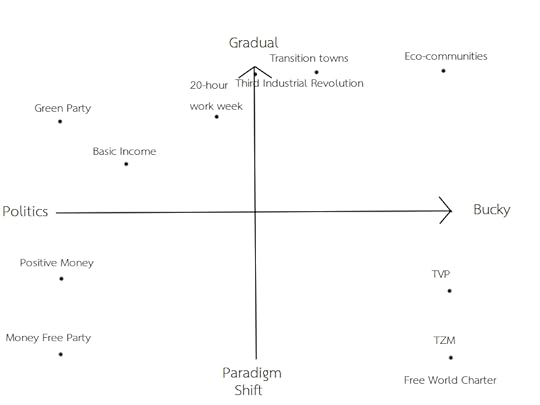
Ultimately, it’s unlikely that any of these avenues will be the One True Transition Plan. Each one has its shortcomings which often can be mitigated by work someone else is doing. So here’s a callout to celebrate each other’s efforts rather than trying to convince someone to switch to your team. Feel free to tell them what you’ve been doing. Feel free to ask them how they plan to overcome obstacle X in their plan. But let’s keep the debate civil, even if you’re dead certain their path leads to a dead end (maybe they know it already but haven’t come across a better plan). Ask, listen, share, but don’t belittle, patronise or boast. As long as we all have the end goal of post-scarcity in mind, every step is a step forward. A step towards greater understanding, better infrastructure and more clarity on what’s the best direction to go next, to finally reach the world we all desire.


