
Your Novel Check-Up (Part 2)
Welcome back to the novel doctor’s office! This week we’re taking a look at storytelling and the three act structure. While there are exceptions to every rule, following the three act structure can ensure your novel has a strong story arc and a satisfying ending.
Ready? Here we go.
Inciting Incident: What jump-starts your story and takes your character out of their normal into their not-normal? Terrorists attack a key government building. Harry receives his letter to Hogwarts/visit from Hagrid. Gandalf shows up on Bilbo’s doorstep.

Usually the inciting incident happens within the first chapter of the book and forces the character to choose an action that diverts from their present course.
Turning Point 1: What is your first turning point? This always involves a choice by your main character and is usually close to the inciting incident. This is the protagonist’s first chance to turn back and must involve an actual decision moment.
For example, in J.K. Rowling’s Harry Potter series, when Hagrid visits and tells Harry who that he’s a wizard, Harry must choose whether to stay with his (albeit uncomfortable) aunt’s family (the “normal”) or go with Hagrid to the wizarding school, the first step in embracing his greater destiny.
Turning Point 2: The plot has thickened thicker. Things have gotten more difficult.The protagonist is tempted to give up/turn back, to the point the audience would understand if they did. Again, this has to involve another actual decision moment. In the first Lord of the Rings movie, The Fellowship of the Ring, this is when Frodo decides to go off on his own with the ring to keep it out of temptation of his friends.
The Point of No Return: This is the last chance for our hero to bail.
The reader is emotionally invested and wants your hero/heroine to continue on their journey, yet feels the angst and difficulty of them choosing to do so.
Often this point is brought about by the loss of a mentor or friend, or a serious setback. Again, using the Lord of the Rings movies as an example, the point of no return is when Frodo and Sam actually decide to enter into Mordor, knowing they probably will not be able to return home. This is the point of complete commitment, despite personal cost, and usually should occur 2/3 to 3/4 through your manuscript.
Climax: Everything in your book should build to this moment of ultimate struggle for your main character to achieve his/her goal. Frodo climbs up the fiery slopes of Mt. Doom to throw the Ring of Sauron into the volcano. Harry duels Voldemort in the halls of Hogwarts. This is the point where “the quest stands upon the edge of a knife. Stray but a little and it will fail, to the ruin of all.” (Sorry, couldn’t resist. But it’s true).
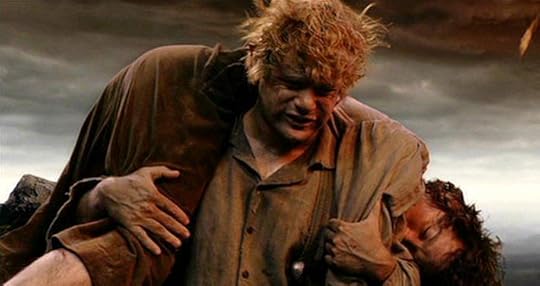
Conclusion/Resolution: Your ending may or may not be happy, depending on the book, but it should satisfy the story and character arc. Questions raised by the inciting incident should be resolved, even if new questions arise as a result of those answers (as is usually the case in a series).
Your protagonist needs to achieve the goal set out at the beginning of the story, even if they achieve it in an unexpected way. For example, Gollum stealing the ring and falling into Mt. Doom (Lord of the Rings); the leader of the white football players and the leader of the black football players becoming best friends and overcoming the racial divide through unexpected tragedy (Remember the Titans).
Your ending should include clear character growth and achievement that answers the reader’s unspoken question: “Was this worth my time?”
You want the answer to be a resounding, “Yes!”
So, there you have it. The skeleton of a novel, the building blocks of a great story. How did your novel do? Is it missing an arm or leg? Or is it pretty solid?
Don’t be discouraged if you discover you still have some more work to do! Just keep on writing and one day you’ll find that, just like our heroes, you’ve accomplished more than you ever imagined.
Where are you at with your novel? How are you going to improve it?



