One Too Many
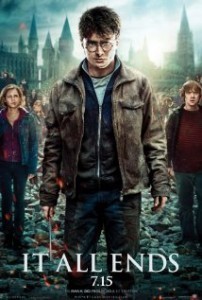
Harry Potter and the Deathly Hallows, part two (Warner Bros, 2011)
Harry Potter and the Deathly Hallows, or number 7, part two, is a film with many endings. I'm sure it has at least seven if you count all the signs of finish: a death and resurrection, villains vanquished one by one, a battle won against all odds, the reappearance of favorite characters from early in the series, many well-arranged group shots, and plenty of cameras panning out and away from Hogwarts, our home away from home this past decade. And then there's the epilogue "19 years later"….
In short, the poster that claims "it all ends," and the media waxing nostalgic, may be premature. The merchandising machine lives on. If I sound impatient it is because I wanted to enjoy this film, as I have enjoyed several in this series, including Deathly Hallows part one– but I found it impossible. The cutting of the last book into two films leaves this piece almost incomprehensible — a rush of action sequences with few connecting emotions. The direction, again by the usually adept David Yates, feels aimless — as if all decisions were made by a committee of marketing managers who needed the camera to pan past Cho Chang one more time so viewers remember where Harry began. Scenes that should be suspenseful, like characters saved at the last second, just seem repetitive. And there are too few moments of pure glee or mischief–like when Professor McGonagall (Maggie Smith) giggles"I've always wanted to use that spell!" at an otherwise dark moment.
The sheer overflow of fun that was one of the charming features of the books and earlier films feels forced: instead of the exuberant variety we're used to we get the "gemino" spell which multiplies everything one touches into more of the same. Many of the most climactic scenes do indeed seem to be pastiches of bits from Lord of the Rings, Indiana Jones, and other former blockbusters. In the scene below in Gringott's bank Harry enters a dark cave and must distinguish the "authentic" object from the copies, just as Indiana Jones must do in The Last Crusade, part of a series that was itself a parody of adventure films. The scene both expresses and contains our ambivalence about overbundance and uniqueness: if this is art, shouldn't it be special and unique? but if it is to make money, and be loved my millions, shouldn't it be mass produced? Voldemort, who has divided his soul into pieces, shows how unsustainable that paradox is.
[There is a video that cannot be displayed in this feed. Visit the blog entry to see the video.]
Overall, the film is more predictable than terrible, but that was disappointing. By its end it is broadcasting shamelessly: the screenplay requires characters to say that the dead "are still here," thumping their hearts, not once, but twice. As Ron says above in one of the movie's many self-referential bits, "you're seriously going to try that one again, are you?" It asks Harry to have faith in love, and its characters to have faith in Harry, but the film has little faith in its viewers.