What's the Deal With Prologues?
I'm an Indie Author. What does that mean? It means that I write because I enjoy writing, and then I share it with the world through self-publishing. Have I tried submitting my work to an actual publisher? Not even once. Have I considered doing so? Maybe in the future, but not so far at this point.
After finishing my first two books (one story, two perspectives), I decided to get some feedback before delving into my next writing project. First, I wanted to know what worked well and what I could have improved on in my finished books.
The feedback I received was mostly positive, but I was lucky to also receive some constructive criticism on what I could work on to do better the next time. Then there was some, shall we say, less-than-constructive feedback, that still ended up being helpful in a way. It was ultimately what led me to invest in the beta-reading and editing services. This was the feedback that centered more on the personal preferences of the reader that really had nothing to do with my writing.
Now that I've started on my next book, I've done a huge amount of research on how to make it really good. I've signed up for a writing workshop led by the world's bestselling author, James Patterson. I've purchased various books, such as Structuring Your Novel by K.M. Weiland, and read numerous articles on fiction writing, like 25 Things To Know About Writing the First Chapter of Your Novel.
I've seen some pretty solid advice through various sources, but there is one thing I just can't quite figure out. That is, WHY are there so many people in the writing industry, whether it be publishers, agents, editors, or whoever, who are completely and unwaveringly against Prologues? So much so that, many people are said to not ever read a prologue of a book. They just skip it all together.
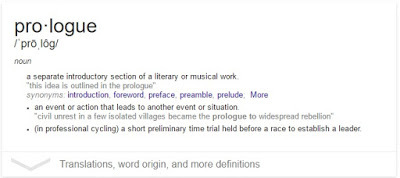
Many articles I see about this are chock full of individual opinions, and few have given any really credible and persuasive information. In fact, many of them are contradictory from one to the other on why these are a bad idea versus when it is okay to use a prologue.
For example: Why I Hate Prologues - written by Natalie LakosilI'll at least give it to this person. They explain why they personally hate prologues, not why everyone else should hate prologues... at until you get past the title.
In this article, the reasons NOT to use a prologue include:Background informationFrom a POV other than the main characterForeshadowing (seriously?)A false startAn attention grabber (again, seriously?)And then they go on to list what a prologue SHOULD be:An introduction - which means the story will CONTINUE FROM THAT POINT, not 30 years laterA preliminary act that sets the ACTION of the novel into play - NOT the action itself displaced into the first three pagesA method to call attention to an important THEME
The Seven Deadly Sins of Prologues - written by Kristen LambThis article, in my opinion, has a lot more merit than the previous one above, because it qualifies what it means, such as "not having the sole purpose of...." instead of just saying not having those things at all.
In this article, what SHOULD a prologue be includes:
To resolve a time gap with info critical to the story (hello, contradiction)A critial element in the backstory is relevant to the plot. (another contradiction!)The reasons NOT to use a prologue include:A vehicle for a massive info dumpHas nothing to do with the main storyHaving the sole purpose to "hook" the readerBeing overly longWritten in a totally different style and voice that is never tied back into the main storyHaving the sole purpose of setting the moodI'd probably agree with most, if not all, of these in this particular article.
The Pleasures and Perils of Prologues - written by Bharti KirchnerThis article posted by The Writer Magazine defines what a prologue is and what it should not .
What the prologue SHOULD be:
A preliminary act (seeing a pattern yet?)A teaser to usher the reader into the storyGenerally happening in a different time period and place (that's two out of three)Sets the stage for the main actions to take placeIt tantalizesForeshadow an event (another contradiction)Establish the mood (contradiction city over here)The prologue should NOT: Spell out too much. It should just whet the reader's appetite.Do you read book prologues? Why or why not?What, in your opinion, should a prologue be and not be?
After finishing my first two books (one story, two perspectives), I decided to get some feedback before delving into my next writing project. First, I wanted to know what worked well and what I could have improved on in my finished books.
The feedback I received was mostly positive, but I was lucky to also receive some constructive criticism on what I could work on to do better the next time. Then there was some, shall we say, less-than-constructive feedback, that still ended up being helpful in a way. It was ultimately what led me to invest in the beta-reading and editing services. This was the feedback that centered more on the personal preferences of the reader that really had nothing to do with my writing.
Now that I've started on my next book, I've done a huge amount of research on how to make it really good. I've signed up for a writing workshop led by the world's bestselling author, James Patterson. I've purchased various books, such as Structuring Your Novel by K.M. Weiland, and read numerous articles on fiction writing, like 25 Things To Know About Writing the First Chapter of Your Novel.
I've seen some pretty solid advice through various sources, but there is one thing I just can't quite figure out. That is, WHY are there so many people in the writing industry, whether it be publishers, agents, editors, or whoever, who are completely and unwaveringly against Prologues? So much so that, many people are said to not ever read a prologue of a book. They just skip it all together.

Many articles I see about this are chock full of individual opinions, and few have given any really credible and persuasive information. In fact, many of them are contradictory from one to the other on why these are a bad idea versus when it is okay to use a prologue.
For example: Why I Hate Prologues - written by Natalie LakosilI'll at least give it to this person. They explain why they personally hate prologues, not why everyone else should hate prologues... at until you get past the title.
In this article, the reasons NOT to use a prologue include:Background informationFrom a POV other than the main characterForeshadowing (seriously?)A false startAn attention grabber (again, seriously?)And then they go on to list what a prologue SHOULD be:An introduction - which means the story will CONTINUE FROM THAT POINT, not 30 years laterA preliminary act that sets the ACTION of the novel into play - NOT the action itself displaced into the first three pagesA method to call attention to an important THEME
The Seven Deadly Sins of Prologues - written by Kristen LambThis article, in my opinion, has a lot more merit than the previous one above, because it qualifies what it means, such as "not having the sole purpose of...." instead of just saying not having those things at all.
In this article, what SHOULD a prologue be includes:
To resolve a time gap with info critical to the story (hello, contradiction)A critial element in the backstory is relevant to the plot. (another contradiction!)The reasons NOT to use a prologue include:A vehicle for a massive info dumpHas nothing to do with the main storyHaving the sole purpose to "hook" the readerBeing overly longWritten in a totally different style and voice that is never tied back into the main storyHaving the sole purpose of setting the moodI'd probably agree with most, if not all, of these in this particular article.
The Pleasures and Perils of Prologues - written by Bharti KirchnerThis article posted by The Writer Magazine defines what a prologue is and what it should not .
What the prologue SHOULD be:
A preliminary act (seeing a pattern yet?)A teaser to usher the reader into the storyGenerally happening in a different time period and place (that's two out of three)Sets the stage for the main actions to take placeIt tantalizesForeshadow an event (another contradiction)Establish the mood (contradiction city over here)The prologue should NOT: Spell out too much. It should just whet the reader's appetite.Do you read book prologues? Why or why not?What, in your opinion, should a prologue be and not be?


No comments have been added yet.