A Brief Sketch of Ghalib- Greatest Urdu Poet of All Times
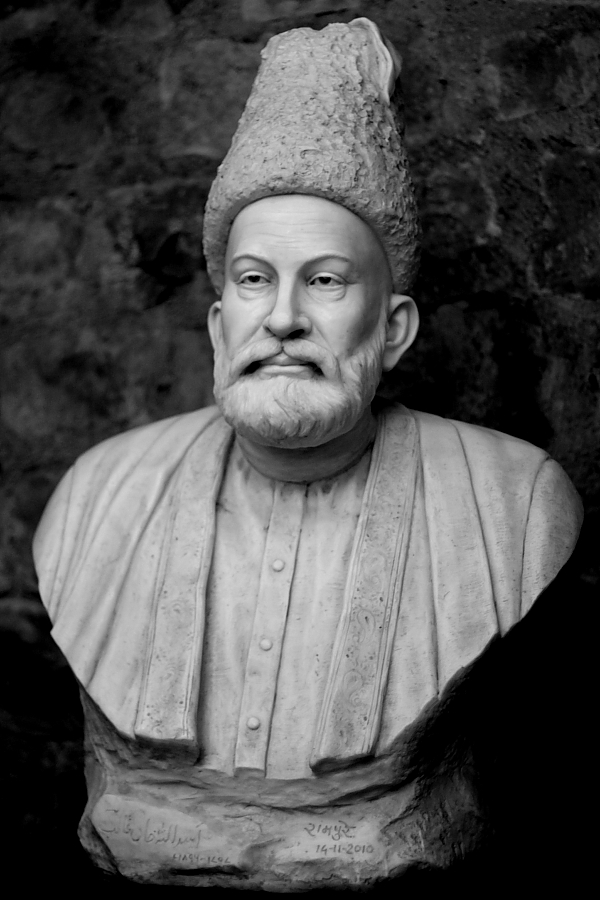 I am not a history scholar, not even an Urdu scholar. I have been running this blog writing on all things which come to my mind. Couple of months back, it occurred to me that while in a world of Whatsapp and Twitter, Urdu poetry has suddenly become popular, it still suffers with little attention. The tragedy of any language is to link it to a religious faith and elevate it to such a level, where it becomes obsolete. Every language is like a lovely butterfly, which needs to play, dance, float and fly in an open garden. Once it gets appropriated by elite, it loses its gait, its charm and eventually its life. This happened to Sanskrit, to Persian and now Urdu faces the same challenge.
 With this in my mind, I created a fresh page on my blog, dedicated to the work of greatest poet of Urdu, Ghalib (Ghalib himself disagreed when he wrote, referring to another stalwart of his times, Meer,
रेख़ते के तुम्हीं नहीं हो उस्ताद ग़ालिब कहते हैं अगले ज़माने में कोई मीर भी था।
You are not the only master of poetry Ghalib,Some say there was much better Meer, in lost days.)
and try my humble attempts at translating and interpreting it. One can say, it is too audacious to be taken seriously; but then, that is the pleasure of leisure writing. I couldn't care much. Two posts went in. Strange reverts came, especially from overseas friends who although now share different origin, came from the same larger Hindustaniyat. A lovely young friend, quite creative in art and literature, quite active in cultural roots of Bangladesh, where she hails from asked me who was the poet for those lines. I replied 'Ghalib' and expected nothing beyond would be needed, and was surprised at the next question, "Is he a famous poet?"
While the root of this question could be in the national boundaries re-drawn between India, Pakistan and Bangladesh when British left India, I wanted to do my bit. We can not afford our heritage like Ghalib to fade away in the oblivion. Noted historian Rana Safvi (Her Blog: On Indian History and Culture)advised me to read Biography of Ghalib , by Pavan K. Verma. I dutifully did and I am forever indebted to her for directing me there.
I read Ghalib first as engineering student, like all young people used to in those days of early 90s. I read many others, mostly writing in diary the couplets which stuck in my mind. While Sahir also stayed with me for long time, but Sahir and other poets were like the loving worshiper of Urdu, Ghalib was like one of the Gods of Urdu poetry. The sense of being ancient, the mysticism of poetry and the man himself and his life, gave him this stature to my young mind.
Ghalib, Mirza Asadullah Beg Khan was born in 27th of December, 1797 in Agra. Most genius minds are plagued with there own insecurities and uncertainties of their own talent. Ghalib was very unlike them. He was at all times, very much aware of his own station in life. Although most of his life, he spent chasing the government, earlier, Mughals and later, the British for what he believed was his due, mostly on account his martial and aristocratic background, he was very much conscious of his literary and philosophical position.He presumed his position to hold in British view as respectable a position as it was to Mughal. However, Mughal sultanate was on a decline and the Emperor himself was a pensioner. In 1805, Akbar Shah II was committed a pension of INR 1500000 later, the company rescinded and reduced it to 1200000. The protests made by the Emperor to the court of director, did not yield any result.Same fate came to Ghalib's request for justice on distribution of his father's pension. A timid soul, unsure of his talent could not have written couplet like:
हैं और भी दुनिया में सुख़नवर बहुत अच्छे कहते हैं कि ग़ालिब का है अंदाज़-ए-बयाँ और|
(There are and will be great poets and writers,They say the way Ghalib converses is different from anyone else)
His father a soldier, came to India in search of employment during the time of Mughal King Shah Aalam II, which was also the time when British obtained the decree for collection of taxes, still ostensibly under the Empire of Mughals. He worked with Alwar King, Nawab of Lucknow and eventually in Agra. Ghalib, however, was orphaned at a young age of five. He started writing by the age of Eight (Eight, my kid is eight and cannot speak with clearer diction). His biographer Hali writes that someone called Kanhaiyyalal had preserved a Masnavi (collection of 6 books) he wrote at the age of Nine. He initially wrote in Persian considering Urdu to be beneath him. He was a prolific writer. Hali writes that Ghalib often composed while drinking in the evening. Sitting alone, his fingers playing with a long sash, he would tie a knot, whenever he finished a verse. In the morning, he would untie the knots, recall the verses and write them down.
He married at the age of 13 to Umrao Begam, a fanatically religious and pious woman, for a long life of companionship. Ghalib's sharp intellect stood at odds with religious dogmas and caused very interesting interaction between the husband and wife. Ghalib writes in a letter to friend Mirza Tufta, while expressing his inability to write introduction to a friend's collection of poem- "God has exempted me from Namaz and Roza (Fasting during Ramzaan), can't you exempt me of writing a Preface." He further says, I do observe Roza, but I keep Roza in good humour, a sip of water here, a smoke, a bite of bread (रोज़ा रखता हूँ लेकिन रोज़ा बहलाए रहता हूँ ). There is an interesting episode with Emperor Zafar, a pious, practicing Muslim. When asked by His Majesty if Ghalib was observing Roza, he responds, Not one Roza observed (which could be read as one not observer, or not one observed out of all the days). He further adds
जिस पास रोज़ा खोल के खाने को कुछ न हो रोज़ा अगर न खाये तो नाचार क्या करे।
(The poor who has nothing to eat for breaking the fast,what would he do rather eat through the fasting)
He writes to his friend, that the emperor could do nothing but laugh at his quick wit and plain-speak.
However, when he eventually moved to Delhi for prospects and recognition in Mughal courts, he began writing in Urdu. BahadurShah Zafar was Mughal Emperor and the anti-British revolt of 1857 was yet to happen. The emperor already had Zauq as his Ustaad or master of literature. His was the fate of any talented migrant. The talented poet had no one to vouch for him, no support system in the largely disinterested city, going through the period of political turmoil. The Emperor did not acknowledge Ghalib till 1850 when he was eventually offered the title of Nazmud-daula, Dabir ul-mulk, Nizam Zang (Star of the Realm, Scribe of the state, Marshal of war). Mughal Emperor was the ruler for namesake, while the real political power rested with the Governor General. Ghalib had an acute appreciation of his own aristocratic lineage and his own genius, which probably made him respond to disinterested Delhi with :
वोह हमसे पूछते हैं, ग़ालिब कौन है कोई हमें बतलाए के हम बतलाएँ क्या।
(The ask me who Ghalib is,Pray, someone tell me, what should I tell them)
Ghalib watched the politics and religious beliefs being put to test, and was one of the most progressive and liberal minds of his time. Writers and poets of those time were far ahead of our times in terms of challenging religious dictum, whether it be Ghalib's writing,
ईमाँ मुझे रोके है जो खींचे है मुझे कुफ़्र काबा मेरे पीछे है तो कलीसा मेरे आगे
(My faith holds me back, while evil tempts me forward,Ka'aba is behind me and the church is in front of me)
Or it be Momin, writing
उम्र गुज़री है तमाम इश्क़ ए बुतँ में मोमिन अब आखरी वक़्त में खाक़ मुसलमाँ होंगे।
(Spent all my life worshiping idols, MominWhat purpose would becoming a pious muslim in the end serve?)
These were brave, illuminated souls, free in spirit. Ghalib attacked the hypocrisy mercilessly when he wrote couplets like
कहाँ मयखाने का दरवाज़ा ग़ालिब और कहाँ वाइज़ पर इतना जानते हैं कल वो जाता था कि हम निकले।
(How could the learned be near the tavern, GhalibBut all I know, is that I saw him on the way in, as I departed)
Ghalib loved his drink, mostly french wine in the evening, which he always had in moderation, much to the annoyance of his wife. He was a man of joyous disposition and ready wit, but he was eaten away by the feeling that the world did not treat him with justice. His pension was withheld for long, and all his effort, to his king, the light of the world, and to the Governor General and the Queen, did nothing to increase his salary. While his biography mentions that he took it into stride as he wrote quasida (Panegyric) praising the Nawabs, Emperor and even the British while seeking the restoration of rightful pension, I would feel his conscience did not much agree with what he had to write. In fact, in his collection of Persian verses he wrote in the preface that he regretted that half his life was wasted in praising fools. I feel this reflected in
हुआ है शाह का नौकर फिरे है इतराता वगरना शहर में ग़ालिब की आबरू क्या है।
(He roams around parading is false pride, being King's servant,Else scant is Ghalib's respect among the citizens)
He is not sparing even with himself.
I would even stick out my neck to say that while the city offered all it could in those times to Ghalib, with the empire breathing its last and impending failed rebellion which would see the definitive collapse of old days of living, with grace, poetry and literature, he was for a long time disenchanted soul. Recognition came late, respect even later as he wrote,
हरेक बात पे कहते हो तुम कि तू क्या है तुम्ही कहो की ये अंदाज़-ए-गुफ़्तगू है।
(You ask on every question, who are you?Tell me what kind of graceful conversion this is.) Although in 1850, he reached the royal court and eventually, was after the death of Zauq, became the Ustaad of emperor Zafar and eventually of his son, as he was last left in the triumvirate of poetic genius of Momin, Zauq and Ghalib. Ghalib was 57 by then and was not given Zauq's title of Malikush-Shuara (Poet Laureate)
Ghalib was told many times that his writings were quite complex and he should dilute his writing to make the comprehension easier. He refused to do so famously writing,"
ना सताइश की तमन्ना ना सिले की परवाह गर नहीं हैं मेरे अशआर में मानी सही।
"Neither am I looking for praise, nor prize,If there isn't any meaning in my verse, let there not be."
सताइश- Praise; अशआर - Verses मानी - Meaning
An irreverent, audacious poet who refuses to bend down to commercial demands, but that is not all that is there to Ghalib. His deep intellectualism, Sufism in his verses, makes him some kind of visionary, a saint in his own right.
Probably Ghalib was also aware of his spiritual position and understanding, when he wrote,
ये मसाएले तसव्वुफ़ ये तेरा बयान ग़ालिब तुझे हम वली समझते जो ना बादा ख्वार होता
(These complex matters of spirituality, and your explanation Ghalib,We would have considered you a saint, had you not been a drunkard).
तसव्वुफ़- Spirituality; वली- Saint; बादा ख्वार- Alcohalic
He was not aloof and disinterested in getting his work read. He eventually started writing in Urdu publishing his first Urdu Diwan (Collection of poems) in 1821. Before publishing this, Ghalib did edit his work with a vengeance at the advise of Fazl-e-haq, discarding around two-third of all he had written. In a letter, he even confessed in his old age that most of his writing during the age of 15 to 25 was rubbish. He then torn off the Diwan, retaining merely 15 -20 of the verses. In 1828, he published a combined selection of Urdu and Persian verses- Gul-i-Rana. His Urdu Diwan was published in 1841 and sold out. It was republished in 1847. His collection of Persian verse was published in 1845.
I welcome you to the world of Ghalib. Ghalib, often terms as Eliot of East, is a source of inspiration not only to his readers, but also to other writers. In his life and reflections, I personally find him closer to Oscar Wilde. His life is an example of unyielding spirit of a true artist. Ghalib continuously had brushes with authority in spite of being court poet and a noble. He even ended up being jailed for three months, in spite of the intervention by the Emperor, His Majesty, The shadow of God. This was a rude shock to Ghalib, in terms of his own estimation of his worth as a noble and as a poet, and also in terms of the authority of the last Mughal (this was much before 1857, when the pretense was still alive). He always had friends among the British who were appreciative of his literary prowess, but it never helped him. As early as 1842, he was offered the job of Persian teacher in Delhi College. He went for the interview but declined as his interviewer, secretary to the Government of India, Thomson did not come out of his office to receive the poet. Ghalib took that as an affront and refused the job. This was customary in old ways of Delhi, and little did Ghalib know at that time that those days were just couple of decades away from end. Ghalib suffered much in long life, obscurity, ridicule and infamy, although he was for most of his long life a poet of masses. He probably referred to this aspect when he wrote
होगा कोई ऐसा भी कि ग़ालिब को ना जाने शायर तो वह अच्छा है पे बदनाम बहुत है।
(Would there be anyone who would not know Ghalib,He is a good poet, but is so very infamous.)
In his private life, he was always in debt, and lost all his kids. His brother died in the aftermath of 1857, when the whole city of Delhi was destroyed. Ghalib lived to see the city limping to life, but never regaining its earlier glory, before finally departing on 15th February 1869. He wrote his last Urdu verse in 1866 and last Persian ghazal in 1865. Before his death he saw the whole way of living destroyed, with Quila-e-Mualla (The red fort) converted to barracks, Mughal emperor exiled to Rangoon. The world of literature and poetry and art, gave way to marching soldiers on the streets of Delhi. He who counted Raja Bansidhar, Mushi Hargopal Tufta and such his friend and was so secular in his views, would have also seen with some sadness the changes as beef ban imposed by the Mughals being lifted by the British with little understanding of India, triggering first communal riot in modern times. His wife died exactly one year after him.
(I hope you will enjoy reading my posts on Ghalib's poetry. I am no scholar, but am trying and therefore will appreciate your feedback and corrections. In words, we rise).


No comments have been added yet.