"What's your book like?"
I see this often.
Writers, to entice readers, compare their new books to other stuff. Not that it's always a bad thing. A quick example would be along the lines of, "It's a spy story. Do you like Jason Bourne or James Bond? Well my book is in that genre. It's about the top spy in India's government. It has international espionage. Intense action sequences. Exotic locations. If you like James Bond, this is similar in genre, but goes in a different direction and offers something totally new and different."
The comparison is there, but we're also given a promise of something unique and original. Unfortunately online I see a lot of writers go in another direction. The example being, "It's like if that Indian dude from Heroes was James Bond." Or, "It's like Life of Pi grows up and becomes James Bond."
As much as we'd all love to see Pi Patel thwart Spectre, there's a lot lost in this description. Mostly creativity. My immediate reaction to this sort of advertising is that the author has very few original ideas and probably watches way too much TV.
It's just poor practice. At least for the author or publisher. You should be able to sell your story on its own merit without pilfering the credibility of more successful works.
And just to make the distinction, there's no problem here if somebody's who's read the book is trying to recommend it to friends. There's a thick line between an author trying to pitch knock off James Bond and some coworker on a James Bond kick.
My reason for pointing this out is that I recently saw an author do this in her own book title. The novel was called Blind Influence: It's Like Jason Bourne Meets The Good Wife In The West Wing.

Since I first saw this, the title has been reduced to Blind Influence . So the author learned her lesson. There's a hyperlink for anybody interested in reading her stuff. It very well could be a good book. And I can't completely fault her for attempting this tactic. The argument being that it's tough to get noticed. For indie writers like myself, it takes a lot of constant hammering for people to gain interest in our works. Every day I'm tweeting. I'm pushing my novel to friends and family on Facebook. I go to local bookstores asking if they'd like a few copies on their shelves. I post in several author and Kindle forums. I create new content for my blog. I send out promotional copies. I've purchased several online ads. I've sunk way more time and money into my book than I've seen returned. Marketing is a full time job, and like many authors, my degree is in creative writing. Not any form of business. Actually, that's about as far from a degree as I could get. In fact, having no degree at all would be closer than mine to a degree in business. So a lot of what I do trial and error. More often than not, the day ends with no new book sales and an ever growing feeling of failure. I certainly understand Linda Riesenberg Fisler's tactic of comparing her book to three popular things in one title. It makes perfect sense why so many authors attempt pushing their work this way. But the fault is still there. While it seems enticing to draw people in by using films and shows they might enjoy, doing so runs the massive risk of showing a lack of originality.
For a bit of comparison, this is the same technique grocery stores use to push their own versions of products that are never quite the original.
"Why drink Coca-Cola when you could have Walmart Brand Soda for a dollar less? It's practically the same thing."
Simply put, it feels cheap. It feels like a knock off. It doesn't even matter how it tastes. The last thing you want to say about your new novel is, "It's practically the same thing as something else."
You don't want to sell It's practically James Bond.
You want to sell This is bigger and better than James Bond.
You want to sell This kicks James Bond's ass!
You want to sell This book drags James Bond out in the middle of the woods, ties him to a tree, bludgeons him repeatedly with a baseball bat covered in razor blades, and then leaves him for dead before an inevitable bear attack.
...Okay. Well, maybe not THAT enthusiastic. But you get the idea. Don't settle for comparing your original work to something else. Elevate it above all that old news that's already out there.
So lesson over. But let's keep talking and build on it a bit. Like I said, I've been trying to push my latest novel, attempting all sorts of online and offline advertising. Typically with mixed levels of success. Building a brand takes time. You're going to have a lot of defeating days of hard work before your audience even starts to notice this awesome thing you've created. And I'm right there with you. Which of course means I have to take you down. You know, being the competition and all.
No really, I'm going to use my novel as an example for the rest of this blog to further illustrate the point. You're all safe. Or at least I want you to feel that way. But, seriously, sleep with one eye open.
Anyway, my novel is a fantasy story called Necromantica . Here's an ad I've been using online:
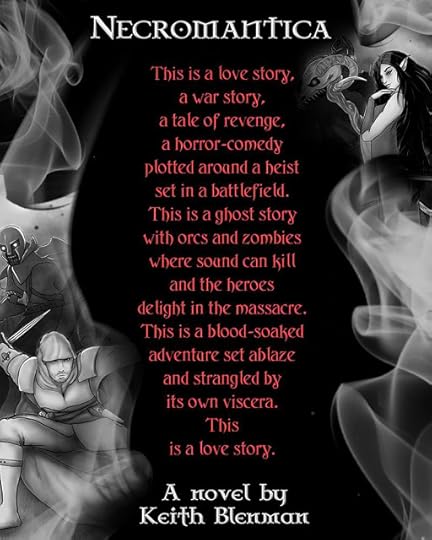
Feels original, doesn't it? Of course there is the worry is that some people will react negatively, thinking the ad makes the book feel like a garbled mess of far too many ideas. Or that it's too broad. And that's okay. Other ads on Facebook and Google are more image based, showing just the cover and one or lines of text. With this ad, the book looks like so many things, but what is it? Who is it appealing to? The most basic description of the plot is that Necromantica is about a thief and necromancer sneaking their way through a battle field during an orc invasion in attempt to steal a magic relic from an evil king, and everything goes horribly wrong. The advertisement says none of this. Its only goal is to create enough intrigue to get readers to click on the link and read a bit more. Whether that link is to this blog or the book description on Amazon. I'm not spoiling anything. I'm not inviting direct comparisons. I'm showing my hand while leaving as much mystique as possible. So And here's the book description and cover.
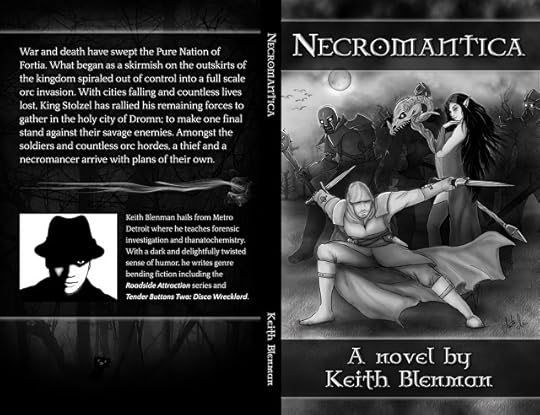
Before I go on, I should point out that all of the art in my ads were created by Christina Irwin. The link is to her email, and I can't recommend her enough. Her art is fantastic. Her rates are awesome. She's worked with multiple indie writers and definitely gets how to sell a book. Currently she's working on a book trailer for me and I'm pretty much counting the minutes until it's finished.
That said, now that you have a sense of the story, let's get back to our earlier topic of comparing stories to other things. It's an action packed fantasy novel featuring orcs, necromancy, thieves, an epic battle, and an evil king. So right away, I can draw comparisons to Lord of the Rings and Game of Thrones. Dungeons & Dragons fans would love it. But let's examine how that statement plays online:
This loses all intrigue. Originality is out the window. Any respectful fan of fantasy will roll their eyes at comparing LOTR and GOT. And not every lover of the genre is into D&D. Connoisseurs of fantasy, the audience I'm trying to cultivate, are going to be put off by that advertisement. Also, I've left absolutely no room for people not interested in any of those things. I'm never going to win over people not interested in fantasy, but I want to be appealing to people who enjoy fantasy without necessarily liking those three specific things. So instead, let's try working on statement that discusses the story, but keeping those comparisons in mind. Let's start as broad as possible. This won't be the final advertisement, but we still need an original foundation to work with.
WAAAAAAAY too broad. We've got the feel of the story. We want an ad that appeals to lovers of fantasy who enjoy action and adventure. But when we say it directly, it comes off as plain vanilla. So let's build a little bit. Let's work some plot into that.
Note the underlining and italicizing. For our purposes, I'm trying to show how the sentence breaks down. A few notes here. First, we have our main characters; two thieves. I haven't mentioned that one of them is a necromancer, and given that the book is titled Necromantica, it's probably a detail that demands a lot more attention. But we're still improving from comparing to other works and flat statements of being action and adventure. We have protagonists, our party of heroes often seen in fantasy stories. We have multiple antagonists, being the orcs and evil king. Describing the protagonists and thieves helps set a tone for the story. Also note we have thieves, orcs, and an evil king. There are no good guys here. Just different degrees of bad guys. We have the implication that because these characters are thieves, this story is some sort of caper. They are after something to get at this evil king. And we have a massive obstacle for them to overcome in the orc invasion.
Another thing done here is that we're allowing the person to read this statement to make their own attachments. "There's an evil king in this. Game of Thrones has that evil king, Joffrey. Man, I want that little shit to die. I hope these two thieves really stick it to him."
Okay, maybe not that enthusiastic, but you get the point.
"An orc invasion, huh? Lord of the Rings had an orc invasion. Bilbo was a burglar in The Hobbit, so are these thieves like him?"
But we're also not limiting ourselves to those specific franchises. We're allowing readers to make their own meaningful connections.
"Thieves, eh? I really like that movie where Sean Connery played a thief. And Sean Connery also played James Bond. Oh my god! I bet this book is exactly like James Bond. And maybe with some Good Wife stuff thrown in."
Well, probably not that comparison.
Also of note is that not once in that statement did we use the words action, adventure, or fantasy. But every single one of them was implied. We have orcs and an evil king, so this is definitely a fantasy novel. We have an invasion and thievery, so action and adventure are most definitely present. At a minimum, it's a safe bet that the two thieves aren't just sitting a room discussing the politics of the king as orcs wage war off in some countryside. So all of those adjectives are in the subtext, but we're using our limited advertising space to discuss the story itself. Is it successful? Well, we'll see how many people click on the links. Personally, I think there's still some stuff missing. Again, one of the thieves is a necromancer. She uses magic to command dead bodies to arise and become her zombie warriors. This is a major hook for the story, and a new twist on a familiar concept. Necromancers, particularly in LOTR, are consistently villains. We have one in the hero role. The fact that she's a strong woman being significantly more than a romantic interest in a fantasy adventure appeals to an entire audience I haven't even tapped into. So let's try something about her.
The question may arise, "Should I use one ad over another?"
No. Absolutely not. I encourage people to use multiple ads, blurbs, and taglines. You want to appeal to a specific audience, but not every ad is going to appeal to everyone in that audience. Every time you say something different, you're giving your potential readers a little taste of something new. Variety is your friend. Especially on social media websites like Twitter and Facebook, where redundancy gets really old, really fast. In one tweet discuss the overall plot. In another, say something about a character. In another, give a tagline. For the people who read multiple ads, the story becomes more familiar without getting old. Have you ever seen the same commercial on TV over and over again? And by the fourth time you're ready to burn down whatever advertising agency? The same rule applies. Always try to say something new, fresh, original. You're writing creatively, so be creative. And always be way more creative than comparing your book to other things.But if you have to do it, at least be more original than everyone else.
Yeah. My book is kinda like that. There's no sex in the story. But it's kind of like that.

Writers, to entice readers, compare their new books to other stuff. Not that it's always a bad thing. A quick example would be along the lines of, "It's a spy story. Do you like Jason Bourne or James Bond? Well my book is in that genre. It's about the top spy in India's government. It has international espionage. Intense action sequences. Exotic locations. If you like James Bond, this is similar in genre, but goes in a different direction and offers something totally new and different."
The comparison is there, but we're also given a promise of something unique and original. Unfortunately online I see a lot of writers go in another direction. The example being, "It's like if that Indian dude from Heroes was James Bond." Or, "It's like Life of Pi grows up and becomes James Bond."
As much as we'd all love to see Pi Patel thwart Spectre, there's a lot lost in this description. Mostly creativity. My immediate reaction to this sort of advertising is that the author has very few original ideas and probably watches way too much TV.
It's just poor practice. At least for the author or publisher. You should be able to sell your story on its own merit without pilfering the credibility of more successful works.
And just to make the distinction, there's no problem here if somebody's who's read the book is trying to recommend it to friends. There's a thick line between an author trying to pitch knock off James Bond and some coworker on a James Bond kick.
My reason for pointing this out is that I recently saw an author do this in her own book title. The novel was called Blind Influence: It's Like Jason Bourne Meets The Good Wife In The West Wing.
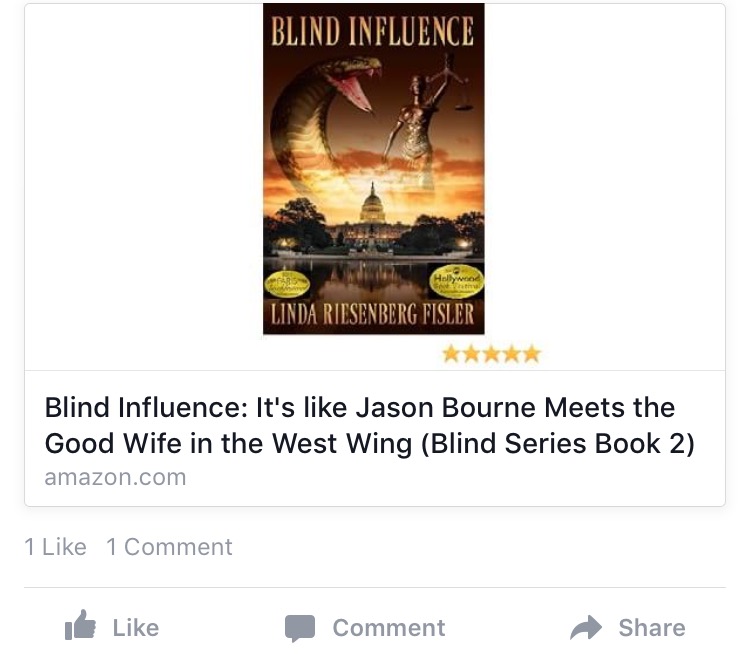
Since I first saw this, the title has been reduced to Blind Influence . So the author learned her lesson. There's a hyperlink for anybody interested in reading her stuff. It very well could be a good book. And I can't completely fault her for attempting this tactic. The argument being that it's tough to get noticed. For indie writers like myself, it takes a lot of constant hammering for people to gain interest in our works. Every day I'm tweeting. I'm pushing my novel to friends and family on Facebook. I go to local bookstores asking if they'd like a few copies on their shelves. I post in several author and Kindle forums. I create new content for my blog. I send out promotional copies. I've purchased several online ads. I've sunk way more time and money into my book than I've seen returned. Marketing is a full time job, and like many authors, my degree is in creative writing. Not any form of business. Actually, that's about as far from a degree as I could get. In fact, having no degree at all would be closer than mine to a degree in business. So a lot of what I do trial and error. More often than not, the day ends with no new book sales and an ever growing feeling of failure. I certainly understand Linda Riesenberg Fisler's tactic of comparing her book to three popular things in one title. It makes perfect sense why so many authors attempt pushing their work this way. But the fault is still there. While it seems enticing to draw people in by using films and shows they might enjoy, doing so runs the massive risk of showing a lack of originality.
For a bit of comparison, this is the same technique grocery stores use to push their own versions of products that are never quite the original.
"Why drink Coca-Cola when you could have Walmart Brand Soda for a dollar less? It's practically the same thing."
Simply put, it feels cheap. It feels like a knock off. It doesn't even matter how it tastes. The last thing you want to say about your new novel is, "It's practically the same thing as something else."
You don't want to sell It's practically James Bond.
You want to sell This is bigger and better than James Bond.
You want to sell This kicks James Bond's ass!
You want to sell This book drags James Bond out in the middle of the woods, ties him to a tree, bludgeons him repeatedly with a baseball bat covered in razor blades, and then leaves him for dead before an inevitable bear attack.
...Okay. Well, maybe not THAT enthusiastic. But you get the idea. Don't settle for comparing your original work to something else. Elevate it above all that old news that's already out there.
So lesson over. But let's keep talking and build on it a bit. Like I said, I've been trying to push my latest novel, attempting all sorts of online and offline advertising. Typically with mixed levels of success. Building a brand takes time. You're going to have a lot of defeating days of hard work before your audience even starts to notice this awesome thing you've created. And I'm right there with you. Which of course means I have to take you down. You know, being the competition and all.
No really, I'm going to use my novel as an example for the rest of this blog to further illustrate the point. You're all safe. Or at least I want you to feel that way. But, seriously, sleep with one eye open.
Anyway, my novel is a fantasy story called Necromantica . Here's an ad I've been using online:
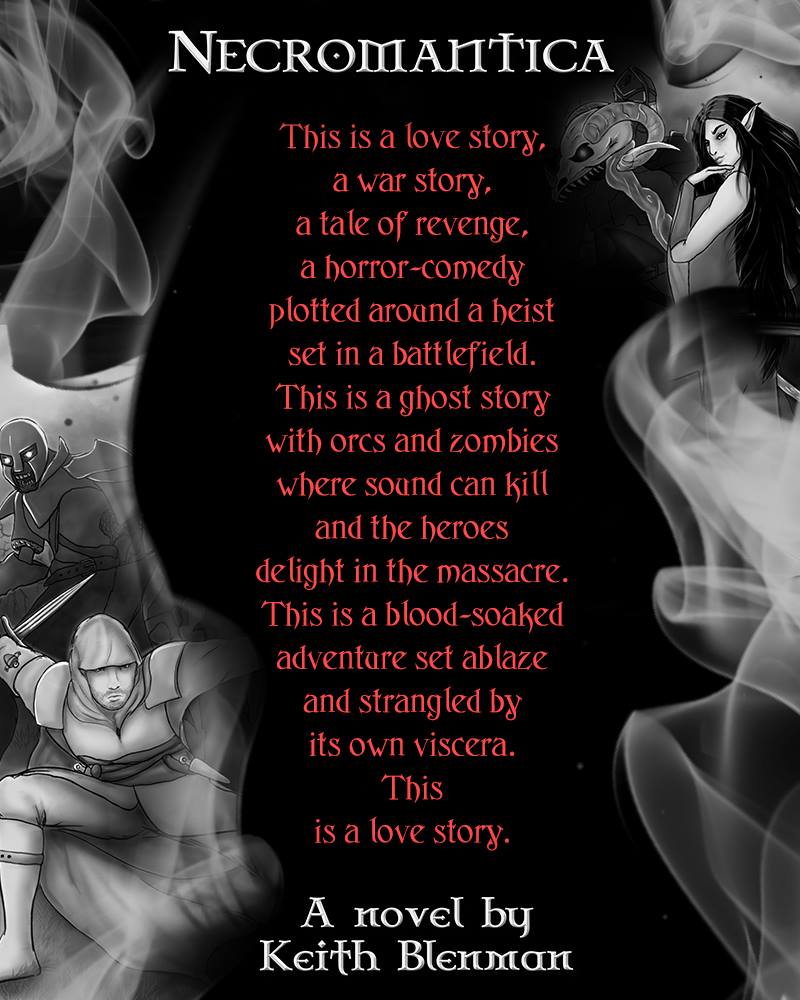
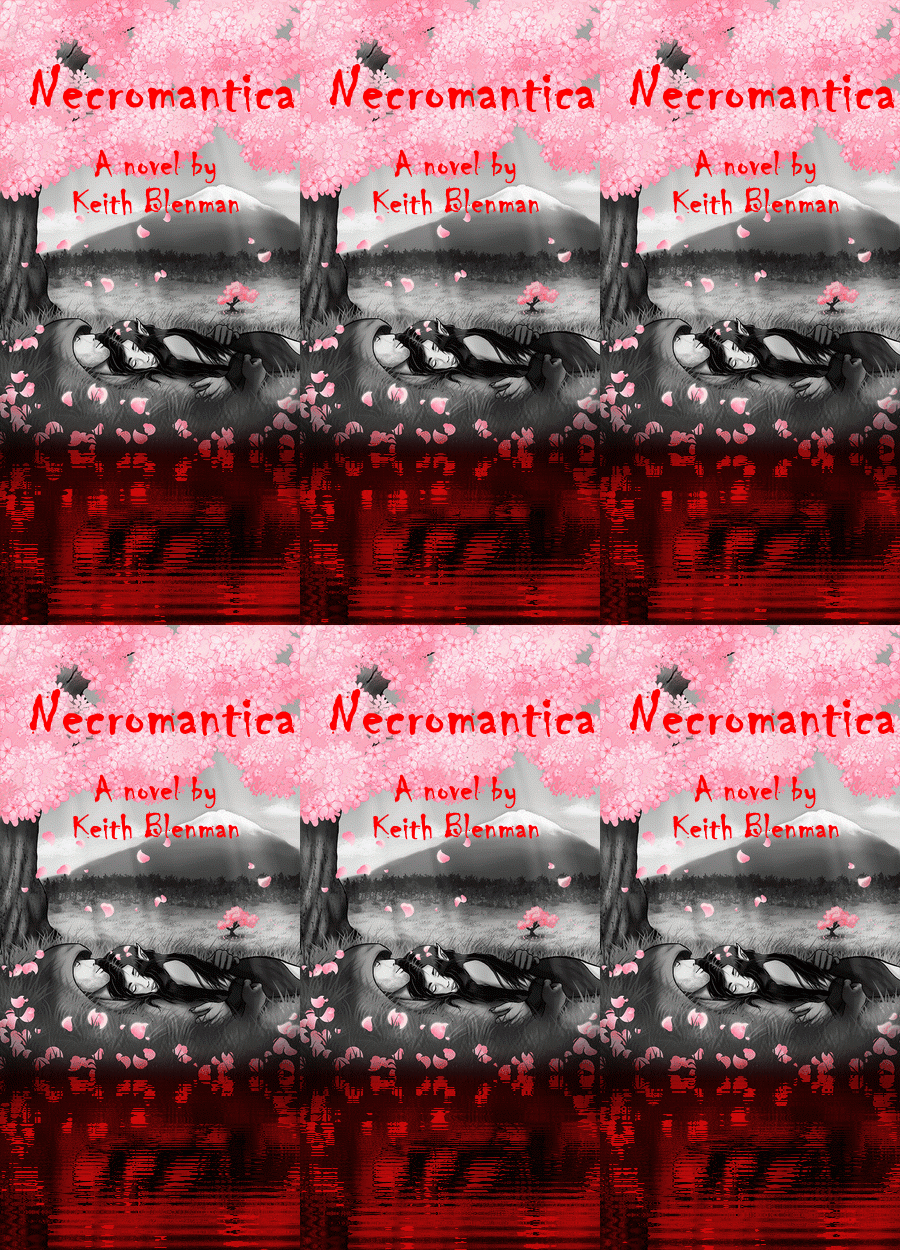
Feels original, doesn't it? Of course there is the worry is that some people will react negatively, thinking the ad makes the book feel like a garbled mess of far too many ideas. Or that it's too broad. And that's okay. Other ads on Facebook and Google are more image based, showing just the cover and one or lines of text. With this ad, the book looks like so many things, but what is it? Who is it appealing to? The most basic description of the plot is that Necromantica is about a thief and necromancer sneaking their way through a battle field during an orc invasion in attempt to steal a magic relic from an evil king, and everything goes horribly wrong. The advertisement says none of this. Its only goal is to create enough intrigue to get readers to click on the link and read a bit more. Whether that link is to this blog or the book description on Amazon. I'm not spoiling anything. I'm not inviting direct comparisons. I'm showing my hand while leaving as much mystique as possible. So And here's the book description and cover.
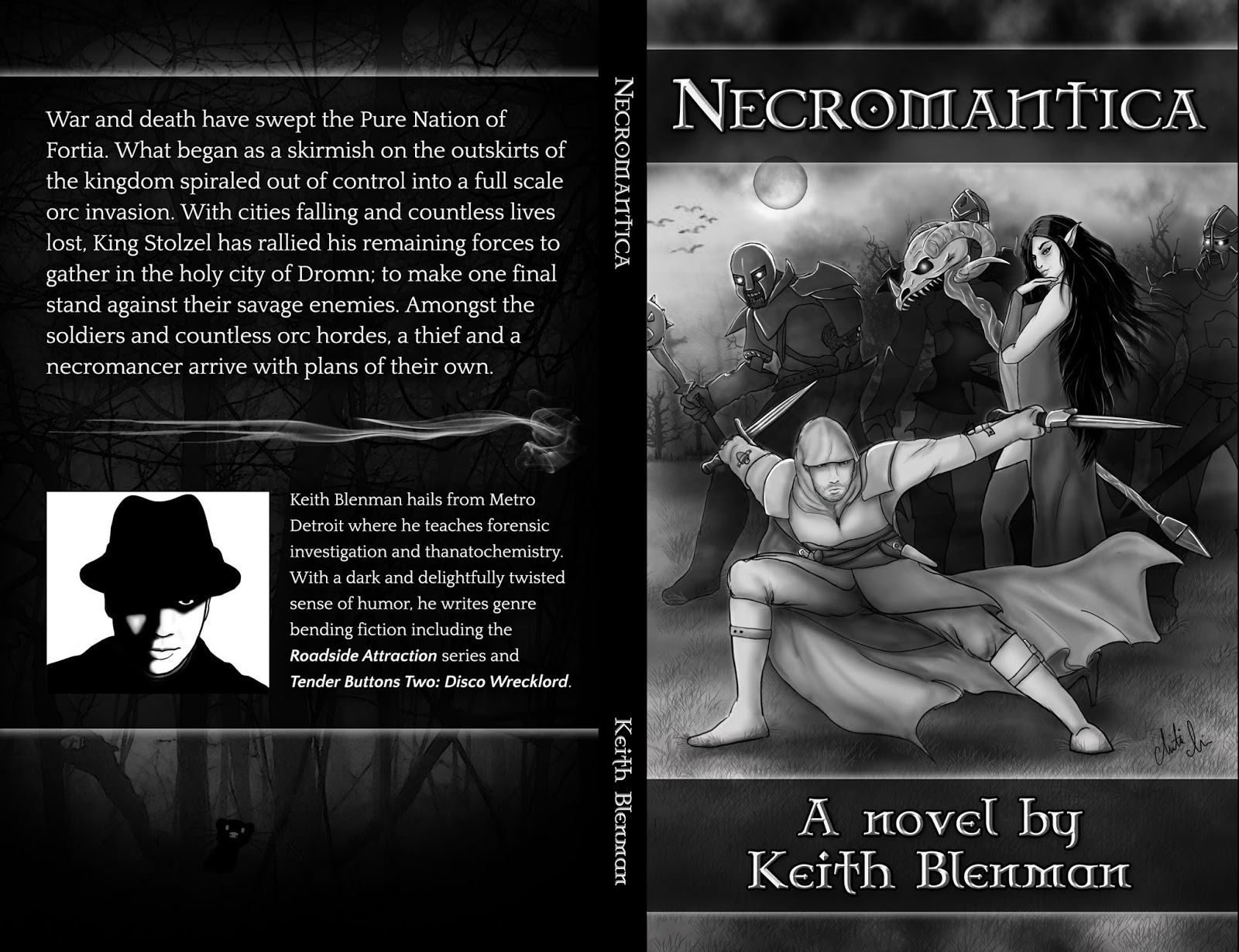
Before I go on, I should point out that all of the art in my ads were created by Christina Irwin. The link is to her email, and I can't recommend her enough. Her art is fantastic. Her rates are awesome. She's worked with multiple indie writers and definitely gets how to sell a book. Currently she's working on a book trailer for me and I'm pretty much counting the minutes until it's finished.
That said, now that you have a sense of the story, let's get back to our earlier topic of comparing stories to other things. It's an action packed fantasy novel featuring orcs, necromancy, thieves, an epic battle, and an evil king. So right away, I can draw comparisons to Lord of the Rings and Game of Thrones. Dungeons & Dragons fans would love it. But let's examine how that statement plays online:
Necromantica. It's like Lord of the Rings meets Game of Thrones! The perfect book for D&D fans.
This loses all intrigue. Originality is out the window. Any respectful fan of fantasy will roll their eyes at comparing LOTR and GOT. And not every lover of the genre is into D&D. Connoisseurs of fantasy, the audience I'm trying to cultivate, are going to be put off by that advertisement. Also, I've left absolutely no room for people not interested in any of those things. I'm never going to win over people not interested in fantasy, but I want to be appealing to people who enjoy fantasy without necessarily liking those three specific things. So instead, let's try working on statement that discusses the story, but keeping those comparisons in mind. Let's start as broad as possible. This won't be the final advertisement, but we still need an original foundation to work with.
Necromantica. An action packed fantasy adventure.
WAAAAAAAY too broad. We've got the feel of the story. We want an ad that appeals to lovers of fantasy who enjoy action and adventure. But when we say it directly, it comes off as plain vanilla. So let's build a little bit. Let's work some plot into that.
Necromantica, Two thieves battle through an orc invasion to face an evil king.
Note the underlining and italicizing. For our purposes, I'm trying to show how the sentence breaks down. A few notes here. First, we have our main characters; two thieves. I haven't mentioned that one of them is a necromancer, and given that the book is titled Necromantica, it's probably a detail that demands a lot more attention. But we're still improving from comparing to other works and flat statements of being action and adventure. We have protagonists, our party of heroes often seen in fantasy stories. We have multiple antagonists, being the orcs and evil king. Describing the protagonists and thieves helps set a tone for the story. Also note we have thieves, orcs, and an evil king. There are no good guys here. Just different degrees of bad guys. We have the implication that because these characters are thieves, this story is some sort of caper. They are after something to get at this evil king. And we have a massive obstacle for them to overcome in the orc invasion.
Another thing done here is that we're allowing the person to read this statement to make their own attachments. "There's an evil king in this. Game of Thrones has that evil king, Joffrey. Man, I want that little shit to die. I hope these two thieves really stick it to him."
Okay, maybe not that enthusiastic, but you get the point.
"An orc invasion, huh? Lord of the Rings had an orc invasion. Bilbo was a burglar in The Hobbit, so are these thieves like him?"
But we're also not limiting ourselves to those specific franchises. We're allowing readers to make their own meaningful connections.
"Thieves, eh? I really like that movie where Sean Connery played a thief. And Sean Connery also played James Bond. Oh my god! I bet this book is exactly like James Bond. And maybe with some Good Wife stuff thrown in."
Well, probably not that comparison.
Also of note is that not once in that statement did we use the words action, adventure, or fantasy. But every single one of them was implied. We have orcs and an evil king, so this is definitely a fantasy novel. We have an invasion and thievery, so action and adventure are most definitely present. At a minimum, it's a safe bet that the two thieves aren't just sitting a room discussing the politics of the king as orcs wage war off in some countryside. So all of those adjectives are in the subtext, but we're using our limited advertising space to discuss the story itself. Is it successful? Well, we'll see how many people click on the links. Personally, I think there's still some stuff missing. Again, one of the thieves is a necromancer. She uses magic to command dead bodies to arise and become her zombie warriors. This is a major hook for the story, and a new twist on a familiar concept. Necromancers, particularly in LOTR, are consistently villains. We have one in the hero role. The fact that she's a strong woman being significantly more than a romantic interest in a fantasy adventure appeals to an entire audience I haven't even tapped into. So let's try something about her.
Necromantica. A thief commands a zombie horde in her battle against an evil king during an orc invasion.The operative word being her. We've got one of our main characters, but a few things are off here. It feels cluttered. We're missing the other thief. And while it's fine to drop some details to highlight other features of the story, we want to convey as much as possible. But let's back up and simplify a little.
Necromantica. A thief commands a zombie horde in her battle against an evil king.I dropped the orcs in favor of focusing on the central conflict with the character. She's trying to get at the evil king. But in losing the orcs, I've also lost a major indication of the fantasy genre. For all we know in this sentence, the story is modern day and takes place in some Eastern European country. Since I'm trying to appeal to fantasy readers, I definitely want to make sure there's some indicator of it in my advertising. Now, those of you who really looked at the book cover and advertisement earlier may have noted that the woman has pointed ears. She's an elf. So let's substitute a detail and see how that looks.
Necromantica. An elf commands a zombie horde in her battle against an evil king.Did we lose the thief and caper aspects? Yes. But at the price of making our lead character perhaps a bit more intriguing. We have her central conflict and her motivation. We have fantasy. We have action and adventure. We have plenty of comparisons to LOTR and GOT for people to connect with.
The question may arise, "Should I use one ad over another?"
No. Absolutely not. I encourage people to use multiple ads, blurbs, and taglines. You want to appeal to a specific audience, but not every ad is going to appeal to everyone in that audience. Every time you say something different, you're giving your potential readers a little taste of something new. Variety is your friend. Especially on social media websites like Twitter and Facebook, where redundancy gets really old, really fast. In one tweet discuss the overall plot. In another, say something about a character. In another, give a tagline. For the people who read multiple ads, the story becomes more familiar without getting old. Have you ever seen the same commercial on TV over and over again? And by the fourth time you're ready to burn down whatever advertising agency? The same rule applies. Always try to say something new, fresh, original. You're writing creatively, so be creative. And always be way more creative than comparing your book to other things.But if you have to do it, at least be more original than everyone else.
Necromantica. It's like Lord of the Rings and Game of Thrones were making love all over The Walking Dead when Rambo III showed up and started blasting Romeo & Juliet all over everybody's faces while belting out moments from Inglourious Basterds and stabbing The Raid: Redemption into their hearts. Then The Great Escape and The Crow showed up and were like, "This blood orgy is straight out of Kill Bill meets Cabin In The Woods but with an Assassin's Creed twist!" Suddenly, Sin City and Mad Max: Fury Road joined in while asking, "Wait? What's Star Wars doing here?" Then Edge of Tomorrow birthed Evil Dead 2 and said, "I don't know, man. But it's fucking hot."
Yeah. My book is kinda like that. There's no sex in the story. But it's kind of like that.


No comments have been added yet.