
Collection
By Patty Wilber
Collection of what? Of horses of course.
But not collection like "I have a collection of bits in the tack room" or "I have a collection of horses in the barn."
Collection is when
-the horse has shortened his body by bringing his hind end up under himself.
-the horse feels light in the front (because he is driving with his hind end).
-the horse is soft and responsive to the bit.
I once went to a clinic with Leon Harrel, a cutting horse trainer (and clinician-duh!). He offered to ride our horses during lunch, which I thought was really amazing as it was a a three day clinic and he was working hard.
There was a woman there with a black Tennessee Walker cross. The horse was big. The horse was long. The horse looked like it's head was in a different state from its tail and only maybe controlled by the same brain.
Leon got on that horse, and in less than one minute the horse was shorter from nose to tail by about a foot, had his butt up under himself and went from looking like a relative of a camel to a animal that might actually have some athletic potential.
That was the most impressive display of "collecting" a horse (practically instantaneously) that I have ever seen!
Interestingly, I saw the same rider maybe 4 years later on a horse of a different color, and I'll be damned if the new horse didn't look exactly the same as the first horse–one long string bean with its head and tail in different time zones!
Penny was at a show this weekend and I entered her in western pleasure (a class where you walk, jog and lope around the arena and the judge picks the slowest horse there–no actually the judge picks the horse who is the most relaxed and shows the prettiest movement.)
Penny normally does well in this class, but I showed her in a snaffle bit, and what did she do? She leaned on the bit. This resulted in her butt failing to be up under her like it should be, so she was moving too fast because her weight fell onto her front end (forehand). Her movement felt ploddy instead of springy and light.
She was lacking collection.
Of course that makes it sound like a complete disaster, which is was not. It was a more subtle disaster, that this judge could see. She did not place well!
For Penny one solution is a different bit--one that she will not lean on but will instead "get off of" by tucking her head and lifting her front end. When she does this she feels more agile and her feet grace the ground instead of bumping down.
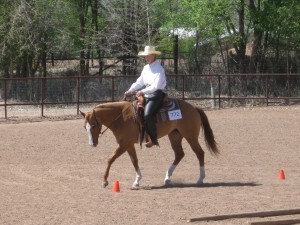
Penny's neck looks pretty relaxed ("soft") and flexible. She has her hind end under her enough to be able to turn easily and lightly around the cone.
Tracy naturally has excellent "self carriage". She almost always uses her butt and is up in the front. She did need to learn to hold her head down a bit more to be "in style" for the show ring, but wow what a spring loaded ride!
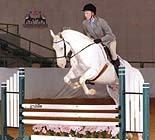
In this picture, Tracy was actually very soft in my hands, but I have her TOO collected. My hands should be up on her neck to allow her to stretch out over this jump and instead I have her bunched up. She is such a great athlete that she handled it fine!
T started off heavy in the front. It felt like he was hammering the ground. He wanted to hold his head with his nose sticking out. This left his big ol' butt in another county.
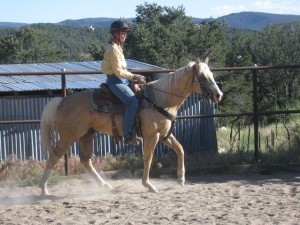
T is not paying real close attention. If I wanted him to change directions right now, it would not happen as his head was not in the game.
Collecting T in a lope (he is trotting in the next pic, but it gives the idea), was the hardest for him to learn. When he figured it out, he got slow and light and very maneuverable. And the one judge he showed under sure liked that!
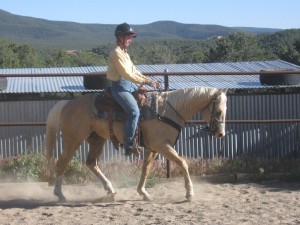
T is all "framed up" or "collected". His neck is soft, his nose is tucked, and he is using his hind end as his motor!
Teaching a horse to collect and then stay framed up is, for me, a fairly long process. The trickiest part to learn was that you can't really PULL a horse's head into place and have collection. Instead, you have to hold your hands steady and use your legs and body to PUSH the horse forward into the shape you want… and then convince him to hold that shape by himself!
Ask (correctly and not too much), get a response (and recognize it as a response), release (quickly–the release is what the horse recognizes as a reward so the release is really important). Repeat 10 million times…horse training does involve a whole lot of repetition and TIME.
But when the collection comes, you've got a horse that is amazing to ride!


