
The Swamp
When I was a little girl–reading novel after novel, watching movie after movie–I noticed one thing: men got to retreat from the hubbub of family life into their own special rooms, and that their time in this room was sacrosanct. They were not to be disturbed unless it was an emergency. This truth cut across time and class. I saw no difference between the way that Mr. Bennet in Pride and Prejudice retreated to his study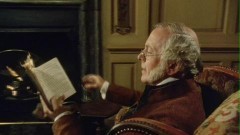
and the way that my father retreated to The Swamp, his garage/man cave/beer fridge/smoking area, the place where he has always gone to get away and think and process and fiddle with things. 
A writer friend of mine told me this story about his mother, who is an author of many novels and the mother of four children. She always wrote at a table that was situated in the middle of the room where he and his sisters played. Her writing sessions were often interrupted–fetching this or that, moderating this argument or that, fixing this meal or that–but the writing got done.
My mom didn't have a Swamp either. No physical space that was just hers. No room of her own. My mom read and sewed and cross stitched in the middle of the chaos that is Real Life. She learned how to disappear into her head, how to give herself some Swamp Time, while still being physically present.
From a very early age, I understood (without really understanding) that what I needed in life was lots and lots of Swamp Time. As a child, I ached for solitude. I wanted to be left alone so I could "spend time in my head," a kind of dissociative state that allowed me to blessedly not be me for short periods of time. I realize now that this dreamy activity was an early form of my writing practice, that I have always been a writer, even before I started writing things down.
But Swamp Time created a great deal of friction in my life. Sometimes, my retreat (whether it be a physical retreat to another room or a mental retreat to another world) made others wonder What's wrong? Did I say something to upset her? Why doesn't she want to play? Why does she have to set herself apart like that? Doesn't she like me? Why is she off in La-La Land when I'm sitting right here talking to her?
I came to understand (without really understanding, a kind of instinctual knowing) that women don't get swamps. Either they get called out of The Swamp upon entering, or they feel selfish about needing Swamp Time in the first place.
[I don't want to argue about this. Maybe you're a man who knows exactly what I'm talking about here. That's fine. I'm just saying this is what a very young Cathy Day intuited about the world she lived in, which was incredibly gender stratified.]
I want to start being more direct with my students about this kind of thing. I need to say: If you want to be a writer, you need to find and protect your Swamp Time. Know that life isn't going to just give you this time. You have to do all the work yourself—fiercely, rigidly. Stake your claim to your Swamp. Find the space–physical or mental space. Find the time, whether it's in big chunks or in small bits. You must be absolutely fearless and a more than a little selfish about this, which for some people (like me) is hard. 
Caveat: In his "Letter to a Young Writer," Richard Bausch says, "Train yourself to be able to work anywhere." Remember that writing is not an excuse to neglect the people in our lives who count on us. "It is an absurdity to put writing before the life you have to lead. I'm not talking about leisure. I'm talking about the responsibility you have to the people you love and who love you back. No arduousness in the craft or arts should ever occupy one second of the time you're supposed to be spending that way. It has never been a question of the one or the other and writers who say it is are lying to themselves or providing an excuse for bad behavior. They think of writing as a pretext for it. It has never been anything of the sort."
I also need to say to my students: You need to date and marry someone who understands this notion of Swamp Time.
Writer-teacher Julianna Baggott has a great series on her blog called "A ½ Dozen." She sends six questions to fellow writers, and one of those questions is always this one, and man oh man, do I wish that someone had told me to think about this when I was younger: "What's your advice to a writer who's looking for a lifelong partner? Any particularly useful traits to suggest in said partner?"
Writer-teacher Michelle Herman had this to say:
My husband is as absorbed with his own work as I am with mine (he is painter), and he too had never been married. He worked all the time, and he needed to be left alone…He thought it was perfectly natural for me to lock myself up in my study for eight or ten hours at a stretch, and he didn't try to talk to me before I had my morning coffee. These were for me dealbreakers. If this doesn't sound like a love story, so be it—but we've been living together for nineteen years, mostly in harmony.
For the last few weeks, an essay's been making the rounds called "How to Steal Like an Artist and Nine Other Things Nobody Told Me." Artist Austin Kleon dispenses some truly great advice, and number 9 is "Be boring. It's the only way to get work done." He advises artists to get over the clichéd notion of the hard-living artist and learn to live simply and well. Be healthy. Stay out of debt. Work a day job to pay the bills. Make sure you punch in every day for some Swamp Time.
And then this: "Marry well. It's the most important decision you'll ever make. And marry well doesn't just mean your life partner — it also means who you do business with, who you befriend, who you choose to be around."
Maybe it seems absolutely ridiculous to you. Creative writing teachers offering relationship advice! Time management advice! Family and relationship dynamic advice! How absurd!
But any writer with at least ten years' seniority and a book or two under the belt will tell you that writing well is about more than craft. It's also about the way you choose to live your life.



