What Do You Say? - FAQ
 Q: I'm nervous about speaking in public -- do you have have some tips on speaking to a group?
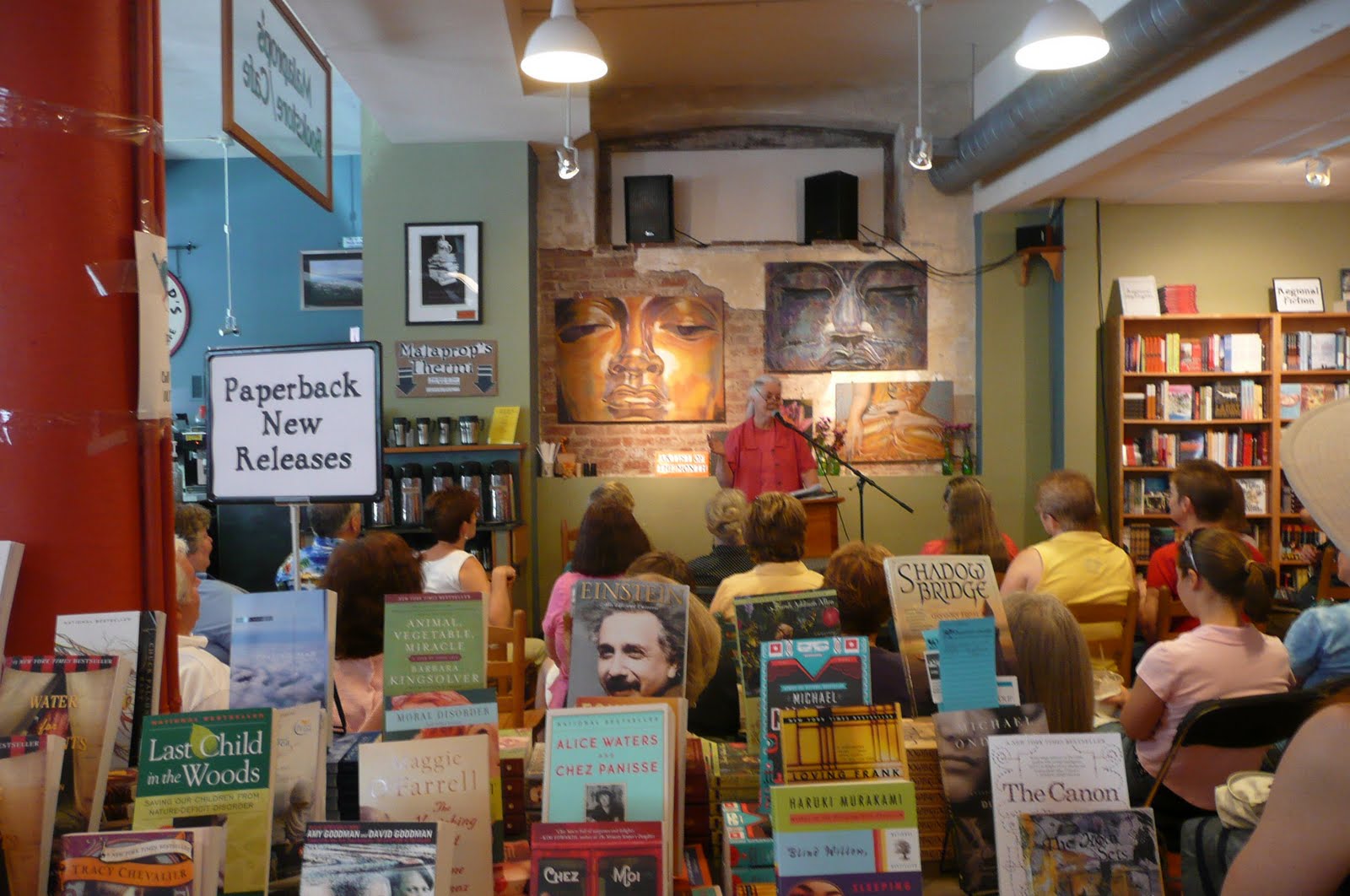
When you have a book out and you do a presentation at a bookstore or library, what do you say? What about just reading from the book?
Q: I'm nervous about speaking in public -- do you have have some tips on speaking to a group?
When you have a book out and you do a presentation at a bookstore or library, what do you say? What about just reading from the book?
A: One encouraging thing to remember about speaking as an author is that your audience is made up of people who have chosen to be there -- unlike the 'audience' a teacher faces every day. Even better, your audience wants to know more about you and your book -- subjects on which you are the expert. Still, a little preparation is certainly helpful.
A typical presentation lasts around an hour -- maybe twenty or thirty minutes of speaking, ten or fifteen minutes for Q and A, and the remaining time for selling and signing books.
When a new book come out, I prepare a little talk and pick out a few short bits to read. Most audiences get a little twitchy with twenty minutes of straight reading -- unless the reader/author is David Sedaris or someone equally compelling. I print it out and read it over to time it. I take the print out with me to the bookstore but usually end up just glancing at it to remind me of what I want to say next. (Of course, I have the bits I'm going to read bookmarked in my reading copy.)
When my first two books came out, I would spend some time talking about how/why I got started writing so late in life and what my inspiration was. Now I concentrate on the story behind the new book -- though often in the Q and A period, someone will ask how I got started and I'll tell the story one more time. (It always gets a laugh.)
And speaking of Q and A -- sometimes the audience will just sit there -- no one wanting to be first. You can prime the pump by having a friend in the audience with a few questions ready. Once the ice has been broken, others will join in.
This below is my standard talk for The Day of Small Things.

DST talk 30 min + Q & A
Thanks, insert name of introducer , thanks to name of bookstore or library for being such a good friend to me, and thanks to all of you for coming out.
It's been a long journey to the publication of this fifth book of mine and there've been some detours and dead ends – which is one reason I didn't have a book out last year.
As far too many people remember, I ended my last book, IN A DARK SEASON on a cliff hanger -- a question about Elizabeth and Phillip's relationship. At the time I confidently expected to resolve that question in a book called UNDER THE SKIN – in fact, I'd already begun to write that book when I met with my editor.
"Why don't you do a spin-off before you do another Elizabeth book?" asked my editor (aka Herself), during our yearly conference at Bouchercon a few years ago. "A stand alone — a non-series book. Maybe about one of your minor characters. No Elizabeth."
Hmm. After four books about Elizabeth Goodweather, I was open to trying something new. Besides, when Herself speaks, I tend to listen.
"I could do that," I said. "What if I picked up where I left off in the historical subplot of Signs in the Blood? I'd been thinking it might be interesting to tell Clytie's story – you, know, Little Sylvie's sister. I could …"
I could tell Herself wasn't interested. She was gazing off into the middle distance as she said, "Mmm, I was thinking about one of Elizabeth's neighbors . . ."
That's how Herself operates. She doesn't so much tell me what to do, as nudge me till I end up where she wants me.
"A book about Miss Birdie." I said. "You want a book about Miss Birdie?"
"What a good idea!" Herself exclaimed. "I can't wait to read it!"
Miss Birdie is Elizabeth Goodweather's eighty-something year old neighbor. She's based on several of my own neighbors and is a gutsy little woman who reminds many of my readers of a favorite grandmother or aunt. A cute little lady who says 'Ay, law' a lot, she bustles around her kitchen making cornbread and dispensing local color. A wonderful minor character – but could I write a whole novel about her?

What did I know of Miss Birdie's past? Not much – her husband Luther was dead as was her only child, a simple minded man named Cletus -- the only child that lived after several that died young.
About this time, while I was trying to decide if there was an interesting past to Miss Birdie, my friend Kathy (the original of Sallie Kate, Elizabeth's realtor friend) told me a heart-breaking story about a local woman who had always been kept at home by her mother, not even allowed to attend school. Why? The mother had wanted to be sure that this youngest daughter would never get married and move away – this daughter was raised to be her mother's caretaker in old age.
Building on this true story, I began to imagine what Birdie's life had been before she was that quaint old woman down the road from Elizabeth's farm – before, in fact, she was Miss Birdie.
I began with Birdie's birth and childhood. In this selection, Least, as she is known, is eavesdropping when a neighbor comes for a rare visit .
Read: pp16 -17 ( 4 minutes)
Oh, my! As I wrote, more and more of Birdie's past made itself known – from her early life close to nature in a lonely mountain cove to the raucous setting of a local tavern/dance hall/brothel. There was Cherokee magic, there was romance, there was unsolved murder.
After a crisis at home Least, as her mother called her, runs away and reinvents herself as Redbird Ray. She finds work as kitchen help and later as a dime-a-dance girl at a local dance hall/tavern/brothel. In this scene she is being pressured go upstairs with the sheriff – who generally has free run of the girls at the tavern. Redbird has only been a dancer previously, taking part in dance downs where the last man standing wins a bottle of whisky --- unless he is bested by one of the dancing girls.
Read pp 162 – 165 ( 6 min)
And finally, in the present day section of the book, I was back to the Birdie of the first four books. But a funny thing happened. I've become increasingly aware of the invisibility of old women and of how easily they are dismissed and I decided I wanted the eighty-something year old Birdie to be a force that couldn't be ignored.…
And as I wrote, Birdie emerged in all her strength – not the cute little neighbor who seemed to sit around waiting for Elizabeth to drop by and bring her to life, but a woman of power – capable of risking all in defense of a child. She began to remind me of Merlin at the end of his life as portrayed by C.S. Lewis in That Hideous Strength.
Read pp 384 -386 (3 minutes)
I really loved finding out more about this woman I thought I'd invented. And I've decided that there are no minor characters – in fiction or in life.
They're all just waiting to have their stories told.
We have time for questions...


No comments have been added yet.