Faces in a Crowd
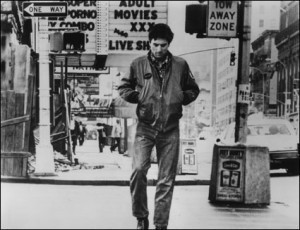
Taxi Driver (1976)
I saw a restored print of Taxi Driver this last weekend at the Film Forum in the Village and thought that it's starting to look like a documentary about New York City in the 1970s. To see Martin Scorsese's iconic film again, now, is to see whatever you didn't see before: the traffic, the sidewalks, the passersby….Those streets are reappearing in the film just as they are disappearing from the city itself. Nedick's? I had forgotten to forget that place. 42nd Street? It "was once" sleazy, I hear.
This time around the face was front and center too. Scorsese's camera lingers on faces for unnaturally long takes. It feels eerie and abnormal, so it makes sense in the depiction of Travis Bickle (Robert De Niro). But Scorsese also lingers on Betsy (Cybill Shepherd), an enigmatic woman in white who somehow agrees to go out with Bickle more than once. Why? The only plausible explanation seems to be that she, like Iris (Jodie Foster), is a modern girl fleeing the suburbs to make it in the city and finding she's out of her depth. That was feminism then– all promises. Betsy is a blank canvas for our projections as well as Bickle's. They converse and the camera stays close to her face. What is she thinking, with that enigmatic smile? Who is she really? It's impossible to know, perhaps because she doesn't know either. As the film ages, whatever was once novel (De Niro's performance, Bickle's character, the urban realism, and horror-film violence) now seems normal. It is what was once normal (Chuckles, pay phones, open fire hydrants, and innocent young working women) that now seems strange.