
You're Not Ready to Write a Novel: by Rebecca Rasmussen
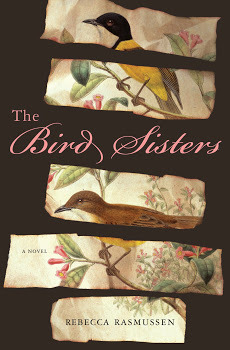
If you would like to write a guest post for "The Big Thing," by all means, let me know. Maybe we could trade? That's what debut novelist Rebecca Rasmussen and I did. My essay on "Literary Citizenship" appeared on her blog, The Bird Sisters. I'm really looking forward to her book, which will burst into flight on April 12.
You're Not Ready to Write a Novel
By Rebecca Rasmussen
You're not ready to write a novel. If you can't write a proper short story, what makes you think you can handle the scope of a novel? Why would you want to write a novel, when short stories are the far superior art form? Stick with what you know. Haven't you heard of Poe's unity of effect?
It seems unbelievable to me now that anyone was ever not in support of me writing a novel, but after attending two MFA programs, I have to say that the above statements are generally what a student of fiction can expect to hear over the course of their time in a writing program. The question now that I have written a novel that's being published in April is why?
My general feeling is that a lot of professors who teach in MFA programs write short stories (often because that's what they were taught to write) and therefore teach short stories. Some love novels, others don't. I think it's safe to say that in a lot of programs novels get a bad rap because people are so busy defending the merits and the superiority (artistically) of the short story. Not that they don't love novels; they just don't love them in a workshop.
But why?
First, the basics. I think the committees that decide which classes will be taught often don't know how to approach a class on novel writing in terms of workload and description. Will the students be writing a chapter? A whole manuscript? Either option doesn't seem to win many over, including the professors that will be teaching the courses for two reasons: 1.) A single opening chapter doesn't aptly teach students how to write a novel, and 2.) A whole manuscript from twelve or so students is a workload that is too large and would send said professors very far away from their own writing projects that semester, which I sympathize with completely.
In my first MFA program, no one said, "Don't write a novel," but no one said, "Give a novel a try" either. Experiment. Probably my writing was so unkempt at that time that reading the shorter version of it was grueling enough, so I am thankful that such care was taken with my work back then by my hardworking professors. And it didn't seem a completely obvious thing to do—to write a novel—when most of what I was reading was short stories. A novel? What was that? You mean like Dostoevsky? I think I studied that guy in college.
When I was in my second MFA program at UMASS-Amherst, the faculty there managed to reach an interesting and workable balance. (Also, I was older and more mature by then.) One of my professors, Sabina Murray, taught a novel writing class, where we were expected to produce or come into the class with 150 pages of a novel. Each week, we workshopped one student's novel-in-progress. The class was capped at ten students. I learned a great deal about novel writing by reading the first halves of other novels and by writing my own (and making my own mistakes—many, many mistakes). I learned that I was trying to stuff my novel full of plot because that's what I thought I was supposed to do. I learned that my first chapter confused people and even made some angry. Yikes! Not my intention.
What I value about that experience even though I didn't end up finishing that novel is that I was no longer afraid to deal with a never-ending manuscript and that I actually enjoyed the mess of a first draft much more than the constraints I put on myself as a short story writer (including that obnoxious little self-imposed epiphany to round out the arc of the story). I have published a handful of short stories in wonderful literary journals, but this isn't the form that is most natural to my storytelling.
I love thinking about plot and character on a larger more layered scale than what I am personally capable of achieving in a short story, but don't get me wrong: some of my very favorite writers are short story writers. Alice Munro, Alan Heathcock, and Siobhan Fallon. I admire these folks very much, and maybe one day I will be in the right frame of mind to write short stories again. For now, though, I am sticking with the novel even though it goes against 90+% of my training. And at some point, I would love to teach a novel workshop because I think it's simply not accurate to say that a writer isn't ready to write a novel if he or she can't write a short story. Who can really say such a thing? Who has the right? Leap, is what I say.
Though many people disagreed with her, Sabina also said three very practical things in her novel workshop that stuck with me:
1.) You need a book, often with a major press, to get a job in an MFA program these days.
2.) Major New York presses generally veer away from short stories.
3.) How much do you like teaching freshman composition?
I'm not going to tell you that I started writing a novel for purely practical reasons because I didn't. (I fell in love with the form after writing 150 bad pages, if you can believe it!) But at the time I had just given birth to my daughter and our dismal financial situation was on my mind. I may have fallen into the trap of saying these dangerously potent words: "If only I can sell a novel…"
It turns out that being broke is excellent motivation for writing and finishing a novel, for continuing when the going is rough and it looks like no one wants it, and for knocking on doors until someone says yes. For revising and revising and revising. The way I figure, writing a first novel is a lot like writing a first short story: there is a lot of muddling through to be done, a lot of failing, and maybe, if a writer is really lucky, a little success to be had.
Rebecca Rasmussen is the author of the novel The Bird Sisters, forthcoming from Crown Publishers on April 12th, 2011. She lives in St. Louis with her husband and daughter and loves to bake pies. Visit Rebecca at http://www.thebirdsisters.com for more information.


