Sassafras, A Tale of a Kitty
When my husband and I got together, we knew that we would never have children together. We were both in our mid-40s, plus I have two sons from my first marriage and he has three, so our family was already going to be a large one. We also had between us a rather large assortment of animals, but somehow another pet didn't seem as daunting. So, when someone came into PetsMart carrying a laundry basket with four tiny kittens, we looked and instantly fell in love with one in particular, a little tortie with a color line right down the middle of her face. Sassafras came home with us that afternoon. We called her our daughter.
We weren't really certain how old Sassy, as she soon came to be known, was, so I supplemented her diet with kitten milk, which I fed to her out of a bottle. Her sharp milk teeth made short work of the nipple. We also didn't feel she was ready to face an entire household of dogs and cats, so her first home was the master bathroom, which doubles as a sort of kitty dormitory for newcomers to the household, after ensuring that the middle-aged, orange and white tom cat awaiting neutering in that same space would not be any kind of danger to her. As it turns out, Ginger, the tom, was not only not dangerous, he was so besmitten with her that he allowed her to nurse. Yes, our male cat nursed this tiny kitten and even, we believe, produced milk.
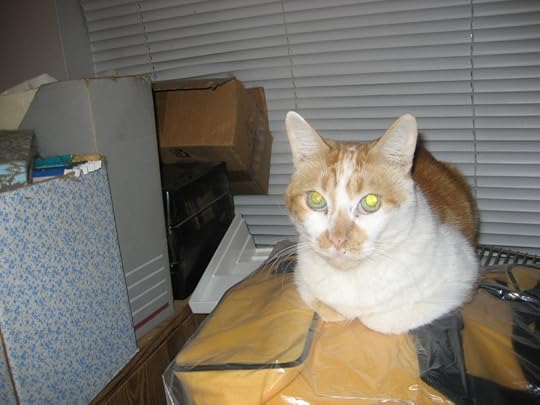
Eventually, the pair, one weaned and the other neutered, made it out of the bathroom and into the rest of the house. Ginger struck up a friendship with a large, white Turkish Angora we called Haiku and, together, the two gents set to dominating the household. Ginger was clearly in charge, while Haiku was his muscle. We hadn't known cats could take such a complicated route to rule.
Sassy, however... Tiny, soft, little bundle of fur Sassy... Well, our old German Shepherd, Luz, thought she was darling. Luz would just about engulf our petite baby in her mouth, sometimes simply slobbering on her, sometimes trying to carry her around. Sassy seemed to put up with being drenched in German Shepard drool as a normal part of the adoration that she should receive from all beings. Still, often enough, one of us humans would often feel compelled to tell Luz, "That's enough," and rescue her from the bath, sometimes substituting it with one of our own.
Sassy was also fearsome, at least when it came to food. One night, back when we were still meat eaters, we were having pork chops for dinner. There were just enough pork chops to go around, with none to spare. Sassy, who probably weighed less than a pound at the time, hopped up on the table and grabbed the pork chop from my youngest step son's plate, then carried it down under the table and proceeded to growl fiercely while protecting her kill. F____, determined not to lose his supper to her, did manage to retrieve his meal and take it to the sink for washing, but I suspect he paid in blood for the priviledge.
On another occasion, one of my boys was visiting for the night and slept on the couch. Sassy waited until he was just drifting off, then raced through the kitchen and dining room, took the sharp curve into the living room at maximum speed, and leapt up onto the couch at his feet, dashed across his body, then launched herself from his face and through the doorway into the family room, having made, more or less, a complete circle. He yelled, but soon grew sleepy again. Once more, just as he was starting to sleep, Sassy sprang into action. This happened again. And again. And again.
(We wonder, is this normal tortie behavior? My husband Karl used to have another tortie, Olympia, aka Pia. Pia had the same habit, only her victim was Karl and she did this night after night—bouncing from his chest, fortunately, rather than his face—as the flat in which he lived didn't include an interior door he could close to keep her out of the bedroom.)
As Sassy got a bit older, she became my office companion. In response, I installed PawSense to try to minimize the damage she did to my work on the computer when she walked across the keyboard. Even so, I enjoyed having her around. She refused to look the camera in the eye, though, so it was hard to get a good picture of her face.
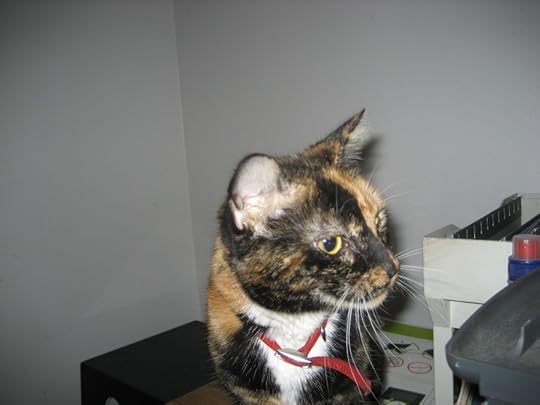
When my office moved from the dining room into the master bedroom (to accommodate one of our older boys returning home), Sassy decided that our no cats in the bedroom rule didn't apply to her. She would follow us down the hall and dart past our feet to get in. We tried to notice, so we could head her off. She became sneakier. No matter how much we tried, it seemed she could beat us at this game. And it was a game, one she loved. The next step after getting in was to dart under my desk and get into the farthest corner, behind the computer cords. When I dragged her out, she would sink her claws into the carpet, but when I finally had her in my arms, before that even, she would be purring loudly. Silly people that we were, we couldn't resist giving her the cuddles she demanded, even as we (mildly) scolded her. If I didn't crawl under the desk to get her, Sassy would sneak around behind my desk chair and jump up onto the bed, then sneak past Karl, who works sitting on his side of the bed, and roll in the spot where I sleep. Of course, by the time she'd had a nice, luxurious roll, she'd have our full attention. Once again, lots of petting before we put her back out in the hallway.
Over the last year, we started to notice that she wasn't getting along well with the other cats. We'd hear yowling from another room, but usually by the time we got there, everyone would be on different sides of the living room, so we couldn't be certain which cats were doing what. But, I noticed that if the "boys," as we call our three male cats, were in the hallway, Sassy would avoid them, leaping from my arms over their heads, or slinking to the other side of the hall, then running at top speed once she was past. None of the boys ever seemed to try to attack her or chase her when I was standing right there, but clearly something was going on.
Then, about six weeks ago, I noticed a sudden change in her dinnertime behavior. I feed my cats in crates, since some are greedier than others and this ensures that everyone gets the correct amount of food. Sassy's crate was stacked on top of two larger crates, and she normally scrambled up and stood waiting next to it for me to feed her. But, one night, her climb was slower and less certain. The next, she stayed on the floor by my feet, where she seemed wobbly. I picked her up and fed her, though she ate slowly and didn't finish her food, then lifted her out again when she was done. She was still wobbly, and now I saw that she was listing to the left and turning in stumbling circles.
Just a few months ago, another of my "babies," a sleek grey and white tuxedo cat who also came to me as a kitten (along with his mother), had a stroke. He went into a seizure just as I was walking in the door from work; the vet explained there was nothing we could do and recommended euthanasia, which we accepted. I was still broken up by losing him, and it was impossible to avoid wondering if my beloved Sassy was also having a stroke. Still, there was hope. Sassy hadn't had the grand mal seizure that her "brother" had, plus she was clearly aware of us and her surroundings, even though she was having trouble with her balance.
Unfortunately, it was too late at night to do anything about it. The only all night vet clinics in town are sufficiently expensive to put them out of reach for us. Plus, our past experiences with them, even when we could afford their services, have been, well, less than optimal. So, the next day, we called our vet to schedule an appointment.
They couldn't fit us in; it's a one-woman clinic, and it just couldn't be done. I had to go to work; I get paid by the hour, and money was already tight. Karl got on the phone and finally found a clinic that was reasonably priced and had an opening. We'd never worked with them before, but he took the appointment.
At the clinic, Karl was startled and dismayed when the vet laughed at Sassy's wobbly gait. Still, she did an examination and seemed to take proper, gentle care of Sassy. When she was done, she told Karl that without an MRI, she couldn't pronounce a full diagnosis, but that her trouble balancing was probably from one of three things: an ear infection, or inflammation from an infection that was pressing on a nerve; a tumor that was pressing on a nerve; or, a stroke. But, she said, the treatment in any of those cases was prednisone, so a more complete diagnosis wasn't necessary. It might take several weeks, but Sassy had a chance. Sassy was given some injections of steroids and antibiotics. Karl brought her home along with prednisone and Cerenia, an anti-nausea medication for dogs that is used off-label for cats. So, the pills began. The prednisone was twice a day, the Cerenia once. Some days, she seemed a bit better, and some she seemed a bit worse, but overall we thought we might be seeing some small improvement. To help coax her to eat, we offered her high-quality canned food next to her dry food, as well. She soon ignored the dry food, entirely, but even the wet food she ate sparingly.
It had been, what? Three days? A week? I can't even remember, now. She took a sudden turn for the worse. She was weak, uninterested in food, and cried. Her ears were hot (fever), and she was drooling terribly. We called the vet. She couldn't tell us what was happening. By instinct, more than anything else, we decided to stop the Cerenia. I looked it up and, yes, the symptoms we were seeing were among the side effects of Cerenia. Another call to the vet and we started giving her famotidine (generic Pepcid), cutting the pills in half.
About two weeks ago, Sassy still wasn't showing any real signs of improvement, and we were worried by her lack of appetite and extreme lethargy. We took her back in to the vet; this time, I was able to come along. In this strange place she seemed to perk up, looking around alertly. When the vet placed her on the floor, she crawled around, still wobbly, but better than we'd seen her in days. The vet noted, however, that her weight had dropped from 6 1/2 pounds to 5 1/4. She suggested that Sassy should be given a medication to increase her appetite; a single dose would give her a substantial boost in appetite for 3 days, but she would feel woozy for about 12 hours, starting a couple of hours after she received the medication. We hesitated, but agreed.
Karl dropped me off at work, then took Sassy home and offered her food. She ate well. Within a few hours, though, she was too woozy to hold herself upright. To move, she crouched on the floor, flopping over on her side every foot or so, or leaning up against a wall. Until this point, she'd been managing the impressive feat of always using her litter tray (she wasn't able to climb in or out of a box), but now when she reached it she could no longer hold herself up and had to lie in the litter to do her business. We tried holding her up when we could, and it worked once or twice, but mostly she was better off lying down. And food? Forget it. She was too weak and woozy to hold herself up to eat. We tried everything, even feeding her in her bed and hand feeding. Nothing was adequate. She soon stopped showing any interest in food.
But, she still purred when we petted her. She still seemed able to find happiness in those moments. We saw in her a tremendous will to live, and we wanted to respect that while there was still hope.
But, she never really recovered after her extreme reaction to the appetite increaser. We called and spoke to the vet again, asking about whether there was some other way we could feed her, short of a syringe. (Cats tend to resist and aspirate on food when it's force fed through syringe.) What about milk we asked, like kitten milk, but for cats. No, she answered. She knew of nothing more we could do. Cats, she told us, don't tend to retain enough of a suckling reflex to be able to be bottle fed.
But, we remembered giving another cat nutritional paste from a tube. And, Sassy had actually been sucking on my fingers after I'd given her pills. Surely, there must be something. I went to PetsMart. They had kitten milk in cans, and bottles intended for kittens. They had the tubes of high-calorie nutritional paste. We usually just called it goo. We started feeding Sassy bits of goo and kitten milk. She rallied. For a day.
We kept doing everything we could to help Sassy keep her strength up. It seemed to us that the dizziness was less, but she just wasn't strong enough to feed herself. If we could just get her a bit stronger, she might start eating. We tried. But, for every day we thought we saw improvement, it seemed there was one, or more, in which she faltered. She started lying in her little bed, moaning unless one of us were petting her when she was awake, but sleeping more and more. She was little more than skin and bones. We wanted to cuddle and hug her, but we avoided picking her up because it seemed to hurt her and her head would hang limp and flop if not properly supported. Every time I checked on her, I was amazed to find her still alive.
Throughout this illness, we struggled with the issue of how much care is enough care, and when is it too much.
Finally, she started gagging on her pills, and on the milk and water we offered from the bottle. She no longer purred when we petted her. She turned her head away, if she had the strength, when she saw us or heard us coming. And we decided. This is enough. This is too much. We're no longer helping her. She's no longer happy in this world.
Did she still want to live. To tell you the truth, I think she did. But, her body was failing. All she had left was more pain and misery. And we just couldn't do that to her.
So, today, we took her to a vet. Not the vet who laughed at her, who prescribed the appetite increaser that made her too ill to eat, who didn't know that there are ways to provide nutrition to a sick cat that don't require a syringe. No, instead we went to a new vet, someone we hadn't seen before. We asked that she be put to sleep.
It was a terrible experience. It didn't have to be. We've had sick animals put to sleep before, by vets who were respectful and caring. The vet we saw this afternoon was neither, nor was her technician. Between them, they made a difficult situation even worse. But, Sassy did go to sleep. She will never wake. She will never purr in my arms again. But, she won't be dizzy and frightened anymore, either.
I will miss her.
P.S. I've disabled comments. An emotional story can be hard to respond to, and I don't want you to feel obligated.
We weren't really certain how old Sassy, as she soon came to be known, was, so I supplemented her diet with kitten milk, which I fed to her out of a bottle. Her sharp milk teeth made short work of the nipple. We also didn't feel she was ready to face an entire household of dogs and cats, so her first home was the master bathroom, which doubles as a sort of kitty dormitory for newcomers to the household, after ensuring that the middle-aged, orange and white tom cat awaiting neutering in that same space would not be any kind of danger to her. As it turns out, Ginger, the tom, was not only not dangerous, he was so besmitten with her that he allowed her to nurse. Yes, our male cat nursed this tiny kitten and even, we believe, produced milk.
Eventually, the pair, one weaned and the other neutered, made it out of the bathroom and into the rest of the house. Ginger struck up a friendship with a large, white Turkish Angora we called Haiku and, together, the two gents set to dominating the household. Ginger was clearly in charge, while Haiku was his muscle. We hadn't known cats could take such a complicated route to rule.
Sassy, however... Tiny, soft, little bundle of fur Sassy... Well, our old German Shepherd, Luz, thought she was darling. Luz would just about engulf our petite baby in her mouth, sometimes simply slobbering on her, sometimes trying to carry her around. Sassy seemed to put up with being drenched in German Shepard drool as a normal part of the adoration that she should receive from all beings. Still, often enough, one of us humans would often feel compelled to tell Luz, "That's enough," and rescue her from the bath, sometimes substituting it with one of our own.
Sassy was also fearsome, at least when it came to food. One night, back when we were still meat eaters, we were having pork chops for dinner. There were just enough pork chops to go around, with none to spare. Sassy, who probably weighed less than a pound at the time, hopped up on the table and grabbed the pork chop from my youngest step son's plate, then carried it down under the table and proceeded to growl fiercely while protecting her kill. F____, determined not to lose his supper to her, did manage to retrieve his meal and take it to the sink for washing, but I suspect he paid in blood for the priviledge.
On another occasion, one of my boys was visiting for the night and slept on the couch. Sassy waited until he was just drifting off, then raced through the kitchen and dining room, took the sharp curve into the living room at maximum speed, and leapt up onto the couch at his feet, dashed across his body, then launched herself from his face and through the doorway into the family room, having made, more or less, a complete circle. He yelled, but soon grew sleepy again. Once more, just as he was starting to sleep, Sassy sprang into action. This happened again. And again. And again.
(We wonder, is this normal tortie behavior? My husband Karl used to have another tortie, Olympia, aka Pia. Pia had the same habit, only her victim was Karl and she did this night after night—bouncing from his chest, fortunately, rather than his face—as the flat in which he lived didn't include an interior door he could close to keep her out of the bedroom.)
As Sassy got a bit older, she became my office companion. In response, I installed PawSense to try to minimize the damage she did to my work on the computer when she walked across the keyboard. Even so, I enjoyed having her around. She refused to look the camera in the eye, though, so it was hard to get a good picture of her face.
When my office moved from the dining room into the master bedroom (to accommodate one of our older boys returning home), Sassy decided that our no cats in the bedroom rule didn't apply to her. She would follow us down the hall and dart past our feet to get in. We tried to notice, so we could head her off. She became sneakier. No matter how much we tried, it seemed she could beat us at this game. And it was a game, one she loved. The next step after getting in was to dart under my desk and get into the farthest corner, behind the computer cords. When I dragged her out, she would sink her claws into the carpet, but when I finally had her in my arms, before that even, she would be purring loudly. Silly people that we were, we couldn't resist giving her the cuddles she demanded, even as we (mildly) scolded her. If I didn't crawl under the desk to get her, Sassy would sneak around behind my desk chair and jump up onto the bed, then sneak past Karl, who works sitting on his side of the bed, and roll in the spot where I sleep. Of course, by the time she'd had a nice, luxurious roll, she'd have our full attention. Once again, lots of petting before we put her back out in the hallway.
Over the last year, we started to notice that she wasn't getting along well with the other cats. We'd hear yowling from another room, but usually by the time we got there, everyone would be on different sides of the living room, so we couldn't be certain which cats were doing what. But, I noticed that if the "boys," as we call our three male cats, were in the hallway, Sassy would avoid them, leaping from my arms over their heads, or slinking to the other side of the hall, then running at top speed once she was past. None of the boys ever seemed to try to attack her or chase her when I was standing right there, but clearly something was going on.
Then, about six weeks ago, I noticed a sudden change in her dinnertime behavior. I feed my cats in crates, since some are greedier than others and this ensures that everyone gets the correct amount of food. Sassy's crate was stacked on top of two larger crates, and she normally scrambled up and stood waiting next to it for me to feed her. But, one night, her climb was slower and less certain. The next, she stayed on the floor by my feet, where she seemed wobbly. I picked her up and fed her, though she ate slowly and didn't finish her food, then lifted her out again when she was done. She was still wobbly, and now I saw that she was listing to the left and turning in stumbling circles.
Just a few months ago, another of my "babies," a sleek grey and white tuxedo cat who also came to me as a kitten (along with his mother), had a stroke. He went into a seizure just as I was walking in the door from work; the vet explained there was nothing we could do and recommended euthanasia, which we accepted. I was still broken up by losing him, and it was impossible to avoid wondering if my beloved Sassy was also having a stroke. Still, there was hope. Sassy hadn't had the grand mal seizure that her "brother" had, plus she was clearly aware of us and her surroundings, even though she was having trouble with her balance.
Unfortunately, it was too late at night to do anything about it. The only all night vet clinics in town are sufficiently expensive to put them out of reach for us. Plus, our past experiences with them, even when we could afford their services, have been, well, less than optimal. So, the next day, we called our vet to schedule an appointment.
They couldn't fit us in; it's a one-woman clinic, and it just couldn't be done. I had to go to work; I get paid by the hour, and money was already tight. Karl got on the phone and finally found a clinic that was reasonably priced and had an opening. We'd never worked with them before, but he took the appointment.
At the clinic, Karl was startled and dismayed when the vet laughed at Sassy's wobbly gait. Still, she did an examination and seemed to take proper, gentle care of Sassy. When she was done, she told Karl that without an MRI, she couldn't pronounce a full diagnosis, but that her trouble balancing was probably from one of three things: an ear infection, or inflammation from an infection that was pressing on a nerve; a tumor that was pressing on a nerve; or, a stroke. But, she said, the treatment in any of those cases was prednisone, so a more complete diagnosis wasn't necessary. It might take several weeks, but Sassy had a chance. Sassy was given some injections of steroids and antibiotics. Karl brought her home along with prednisone and Cerenia, an anti-nausea medication for dogs that is used off-label for cats. So, the pills began. The prednisone was twice a day, the Cerenia once. Some days, she seemed a bit better, and some she seemed a bit worse, but overall we thought we might be seeing some small improvement. To help coax her to eat, we offered her high-quality canned food next to her dry food, as well. She soon ignored the dry food, entirely, but even the wet food she ate sparingly.
It had been, what? Three days? A week? I can't even remember, now. She took a sudden turn for the worse. She was weak, uninterested in food, and cried. Her ears were hot (fever), and she was drooling terribly. We called the vet. She couldn't tell us what was happening. By instinct, more than anything else, we decided to stop the Cerenia. I looked it up and, yes, the symptoms we were seeing were among the side effects of Cerenia. Another call to the vet and we started giving her famotidine (generic Pepcid), cutting the pills in half.
About two weeks ago, Sassy still wasn't showing any real signs of improvement, and we were worried by her lack of appetite and extreme lethargy. We took her back in to the vet; this time, I was able to come along. In this strange place she seemed to perk up, looking around alertly. When the vet placed her on the floor, she crawled around, still wobbly, but better than we'd seen her in days. The vet noted, however, that her weight had dropped from 6 1/2 pounds to 5 1/4. She suggested that Sassy should be given a medication to increase her appetite; a single dose would give her a substantial boost in appetite for 3 days, but she would feel woozy for about 12 hours, starting a couple of hours after she received the medication. We hesitated, but agreed.
Karl dropped me off at work, then took Sassy home and offered her food. She ate well. Within a few hours, though, she was too woozy to hold herself upright. To move, she crouched on the floor, flopping over on her side every foot or so, or leaning up against a wall. Until this point, she'd been managing the impressive feat of always using her litter tray (she wasn't able to climb in or out of a box), but now when she reached it she could no longer hold herself up and had to lie in the litter to do her business. We tried holding her up when we could, and it worked once or twice, but mostly she was better off lying down. And food? Forget it. She was too weak and woozy to hold herself up to eat. We tried everything, even feeding her in her bed and hand feeding. Nothing was adequate. She soon stopped showing any interest in food.
But, she still purred when we petted her. She still seemed able to find happiness in those moments. We saw in her a tremendous will to live, and we wanted to respect that while there was still hope.
But, she never really recovered after her extreme reaction to the appetite increaser. We called and spoke to the vet again, asking about whether there was some other way we could feed her, short of a syringe. (Cats tend to resist and aspirate on food when it's force fed through syringe.) What about milk we asked, like kitten milk, but for cats. No, she answered. She knew of nothing more we could do. Cats, she told us, don't tend to retain enough of a suckling reflex to be able to be bottle fed.
But, we remembered giving another cat nutritional paste from a tube. And, Sassy had actually been sucking on my fingers after I'd given her pills. Surely, there must be something. I went to PetsMart. They had kitten milk in cans, and bottles intended for kittens. They had the tubes of high-calorie nutritional paste. We usually just called it goo. We started feeding Sassy bits of goo and kitten milk. She rallied. For a day.
We kept doing everything we could to help Sassy keep her strength up. It seemed to us that the dizziness was less, but she just wasn't strong enough to feed herself. If we could just get her a bit stronger, she might start eating. We tried. But, for every day we thought we saw improvement, it seemed there was one, or more, in which she faltered. She started lying in her little bed, moaning unless one of us were petting her when she was awake, but sleeping more and more. She was little more than skin and bones. We wanted to cuddle and hug her, but we avoided picking her up because it seemed to hurt her and her head would hang limp and flop if not properly supported. Every time I checked on her, I was amazed to find her still alive.
Throughout this illness, we struggled with the issue of how much care is enough care, and when is it too much.
Finally, she started gagging on her pills, and on the milk and water we offered from the bottle. She no longer purred when we petted her. She turned her head away, if she had the strength, when she saw us or heard us coming. And we decided. This is enough. This is too much. We're no longer helping her. She's no longer happy in this world.
Did she still want to live. To tell you the truth, I think she did. But, her body was failing. All she had left was more pain and misery. And we just couldn't do that to her.
So, today, we took her to a vet. Not the vet who laughed at her, who prescribed the appetite increaser that made her too ill to eat, who didn't know that there are ways to provide nutrition to a sick cat that don't require a syringe. No, instead we went to a new vet, someone we hadn't seen before. We asked that she be put to sleep.
It was a terrible experience. It didn't have to be. We've had sick animals put to sleep before, by vets who were respectful and caring. The vet we saw this afternoon was neither, nor was her technician. Between them, they made a difficult situation even worse. But, Sassy did go to sleep. She will never wake. She will never purr in my arms again. But, she won't be dizzy and frightened anymore, either.
I will miss her.
P.S. I've disabled comments. An emotional story can be hard to respond to, and I don't want you to feel obligated.


No comments have been added yet.