M.B. Weston's Blog, page 28
October 13, 2012
Today’s Writing Muse: The Swamp
 Swamps make such great settings. The plants look odd. (Seriously, look at those tree roots!) The potential for gross out moments escalates with murky water and the who-knows-whats-in-it muck under the water. Quite a few of the inhabitants bite.
You may have an idea for a great setting, such as a swamp, but you may lack a story. If this occurs, ask yourself a few questions to stimulate creativity:
Why is my character here? If your setting is a swamp, your character needs a pretty good reason to be there. She may be hunting crawfish. He may be trying to get rid of a body. Someone may have lost a bet.
How is my character going to get out of here? Is a boat available? (You can always break the motor, you know.) Will she have to wade back?
What obstacles stand in my character’s way? Swamps give you so many options to choose from: alligators, lack of compass, mosquitoes, poisonous snakes.
Notice that these questions focus on things that can create conflict. Conflict is the essence of a story. Focusing on questions that lead to conflict can help you think up a good story based on a cool setting.
There’s your muse! Go!
Fantasy novelist M. B. Weston is the author of The Elysian Chronicles, a fantasy series about guardian angel warfare and treason. Weston speaks to children, teens, and adults about writing and the process of getting published. For more information on M. B. Weston, visit www.mbweston.com. Find out more about The Elysian Chronicles at www.elysianchronicles.com.
Related articles
Today’s Writing Muse: Dangerous Trees (mbweston.com)
Today’s Writing Muse: Nature’s Claw (mbweston.com)


October 12, 2012
Writing Technique: Star Wars–an Example of How to Break the Rules
Almost any writing rule can be broken, as long as the author 1) earns the right to break it and 2) executes properly.
For the past few weeks, we’ve been discussing how to create the suspension of disbelief in readers by surrounding our make-believe elements with believable elements (click here to read the blog post). Today, we are going to discuss how you can break this rule and get away with it using George Lucas’s Star Wars: A New Hope as an example.
Think of the opening scene in Star Wars: First we see a tiny spaceship being chased by a colossal space ship. Then, we see some men in weird helmets start shooting lasers at some…dudes in white armor. All the humans die or retreat. Then, we see this masked guy, who dressed all in black—with a cape—and sounds like he is breathing through SCUBA gear, enter the scene and step over the dead people, including his own. Oh yeah, and the female lead looked like she was wearing hair-wrapped bagels over each ear.
I ask you: What part of this seems believable?
Lucas didn’t even bother to surround his make-believe elements with believable elements or prep the reader in his opening scene, and yet this scene captivated the audience. Millions of people, who by the way don’t love science fiction, love Star Wars. This shouldn’t make sense, should it?
Lucas broke the writing rules, and it worked because he earned the right to break them and executed properly. Here’s how he did it:
He used mythological archetypes. Lucas studied myths, legends, and The Hero’s Journey. We can relate to his characters because we’ve seen models of them before in other stories. Star Wars is actually an epic fantasy wrapped in a science fiction shell.
He had great characters and great character development. Han, Luke, and Leia had depth and individual personalities. They were well-developed. They didn’t fit clichés. Think about this. The hero, Luke, whines. The princess, Leia, shoots a couple of storm troopers the moment we first see her. The sidekick/friend is an anti-hero smuggler, in it for himself and the money. (Come on, admit it. Your heart still jumps when Han Solo comes back at the end of the movie. You know it does!)
He used epic conflicts. A small band of rebels fighting for freedom from an oppressive dictator is a conflict you can find throughout both history and all genres of literature.
He used a great soundtrack. In a world of dissonant soundtracks that sounded more like that of Planet of the Apes, Lucas gave us John Williams. Writers can’t use sound tracks, but we can use sensory details and description to enhance our readers’ emotions. I discussed this in a series of blog posts on description and creating a main impression a few months ago:
The Writer’s Descriptive Techniques: #1—Create a Main Impression
The Writer’s Descriptive Techniques: #2—Choose Details that Enhance Your Main Impression
The Writer’s Descriptive Techniques: #3—Group Related Details Together
The Writer’s Descriptive Techniques: #4— Use Comparisons that Relate to Your Main Impression
He used great special effects no one had ever seen. Again, writers don’t get to use special effects, but we can, in a sense, create the need for them by creating amazing, new concepts within our books. Think “shock and awe.” Be creative. Break the mold.
His world had back story, which helped it feel real. Obi-Wan mentions the Clone Wars to Luke. Luke knows exactly what the Clone Wars were, and the fact that Obi-Wan fought in them impressed him. Likewise, Han Solo mentions that the Millennium Falcon is “the ship that made the Kessel Run in less than twelve parsecs,” as though Luke would know what he meant. Heck, Luke used to bull’s-eye womp rats in his T-16 back home. (I may not know what a womp rat is, but I’m sure it’s not much bigger than two meters.) Little things like this make the world feel real.
What we saw visually made sense, even if it was make-believe. Luke didn’t traverse the desert in some odd contraption we had never seen before. He used something that looked like a beat-up car that hovered. His speeder made sense. (Notice Lucas saved the AT-ATs for Empire Strikes Back.) The same can be said for other items, such as blasters, armor, and light sabers. They looked normal—not like something Dr. Emmett Brown would wear on his head to read someone’s thoughts.
The story appealed to people on a deep level. This is the magic of stories, which I will in much more detail later. For now, remember that humans desire adventure, companionship, and the ability to make a difference. You can help your readers meet these desires by allowing them to live vicariously through our characters.
He opened with an exciting, tension filled scene. At the end of the first scene, we know who the bad guys are and who the good guys are. We know the bad guys seem to have the advantage. We also know the chick in those sweet bagel buns is someone you don’t want to mess with, and she’s a good guy.
What to take from this: You can break the rules, but make sure to do it properly. Study the works of successful storytellers who broke the rules and got away with it.
Mainstream writers: Open your story with something that hooks the reader. It doesn’t have to be a space battle, but it needs to be something. Grab your readers head on and don’t let them look back.
Speculative writers: Yes, you can break the rules and hit your audience with some hard-core make-believe, but make sure you execute!
If you are new to this blog, I’ve been writing a series of posts about writing speculative fiction, including fantasy, science fiction, steampunk, comic books, paranormal, and horror. For the full list, click here or on the category called “Making Make-Believe Believable.” Thanks for stopping by!
Fantasy novelist M. B. Weston is the author of The Elysian Chronicles, a fantasy series about guardian angel warfare and treason. Weston speaks to children, teens, and adults about writing and the process of getting published. For more information on M. B. Weston, visit www.mbweston.com. Find out more about The Elysian Chronicles at www.elysianchronicles.com.

October 11, 2012
Writing Technique: Prep the Reader for Your Plot Twist and/or Make-Believe Element
Using a few techniques to prepare your reader for you plot twist or your make-believe element can draw your reader into your story, increase suspense, and create a huge emotional reaction in your reader.
I was probably three or four the first time I went to see Santa Claus. I remember looking up at this huge guy with a biker beard who was dressed in bright red and wanted me to sit on his lap. It did not go well. I freaked out and burst into tears. My mom had not prepped my preschool self appropriately for Santa Claus. Had I been told that Santa was the nice man responsible for filling my Christmas wish list, I might have been much more willing to sit in the guy’s lap.
The second time I visited Santa, I had experienced a Christmas where he had left me presents. I had seen Christmas movies about Santa and Rudolf. I was fully prepared to tell Santa my Christmas desires—without bursting into tears.
Sometimes, you just can’t throw a three-year-old on Santa’s lap without explaining who Santa is. In the same way, sometimes you need to prep your audience in order to get them to suspend disbelief in your make-believe elements. Drawing the reader in and leaving clues to your make-believe element is a great way to get your audience to press the I Believe Button. It works especially well in with genres such as paranormal, urban fantasy, and crossovers that are intended to grab a larger audience.
Prepping the reader can:
Create suspension of disbelief. A reader who might not like speculative fiction will be more willing to suspend disbelief because the clues were laid out for him first.
Build suspense. Prepping the reader creates suspense. Suspense, after all, is a form of tension, and tension turns pages. The unknown is a powerful tool for writers. It creates fear in readers that you can’t create by just throwing a monster at them. On that note, remember that…
Cause your reader to imagine the worst possible scenario. I’ve discovered this through my readers and the questions they would ask me about what might happen in the next book. So many times, I’ve thought, “Wow, that’s pretty scary. I didn’t even consider it.” Hiding your monster, villain, or ghost from the reader’s view will give your reader the chance to imagine something worse than you can dream up. (On that note, make sure the creature (or the secret world, etc.) lives up to the hype when you finally bring it out in the open.)
Make your reader continue to read. Curiosity can kill cats. Curiosity can also keep your reader interested in your story. What is causing the noise in the attic upstairs? What made the crop circles in the corn field? How did the books move across the table when no one is in the house? All of us want to know what’s going on.
Create an intense emotional response in the reader. I still get goose bumps up and down my arms when I watch the climactic scene in Signs, even though I’ve seen it many times. When the audience finally sees how the random cups of water, the asthma, and the dying wife’s cryptic messages of “Swing away” and “Tell Grant to see” finally come together and make sense, my emotional response is far stronger than if those clues were explained right away.
How to prep your audience:
Leave clues throughout the story. This is tricky. You need to leave enough clues so that your end result makes sense, but not too many. You don’t want your audience to guess where you’re heading and call your story “predictable.” You want your audience to experience what I call “The double ‘Oh’ moment.” Oh #1: What your reader says—with surprise—when you reveal your secret. Oh #2 = What your reader says when he realizes the clues where there all along.
Use sensory details as much as possible. I cannot stress the importance of sensory details enough. Make sure your readers feel your story. It will 1) emotionally draw them in and 2) make them suspend disbelief.
Make sure your characters react realistically to the clues. If your clues aren’t strong enough to elicit an emotional reaction from your characters, don’t force it. Likewise, if your character should react a certain way—say, by running away from the growling noise in the basement instead going down the stairs to investigate because you need her too, your audience won’t buy it. Instead they’ll make a spoof off of it and post it on YouTube. (Worse yet, they’ll make up an excuse to create another movie in the Scary Movie series. For the love of good cinema, watch your character’s reactions!)
Hide your creature/villain/surprise for as long as possible. This can create terror in your reader. It can also create wonder and awe. If your surprise fantasy creature is a unicorn, your audience’s reaction to finally seeing will be stronger if you hold off on revealing it. (Ooh, this sounds like a good story. I’m so writing this.)
Make sure your clues are researched. I’m eventually going to write a YA novel about a werewolf. I’ve studied werewolf legends, and I’ve also researched predatory activity in Sylva, North Carolina—the story’s setting. Turns out, they have just released red wolves back into the Smokey Mountains. Guess what I’m going to be bringing up and exploiting in the story? Red wolves. Did they kill whatever my werewolves will kill? No. Will they be blamed? Yes. Will it cause controversy? Yep. Will my clues be researched? Yep.
What to take from this: If you execute it properly, you can get even non-fantasy readers to suspend disbelief in your make-believe world and enjoy your story. The key: prepping them for your make-believe elements.
Mainstream writers: You might not drop the “It was aliens” bomb on your reader, but you may have a plot twist at the end of your story. Make sure to prep your reader for your twist. The reader doesn’t need to be able to guess whodunit, but he does need to be able to reread the story and pick up on all the clues he missed the first time.
Speculative writers: Our biggest mistakes in this area will involve 1) inappropriate character reactions to our clues, 2) failure to live up to the hype we’ve created, and 3) showing the make-believe element too soon. Pay careful attention to these issues.
If you are new to this blog, I’ve been writing a series of posts about writing speculative fiction, including fantasy, science fiction, steampunk, comic books, paranormal, and horror. For the full list, click here or on the category called “Making Make-Believe Believable.” Thanks for stopping by!
Fantasy novelist M. B. Weston is the author of The Elysian Chronicles, a fantasy series about guardian angel warfare and treason. Weston speaks to children, teens, and adults about writing and the process of getting published. For more information on M. B. Weston, visit www.mbweston.com. Find out more about The Elysian Chronicles at www.elysianchronicles.com.
Related articles
Understanding the Suspension of Disbelief (mbweston.com)
Writing Speculative Fiction: Surround the Unbelievable with the Believable (mbweston.com)

October 10, 2012
Writing Technique: Creating Believable Worlds, Characters & Creatures
Even your make-believe worlds, characters, and creatures should still contain believable elements. Use what you know about human nature, history, economics, government, and science to make your world feel real.
Movies are full of ostentatious stunts and explosions that most people will admit are unrealistic. However, most of us in the audience don’t really care. We are willing to suspend our disbelief in Hollywood stunts because they don’t (usually) detract from the story. That, and explosions are pretty cool…
I’m not as forgiving when Hollywood messes up basic facts. For instance, in the movie, Rush Hour, a member of the LAPD has applied for the position of special agent at the FBI, but his knowledge about how the application process works is horribly wrong. (I know this because I’ve actually applied to the FBI.) Obviously, the writers didn’t do even research on the process. Simple errors like that can detract from the story and cause your readers to stop suspending their disbelief.
To surround your make-believe elements with believable elements, two things must happen:
You need to become an expert in a lot of subjects, especially fiction where you are creating another world.
You need to avoid making huge mistakes that a basic Google search will expose.
To create believable fiction, you need expertise in:
Human nature. If the characters in your novels behave contrary to your reader’s experience with human nature, he or she will have a harder time believing in your world. This requires understanding of sociology and history. History provides us with a plethora of examples of how humans behave. History also answers the “what if” questions you might have about situations you’ve created in your world.
I wrote my second novel, The Elysian Chronicles: Out of the Shadows, after Vladmir Putin finished his first stint as the president of Russia and was serving as only the prime minister. The prospect of him running for president again seemed silly to many. I disagreed, and though I didn’t actually name the Russian president Vladmir Putin in my book, I gave him the initials VP (for Vascha Polzin) in order to let savvy readers know who I meant. Guess who is president of Russia now—again? That’s right. Vladmir Putin. No, I’m not a prophet. Yes, I understand human nature, history, and Russian history.
NOTE: If your character or people group is not human, you might not be able to rely on what you know about human nature. The key to make your non-human character believable is to establish the species’ nature, and stay consistent with it. For instance, in Star Trek, Vulcans are believable because they are consistently logical. If Vulcans wavered from their nature, Star Trek’s fan base would revolt.
The Opposite Sex. If you write for both genders, you need to understand how the opposite sex actually works. If your men behave like women, or if your women behave like men, you will lose half of your audience. (If you write gender specific fiction, ignore this, but don’t be surprised if the opposite sex consistently makes fun or your characters. I mean seriously, how many women actually behave like those in comic books? And how many men act like those in romance novels?)
Economics. If you are writing fiction that takes place in the real world, you need to understand the economic system in which you are writing. If you are creating your own world, research the economic systems, both today and throughout history. Remember that history provides us with all the examples we need, and that includes economic history. Use these examples as archetypes that your reader can relate to. If your economic system differs from what we know of human nature, explain why. Don’t create a world where people freely give to each other and have no form of payment unless you first explain why they are perfect.
Government. Know how governments work. Study different forms of governments throughout history (and don’t be afraid to steal ideas from them). Your reader will be much more comfortable with the government you create if he or she can relate to it.
Science and technology. For science fiction writers, this is a must, but it’s also true for the rest of us, even mainstream writers. In this information age, you don’t have an excuse for not knowing how things work. If you mess up science, your reader will stop believing anything you present to them. Knowledge of science and technology can do a few things for you:
It can help you create your own forms of fantasy, steampunk, and science fiction technology. I use an encyclopedia of weapons as research when I’m trying to create fantasy weapons. It helps to know how a crossbow works if I want to tweak it.
It can make you look like a genius. Jules Verne. Submarine. End of illustration.
Languages. If you want to surround your make-believe world with believable elements, you need to create names, languages, and dialects that people can relate to. Here are a few tips.
Base languages on already existing languages: Tolkien based a lot of his elvish language on Finish.
Ask yourself if you really need the apostrophes and other symbols: You may be tempted to use apostrophes in your names and languages because they look “cool and fantasy-esque,” but consider how real languages work. Their symbols have a grammatical purpose. Create consistent rules for your apostrophes or eliminate them.
Choose character and location names that sound realistic: Creating a new world with words and names that sound silly will only make readers stop suspending their disbelief. Use a thesaurus, other languages, or Wikipedia as a starting point for your names. You can also use and other such sites to find real names that aren’t as well known.
Good example of names: Star Wars, Episodes 4-6: Han, Luke, Leia, Obi-Wan, Chewbacca, Yoda, Lando. These names are different, but they sound like normal names.
Bad examples of names: Star Wars, Episodes 1-3: planet Naboo, Count Dooku. This is one of the reasons why people had a hard time accepting Lucas’s new worlds is real.
What to take from this: Do your research. Make your world logical. We live in a world powered by Google, so you have no excuse. When you show adequate knowledge on the real things, your readers will accept the make-believe ones.
Mainstream writers: Don’t have your characters apply to the FBI without knowing how the process works.
Speculative writers: To make your world, creatures, and characters believable, you need to show the reader you have knowledge of conventional concepts. You can break with convention as long as you explain it (which means you still need to have knowledge of the concepts).
If you are new to this blog, I’ve been writing a series of posts about writing speculative fiction, including fantasy, science fiction, steampunk, comic books, paranormal, and horror. For the full list, click here or on the category called “Making Make-Believe Believable.” Thanks for stopping by!
Fantasy novelist M. B. Weston is the author of The Elysian Chronicles, a fantasy series about guardian angel warfare and treason. Weston speaks to children, teens, and adults about writing and the process of getting published. For more information on M. B. Weston, visit www.mbweston.com. Find out more about The Elysian Chronicles at www.elysianchronicles.com.

October 9, 2012
Writing Technique: Creating a Believable Setting
Creating a believable setting can help your readers suspend their disbelief and accept the make-believe elements in your story.
Author Lakin Konieczny (read her blog here) left a great comment on one of my blog posts, explaining how she creates suspension of disbelief by “trying to create a setting and characters that feel so real it seems like they could be your next door neighbor, then I add something supernatural or paranormal that gives it that twist as promised by genre.” Based on this comment, I figured I ought to include a post on setting. (By the way, if you write paranormal, fantasy, or horror, do be sure to check out her blog on writing.)
Imagine this: You meet con artist, John, who claims to be a financial, and he offers to invest your money. He wants to meet you for lunch.
Scenario 1: John drives up to meet you in a late model Mercedes Benz. His suit is tailored, his hair is immaculate, and he is sporting a Rolex. His shoes look Italian. You find out that he lives in a posh area of town.
Scenario 2: John drives up to meet you in a beat-up Ford Pinto from the 1980’s. He introduces himself as “Johnny.” His hair is a little bit greasy, his shirt is unbuttoned—framing the heavy gold chain around his neck, and some of his chest hair pokes through. His pants are too tight, and he is wearing flip flops. You find out through conversation that he lives on the sleazy side of town.
Which con artist is more believable?
We writers are actually than con artists trying to get people to buy into our stories, and our settings are the clothing our story wears. Your setting needs to be believable or readers will know they are being conned.
When it comes to setting, try thinking more like a movie director. Directors must create an entire stage that looks real on every level. As writers, we need to concentrate on our setting almost the same way a director must focus on his stage. We don’t need to worry about every cup and picture the way an interior decorator for the set might worry about it, but we do need to fill our setting with things that will make it believable for a few reasons.
Setting can show character. Even though we’ve been discussing how to write speculative fiction, we can’t neglect the importance of showing character, especially since believable characters help your reader suspend his disbelief. Your character’s neatness, decorative choices, and even the place he or she chooses to live show who he or she is—all without you having to describe it.
A real, grounded setting helps the reader suspend disbelief. When the setting feels real, the reader will be more willing to buy into your make-believe world.
Establishing a good setting makes the world come alive for your reader. When I read a well-written story, I see the movie of the story actually playing in my head. You want your reader to see more than just a white background in your story’s movie.
Shock and awe. Have you ever stepped into an awe-inspiring place that gave you goose bumps? Have you ever been in a place that gave you the creeps? You can create these feelings in your reader simply by establishing an appropriate setting.
If you’ve created a different world, you must include setting in order to help your reader feel as though he is a part of that world. If a reader doesn’t see your new world two things happen. First, he is missing out on the magic of the world you see because you haven’t described it to him. Second, he isn’t going to believe in your make-believe elements because the environment doesn’t feel believable in the first place.
How to create a good setting:
Include Sensory Details: A few months ago, I wrote a post about using sensory details and description in your writing. (Click here to read it.) I cannot stress how sensory details make your setting feel real.
Don’t neglect the surroundings. Don’t just focus on the storefront your character is standing in front of. Make sure to show a bit of the other parts of the street.
Remember that people are part of the setting. In movies, they’re called extras. If two characters are meeting in a restaurant, they will be surrounded by patrons and restaurant staff. Don’t forget them.
Clothing is important, especially if you are writing a period piece. Make sure to give a few details on clothing. Also, remember clothing’s effect on your characters. For example, if your characters are wearing armor, it’s going to get uncomfortable. Point that out.
Weather is important, too. Don’t forget weather, and don’t forget that it changes.
How much detail you use when describing your setting will vary depending on genre:
Historical fiction, new fantasy/sci-fi worlds, and steampunk require more description. First, your audience has never been to your world. Second, most readers love these genres because they want the description.
Urban fantasy and modern day paranormal might not require as much description when introducing the world. If I say, “Times Square” most of my readers already know what it is. I can give a few sensory details about it, but I don’t have the same difficulties that I face if I am describing a species of tree that doesn’t exist on this planet.
Children’s fiction and YA will require a different amount and type of description than adult fiction. Think of the differences in writing style and length of description between C.S. Lewis and J.R.R. Tolkien.
On that note, just be yourself. While it’s important to stay within genre, don’t give yourself up in order to do so. Your voice is your voice. I write with less emotion than other authors, and I prefer to let my setting and characters’ behavior show how they feel instead telling the reader. Some readers don’t like it and wish I focused more on emotion. Others love it.
What to take from this: Surround your make-believe elements with believable elements by creating a believable setting. Your setting can also 1) aid with character development and 2) add structure to the movie that the reader sees in his head when he reads your work.
Mainstream writers: You can stir up feelings of magic, awe, and fear simply by creating a good setting.
Speculative writers: Describing your setting is non-negotiable. If you feel like your characters are acting in nothing but white space, you probably need to add in a few details.
If you are new to this blog, I’ve been writing a series of posts about writing speculative fiction, including fantasy, science fiction, steampunk, comic books, paranormal, and horror. For the full list, click here or on the category called “Making Make-Believe Believable.” Thanks for stopping by!
Fantasy novelist M. B. Weston is the author of The Elysian Chronicles, a fantasy series about guardian angel warfare and treason. Weston speaks to children, teens, and adults about writing and the process of getting published. For more information on M. B. Weston, visit www.mbweston.com. Find out more about The Elysian Chronicles at www.elysianchronicles.com.

October 8, 2012
Writing Technique: Using Archetypes
Use familiar archetypes of known fantasy creatures, aliens, and paranormal beings to surround the unbelievable with the believable.
If you are new to this blog, I’ve been writing a series of posts about writing speculative fiction, including fantasy, science fiction, steampunk, comic books, paranormal, and horror. For the full list, click here or on the category called “Making Make-Believe Believable.”
For the next week or so, we will be concentrating on the first technique for helping your reader suspend disbelief: Surround the Unbelievable with the Believable. Here are a few examples of methods we can use:
The Details Example (click here for the blog post)
The Transformation Example (click here for the blog post)
The Social Norm Example (click here for the blog post)
The Hybrid Example (click here for the blog post)
The Archetype Example
Today, we will focus on the archetype example.
“What’s your book about?”
It’s usually one of the first questions someone asks an author at a book signing. Here are a few answers an author might give:
A girl who hunts vampires.
A virus that creates zombies, who try to destroy the world.
A detective who discovers that the serial killer terrorizing his village is a werewolf.
A ghost of a murder victim who haunts the house of her murder.
An advanced alien race that tries to take over Earth.
Thor, the god of thunder.
A scientist living in 19th century England who develops a time machine.
A boy who discovers he’s actually a wizard.
Well, it’s about this creature I made up. It’s got weird horns and the power to read the minds of its victims. It’s kind of a like a cheetah, but it can also disappear, and it’s got this really great magical ability to…
Which of these descriptions will readers least likely be willing to believe? Which of those descriptions will least likely grab you a potential buyer? The one with the unknown creature, of course.
Vampires, Zombies, werewolves, ghosts, aliens, ancient gods, and wizards are all archetypes that most readers, even mainstream readers, have heard of. They feel familiar. Although each author’s version of the archetype might be different, the reader can immediately picture what the book is about. These archetypes are so engrained in our culture that we have suspended our disbelief in them already. Using them is like cheating.
How engrained can these archetypes become in our culture? Take a look at people’s reactions to the Stephanie Meyer’s Twilight series. How many times have you heard someone say, “Real vampires don’t sparkle,” as though vampires actually exist?
If you ask me about my Elysian Chronicles series, I will use the terms angels and demons. I won’t mention that I call them cherubians and mornachts. I want the reader to feel like he can relate to my story immediately. I’ve also got a book in the lineup which will feature a berserker-type of character. Most people haven’t really heard of berserkers, unless they study Viking and Norse history. (Here’s a good description of them if you are interested.) Because of that, this book will be a harder sell to non-fantasy readers, which is one of the reasons I’m putting it on the back burner. I need to establish my audience before I throw a berserker at them.
J.K. Rowling has probably made the optimum use of archetypes in her Harry Potter series. She makes use of creatures that most of us recognize. We’ve all heard of goblins, elves, magic wands, dragons, witches riding brooms, ghosts, and centaurs. Even hippogriffs are mythological creatures. Rowling used creatures we all are familiar with, but she also did the work to make them her own. She also grabbed a large audience of mainstream fiction readers.
How to make your archetypal creature special (i.e. make it your own):
Give your creatures history and backstory. History and backstory not only make your creatures feel more real, but they also make them yours.
Establish a hierarchy of wealth/power/skills. Look at human society as an example. All cultures have a hierarchy of wealth and power. Your creatures should too.
Give your similar creatures differences. In The Elysian Chronicles: Out of the Shadows , I introduce gnomes and dragons into the series. I made sure to divide my gnomes into clans, and I made different races of dragons, patterning them off dragons from different cultures.
Earn the right to use the archetype by proving you have knowledge about them. Study the legends and folklore. Mention it certain aspects of it in your story. I did research on airships for my steampunk short story, “The Survivor,” which features an airship made by Great Britain. This particular ship would have been created long before Britain’s first airships—the R101 and R102. I called it the “HMS Phoenix, a dirigible class R10.” With that in mind…
Add in a few “Easter eggs” for readers who are in the know. I made sure to create a specific gnome clan that loved green, and I called them the Luchorpan clan—the root word for leprechaun. I created a clan called the Nibelung, which will be of interest to those who have studied Scandinavian folklore, as will the Mime clan.
If you break with tradition, make sure to explain it to the reader. If your werewolves can’t be killed with silver bullets, explain why.
Reasons to consider using archetypes:
The reader already knows about the archetypes, which increases his comfort levels.
In most cases, the reader has already suspended his disbelief regarding these archetypes.
It is much easier to write about something that is already known. You aren’t recreating the wheel, and you don’t have to use too many words to describe what you are talking about.
Problems with using archetypes:
The audience already has a preconceived opinion of them. Remember, according to a lot of people real vampires don’t sparkle. One of the difficulties I have encountered is dealing with people’s preconceived notions of angels, which are never the same. I try to explain that they are “Roman Soldiers with wings fighting monsters.”
It’s easy to get lazy with archetypes. Don’t write about a cookie-cutter werewolf. Don’t let your aliens look exactly like those from Roswell. Make sure your ghosts should special qualities. If you include an airship in your steampunk story, make it special. (See above.)
Some people just don’t like “vampire books.” Using archetypes has the potential to limit your audience. Some people might not like to read about zombies, werewolves or vampires. It’s a risk you will have to take. However, remember that some people will buy your books simply because they do feature your archetype, so don’t let it stop you from writing.
What to take from this: Our culture has already chosen to suspend its disbelief in certain archetypes. Take advantage of this! Using the archetypes will help the audience suspend its disbelief because, in a sense, you are surrounding the unbelievable with the believable.
Mainstream Writers: Consider throwing the potential of a speculative archetype into your plot. For instance, in Guy Ritchie’s Sherlock Holmes, Lord Blackwood claims to be powerful in the dark arts. While all of Blackwood’s powers are really only slight-of-hand tricks, the audience is willing to consider the Blackwood might be a wizard. Throwing in the potential of a common mythological or paranormal archetype, such as a vampire (or an alien), into your story might help move the plot forward.
Speculative Writers: Use archetypes, but don’t get lazy. Make them your own.
Fantasy novelist M. B. Weston is the author of The Elysian Chronicles, a fantasy series about guardian angel warfare and treason. Weston speaks to children, teens, and adults about writing and the process of getting published. For more information on M. B. Weston, visit www.mbweston.com. Find out more about The Elysian Chronicles at www.elysianchronicles.com.

October 7, 2012
Sample Sunday: Part of Chapter 30 from The Elysian Chronicles: A Prophecy Forgotten
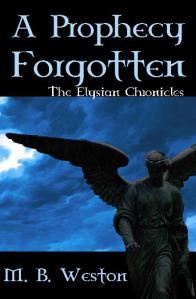 It turns out that several authors post samples of their books on Sunday. (It’s called #samplesunday in the twitter-verse.) I’ve decided to join in!
My first sample comes from Chapter 30 in my first published book, The Elysian Chronicles: A Prophecy Forgotten.
Because this is fantasy, I needed to create names, creatures, weapons, and military divisions. Here are a few terms specific to the Elysian Chronicles:
canaf: (kǝ•năf′) n. Secret cherubian passageway carved into tree trunks, earth, or stone. Most canafs lead out of the City of Ezzer, but several canafs are located throughout Elysian territory in Heaven’s Realm.
cherubian: (chĕr•ū′•bē•ǝn) 1. n. Creature with the body of a human and wings of a falcon. Cherubians are known to humans as angels. 2. adj. of cherubian make. (Click here for more information on cherubians.)
Davian: (dā′•vē•ǝn) RSO Major and cherubian Medal of Courage and Valor winner. Elysia’s top warrior, sent to guard a child who is prophesied to save Earth and Heaven’s Realm.
horde: (hôrd) n. Elysian military numerical unit referring to 100 Morvenian soldiers.
Marcus: (măr′•kǝs) Lieutenant RSO in Davian’s unit, known for being the tallest cherubian ever to make RSO.
mornacht: (mōr′•nŏkt) n. Decrepit monster with leathery skin, a pair of withered stumps on its back that were once wings, and a foul smell akin to that of sulfur. Mornachts are cherubian’s enemies. (Click here for more information on mornachts.)
poisonwood: (poi′•zǝn•wŭd) 1. n. Wood derived from a poisonwood tree, located in Morvenia. 2. n. Slang for a Morvenian poisonwood arrow. 3. adj. Anything made of poisonwood.
Reconnaissance Sabotage Order: (rĭ•kŏn′•ǝ•zǝns săb′•ō•täj ôr′•dǝr) n. Special operations division of the Elysian military. Also referred to as the Bronze, in reference to their bronze armor. (Click here for more information on the Elysian military and RSO’s.)
RSO: (är ĕs ō) n. Acronym for Reconnaissance Sabotage Order.
Saber: (sā′•bǝr) n. A saber-toothed tiger, thought to be extinct on Earth but alive and well in Heaven’s Realm. (Click here for more information on sabers and other creatures in Heaven’s Realm.)
scab: (skăb) n. Derogatory cherubian nickname for mornachts.
Theo: (thē′•ō) RSO soldier and Marcus’s nephew.
Tyce: (tēs) RSO soldier and Marcus’s nephew.
(If you have been keeping up with my blog posts on writing and Making Make-Believe Believable, the “bottle bomb” that Davian makes is reminiscent of a Molotov cocktail, and is an illustration of using a hybrid of modern technology and fantasy/science fiction technology to surround your unbelievable story elements with the believable (click here for the post). For the full list of posts in these series, click here or on the category called “Making Make-Believe Believable.”)
*****
The Elysian Chronicles: A Prophecy Forgotten
Chapter Thirty: The Third Battle for the City of Ezzer
 Davian crouched on a branch that hung over the city’s southern wall and seized a brief opportunity to take off his helmet and wipe his head. He had taken Marcus, Tyce, and Theo outside the city to plant explosives, and then planted all the RSOs in the trees around the southern wall. Davian replaced his helmet and stared at the army through his spyglass. Mornachts, wolves, and sabers filled the southern fields.
“I’d say that’s more than five-hundred hordes,” he said to Marcus.
“Those fields are going to smell for weeks,” Marcus replied.
Davian turned to Theo. “Got any explosive-tipped arrows?”
Theo checked his supply and smiled. “At least twenty-five, sir.”
Davian peeked at Theo’s ammunition supply and sighed with relief. No poisonwood arrows. “They’ve brought sabers, boy, and sabers can climb trees. If these walls don’t hold, the kitties will ravage the city. Save your explosive tipped arrows for the sabers.”
“Yes, sir.”
Davian watched the command bunker until Zephor gave him the signal. “Now,” he said to Theo, and he aimed his crossbow at the young archer in case Theo decided to shirk orders.
Theo proved trustworthy. All but two of the bombs detonated and killed most of the mornachts on the front line. Their bodies exploded just as the secondary lines rushed forward. The tally? Theo’s shots eliminated over five hordes.
And thus began the Third Battle for the City of Ezzer.
The RSOs in the trees killed most of the mornachts that tried to climb the wall with crossbows and sunstars while the archers eliminated commanders and generals on the ground. Davian looked across the Morvenian camp and saw what looked like a long line of lit torches.
“They’ve got fire!” he yelled, an instant before ducking behind a branch just as hundreds of flaming arrows soared over the wall and into the trees.
The fighting continued amidst the flames and smoke until Davian stopped and sniffed. “Marcus!” He gave him an exaggerated sniff.
Marcus gave Davian a confused look and shrugged. “Sir, that’s the sewage plant—and the mornachts out there—and the fire you smell.”
“No, Marcus. They’re here. I don’t know how, but they’ve breached the wall, and they’re inside.”
Suddenly, they heard a yell in a tree—but not a tree on the southern lines. It came from the homes and shops where many of the civilians were hiding. More followed.
Davian grabbed Marcus, and pointed to the shadows that moved in the branches from tree to tree, into and out of homes. “I’ll bet you anything that they’re coming through one of the canafs!” He whistled to the RSOs in the trees and signaled to them to join him. “What was I thinking? They didn’t sabotage the sewage system to keep us from smelling the oncoming army. They sabotaged it to keep us from smelling the scabs once they entered the city!”
Tyce, Theo, and twenty other RSOs joined Davian and Marcus. “Infiltrators!” Davian yelled over the noise. “Inside the walls!” He pointed to the moving shadows in the trees. “Archers, get high: there, and there! The rest of you, we take cover in the trees and take them out. Don’t let them reach the soldiers at the wall! Go! Go!”
The RSOs flew high and melted into the trees. Soon, the screams of civilians were mixed with the shrieks and explosions of mornachts.
Davian and Marcus chased a mornacht into a house. “How many do you think are here, sir?” Marcus yelled as he jumped on one before it could stab a young cherubian girl. Marcus twisted its neck and threw it aside.
“Don’t know.” Davian glanced out a window and shot a mornacht that was climbing the tree trunk. “At least a horde! Probably more!”
He saw another large group of mornachts sneaking up on a shelter in a nearby tree. He grabbed a bottle off of a shelf, jumped on top of the dead mornacht, and cut its throat.
“Ten are sneaking toward another shelter, Marcus!” he said as he filled the bottle with the mornacht’s blood. “Wait for my signal!”
He looked at the mornacht on the floor. Hot steam began to seep out its nose.
“Not yet.”
Steam started spewing out of its armor like a mad teakettle.
“Almost.”
A spark flew off its body.
“Now!” Davian threw the bottle at the sneaking mornachts, and it exploded just before he and Marcus jumped in to finish the job.
Davian felt a sharp pain in his left arm, as though someone had injected him with acid. A poisonwood arrow had grazed him…
Continued in The Elysian Chronicles: A Prophecy Forgotten.
For 10 sample chapters of A Prophecy Forgotten, click here.
Fantasy novelist M. B. Weston is the author of The Elysian Chronicles, a fantasy series about guardian angel warfare and treason. Weston speaks to children, teens, and adults about writing and the process of getting published. For more information on M. B. Weston, visit www.mbweston.com. Find out more about The Elysian Chronicles at www.elysianchronicles.com.

October 6, 2012
Today’s Writing Muse: Dangerous Trees
 Writing Nirvana: discovering one “story fix” that solves more than one problem. For instance, the tree trunk above can help with two writing issues all of us deal with:
Making our character’s journey to solving a problem more difficult that it already it. (You can always make it worse for your characters, and you should.)
Bringing our story’s world to life through setting.
Imagine your character needs to climb a tree in order to reach her goal, be it safety, buried treasure, or a clue to the mystery she is trying to solve. Your character climbs the tree, reaches her goal, and goes on to the next scene. Pretty boring, huh? Even if you add dialogue or a little bit of a slip that requires her to use her strength to pull herself up, you can increase the intensity of the scene without adding a sniper, bomb, or other outside force.
Just have her climb one of these trees. 
In doing so, you will have increased the risk of climbing the tree, which will create emotional angst and possible physical issues. You might even encourage your character to find some new friends who can help or seek out an alternative. You also will have included something special into your story, which will make your world seem more real and more physical.
A simple change from a regular tree to a spiny tree can change your whole story. Look through your writing and see if you can raise the stakes for your characters by heightening the danger with the forces of nature.
If you need a muse to get a story going, take a look at the trunk and ask yourself a few questions:
Why does my character need to climb this tree?
What if, instead of a character climbing the tree, the tree falls?
What kind of person would climb this tree to begin with?
There’s your inspiration! Go!
Related articles
Today’s Writing Muse: Nature’s Claw (mbweston.com)
Today’s Writing Muse: the Overgrown Fountain (mbweston.com)
Fantasy novelist M. B. Weston is the author of The Elysian Chronicles, a fantasy series about guardian angel warfare and treason. Weston speaks to children, teens, and adults about writing and the process of getting published. For more information on M. B. Weston, visit www.mbweston.com. Find out more about The Elysian Chronicles at www.elysianchronicles.com.

October 5, 2012
Surround the Unbelievable with the Believable: Using Hybrid Magic & Technology
Making Make-Believe Believable: Surround the unbelievable with the believable by creating technology, weapons, and magic that is a hybrid of something already familiar to the reader.
If you are new to this blog, I’ve been writing a series of posts about writing speculative fiction, including fantasy, science fiction, steampunk, comic books, paranormal, and horror. For the full list, click here or on the category called “Making Make-Believe Believable.”
For the next week or so, we will be concentrating on the first technique for helping your reader suspend disbelief: Surround the Unbelievable with the Believable. Here are a few examples of methods we can use:
The Details Example (click here for the blog post)
The Transformation Example (click here for the blog post)
The Social Norm Example (click here for the blog post)
The Hybrid Example
The Archetype Example
Today, we will focus on the hybrid example.
One of my favorite parts of George Lucas’s Star Wars: The Empire Strikes Back occurs when Han Solo is trying to fix the Millennium Falcon’s hyper drive. (For the muggles: a hyper drive helps a spaceship ship travel at light speed). We see a tool box and a bit of Han’s arm as he is working on the hyperdrive in the belly of the ship. He ends up asking Chewbacca for the hydrospanners. Chewbacca brings Han something that looks like a tool. We assume it is the desired hydrospanner and continue watching the movie.
Lucas created a science fiction tool that was effectively a hybrid of a regular tool. (For you Americans, a spanner is actually the British term for a wrench.) We’ve heard of a spanner, and we can assume what hydro might imply. We buy into hydrospanners because they are similar to things we already know.
Imagine instead if Chewbacca had brought Han a huge contraption that had a robotic arm and a blow torch instead of an item that looked like it belonged in a toolbox. The audience would have trouble imagining Han trying to fix anything with it. It would feel unbelievable and out of place. It would make us wonder if Lucas was trying too hard.
If you are creating your own fantasy, science fiction, or steampunk world, you will need to make your own tools, weapons, and technology. Keep your audience grounded in your world by creating technology based on things they already know. Here are a few more examples:
James Cameron’s Avatar: Those of you who have spent time scuba diving on coral reefs probably recognized a few of the interesting life forms on Pandora. Here are a few things I recognized that reminded me of things I had encountered when scuba diving:
· The phospholuminescence on the animals
· The plant life that pulled away so fast when you touched it that it looked like it disappeared.
· Many of the plants in general
The Elysian Chronicles: A Prophecy Forgotten by M. B. Weston. (I figure I may as well include some of my own work in here.) I needed to create many fantasy weapons in my Elysian Chronicles series. I could have created off-the-wall weapons that no one had ever heard of, or I could use real weapons as prototypes. I chose to model my weapons off real weapons, partially because I wanted the reader to relate to them:
Blinders: I needed something that would help my angel creatures (called cherubians) escape from the enemy in the middle of the woods during battle. I developed blinders: a weapon similar to a flash bang. They exploded with blinding light and erupted in a mushroom cloud of smoke that my characters could fly into and use for escape. Readers understand flash-bangs and mushroom clouds.
Arrows and sunstars: My characters use arrows and throwing stars—very believable items. My arrows and throwing stars, however, use crystal tips that send out light pulses that kill tissue. Arrows and throwing stars are believable. The concept of light energy and crystals might not be entirely believable to everyone, but it is a familiar concept. I surrounded the tissue-killing light pulses
“The Survivor” by M. B. Weston, a short story to be featured in the Dreams of Steam 3 steampunk anthology: I figure I should throw in a little bit of steampunk into this. For those of you unfamiliar with the steampunk genre, think of science fiction that takes place within the Victorian era and uses materials and technology that are mostly available at the time. For instance, you won’t find many nuclear bombs in steampunk, but you will find steam-powered dirigibles. In my short story, “The Survivor,” my character, Angelica Blackmore, needed a compass. I had to design one for her that could a) look like something a woman in the 1890’s would wear, b) work within the technological constraints of the time, c) be secret, and d) be readily available to her in a situation where she lost her luggage. After doing a bit of research, I discovered that women back then would wear timepieces around their necks, similar to how they might wear a necklace. Watches are round. Compasses are round. I put the compass on the back of the watch and enclosed it with a silver case. Both items are familiar to the audience. Combining them together is something they would find believable, even if such items weren’t for sale during the Victorian era.
What to take from this: Creating magic and technology that is a hybrid of something already familiar to the audience will help surround your unbelievable elements with the believable.
Mainstream Writers: You have all the elements of current technology available at your disposal. Be creative when using them. If you have a character who is a genius inventor, you, too, will need to make sure the unknown technology is similar to that which is known.
Speculative Writers: Don’t think you need to recreate the wheel when you are trying to create magic and technology. Use the hybrid method. It will feel more believable to your audience and save you some time.
Fantasy novelist M. B. Weston is the author of The Elysian Chronicles, a fantasy series about guardian angel warfare and treason. Weston speaks to children, teens, and adults about writing and the process of getting published. For more information on M. B. Weston, visit www.mbweston.com. Find out more about The Elysian Chronicles at www.elysianchronicles.com.

October 4, 2012
Surround the Unbelievable with the Believable Using Social Norms
Surround the Unbelievable with the Believable Using Social Norms
Making Make-Believe Believable: Your setting may take place on another planet; your characters may be fighting a race of alien wizards; but you can surround the unbelievable with the believable by making your characters react the way normal people react. (Note: this is actually called “good writing.”)
If you are new to this blog, I’ve been writing a series of posts about writing speculative fiction, including fantasy, science fiction, steampunk, comic books, paranormal, and horror. For the full list, click here or on the category called “Making Make-Believe Believable.”
For the next week or so, we will be concentrating on the first technique for helping your reader suspend disbelief: Surround the Unbelievable with the Believable. Here are a few examples of methods we can use:
The Details Example (click here for the blog post)
The Transformation Example (click here for the blog post)
The Social Norm Example
The Hybrid Example
The Archetype Example
Today, we will focus on the social norm example.
When I was in high school, I had the opportunity to take several mission trips to the Dominican Republic and Ecuador with my church youth group. We did not visit the resort areas of these nations. We visited the poverty-stricken areas where we helped build churches and eye clinics and worked with the children. Visiting a third world nation, especially as an American high school student, was like visiting a world that very well could have been a fantasy world. No one spoke our language. Garbage lined the streets. Malnourished two-year-olds ran about with bowlegs and dysentery. All the buildings were unfinished. I believe a few times, one of us said, “We’re not in Kansas anymore, Toto.”
One thing I noticed, however, that all of the teenagers in my youth group still acted like teenagers. We teased each other and played sports. Teenage drama often erupted. Boys flirted with girls and vice versa. We were in a foreign setting, but we still behaved like normal humans.
You characters should behave like normal humans, and using social norms and social settings that your readers are familiar with will help surround the unbelievable with the believable.
Let’s look at two examples from Harry Potter and the Sorcerer’s Stone by JK Rowling:
The Great Hall at Hogwarts: The Hogwarts Great hall has an enchanted ceiling, a gothic interior, and food that appears magically. Sounds pretty unbelievable, doesn’t it? However, the Great Hall, is just a normal school cafeteria with fantasy window dressing. Students sit around tables chatting with each other and sometimes fighting with each other—or just ignoring each other. The Great Hall feels familiar because it falls within social norms that many of us are used to. If you went to school, you ate in a cafeteria. You know what it’s like to try to grab a seat with your friends. You’ve experienced the feeling of nervousness on your first day of school when you don’t know where to sit or who to sit with. You understand what it’s like to see your worst enemy a few tables away. A cafeteria feels normal, it’s socially believable, and it’s something that we can relate to. The unbelievable parts of Hogwarts are surrounded by the social norm of a school cafeteria—even with Dumbledore presiding as headmaster.
The Teenage Angst at Hogwarts: The Hogwarts students get to practice magic and fly on brooms, but take all that away, and they are regular teenagers. They experience teenage problems and drama. Bullies roam the halls. Yes, Harry saving the world from Voldemort’s return is the main storyline, and yes, it is quite unbelievable. However, Rowling adds in believable conflict that normal teenagers experience.
A few things to consider:
Use mainstream sub-conflicts: Consider using real world sub-conflicts as a means of surrounding the unbelievable with the believable. Two men in an argument over a woman is a conflict that transcends genres.
Make your humans behave like humans: This means you need to study human behavior, but we’ll cover this later.
Remember that food and eating are keys to human survival and bonding: Some of your greatest character development scenes might take place over a meal.
War-torn environments and other difficult situations may cause your characters to behave differently than what most Americans believe is normal. Don’t change anything, but make sure to explain your character’s behavior. No one questions why Katniss Everdeen of Suzanne Collins’s Hunger Games behaves the way she does. She has endured trauma that most of us could not imagine, and if she acted like a child from the twenty-first century, we wouldn’t buy into her.
What to take from this: If your reader feels as though your characters aren’t behaving the way humans behave, he might stop reading. Surrounding your unbelievable elements within a believable social network will help the reader continue suspending disbelief.
Mainstream Writers: Hopefully, this will seem like second nature to you. However, if your story feels flat, you might need to create some sub-conflicts and make sure your characters are behaving in a believable manner. Also, you may have a character that comes from a different environment than the rest of your characters. Make sure to explain to the reader why his or her behavior is different.
Speculative Writers: Remember that no matter what unbelievable setting your characters find themselves in, you can surround the unbelievable with the believable by putting your characters in situations we might consider normal and by making sure your characters show similar behavior patterns to the mainstream world. The exception occurs when your character is in or has come from a vastly different environment.
Fantasy novelist M. B. Weston is the author of The Elysian Chronicles, a fantasy series about guardian angel warfare and treason. Weston speaks to children, teens, and adults about writing and the process of getting published. For more information on M. B. Weston, visit www.mbweston.com. Find out more about The Elysian Chronicles at www.elysianchronicles.com.