Loren Rhoads's Blog, page 61
June 23, 2014
Writing in Cafes: Cafe furniture
 In addition to all my other requirements (music, baristas who don’t have time to chat, slow enough I can sit for a while), I also have preferences about the kind of chairs and tables in the cafes where I write.
My absolute preference is a banquette, the bench along the wall. I really like to have my back against the wall. I don’t like to have people moving around behind me. I find it distracting. Neurotic, I know. Admitting you have an issue is the beginning of solving it, right?
I like wood chairs, too, if they’re heavy enough they don’t crash over when you get up.
I’m less picky about the tabletop. All I care is that it’s relatively level and doesn’t rock. Nothing worse than having your beverage spill across your notebook.
One thing I absolutely don’t like are marble-topped tables. Especially in the mornings, those stone surfaces can be icy cold. I tend to rest my left elbow on the tabletop — and the chill from the marble makes me uncomfortable enough that I can’t write as long as I would like. This may not be a problem anywhere but San Francisco…
Have you given any thought to what makes you comfortable when you write? Sometimes discomfort — even if it’s minimal — can be enough of a distraction to keep you from getting the work done.


June 22, 2014
Writing in Cafes: Befriending the Barista
 Maybe it’s that the cafes I write in these days have more turnover in their staff, but I really prefer not knowing the barista very well. I don’t want my entrance in a cafe to be a Cheers moment, where everyone knows my name. I just want to slink in, order my breakfast, and settle in to work without having to ask after anyone’s family. (Which is not to say that I refuse to make polite conversation: I just want my conversations to last no longer than it takes to tip for my food.)
Maybe it’s that I have a series of cafes I rotate through now, so I’m not dropping in to the same place every morning at the same time ordering the same thing. When we lived in our previous home, there weren’t many cafes to choose from, so I ended up in the same place every morning. Business was leisurely and the owner had time to chat. Eventually, I started spacing my visits out for the days that I felt like interacting with someone else. Standing around gossiping was cutting into my working time.
What’s your preference? Do you want a cafe where you’re greeted by name and your regular order is already in process by the time you reach the register? Or are you like me, preferring to ghost in and ghost out without tying yourself down to a predictable order?
I’m not sure one way is any better than the other, but I do tend to shy from overly friendly cafes just so that my head isn’t cluttered with other people’s drama when I’m there to do my work.

June 21, 2014
Writing in Cafes: Someone to Write With
 When I was pregnant, a woman I admired but didn’t really know invited me to meet her every week to write in a cafe. I didn’t find out until later that her real goal had been to encourage a mutual friend to write more often — she invited him first, and he’d suggested me — but it didn’t really matter. I was grateful for the encouragement to get out. My pregnancy was so awful that I really looked forward to my one afternoon a week, writing.
Finding someone to write with can be tricky. You want someone who can sit silently for an agreed-upon amount of time. Someone who doesn’t fidget. Someone who won’t sigh or giggle over his own work. Someone who won’t be diving in and out of her bag or upsetting the glasses on the table.
The transition from chatting over lunch (or whichever meal you choose) to settling down to work can be awkward. Ideally, as much as you are enjoying each other’s company, both of you will be equally eager to write. That transition is one of those moments in life that gets easier with practice.
It’s probably best, in the beginning, to try out a new writing partner once or twice before committing to a schedule. When Christine and I wrote together, we just met whenever her crazy working schedule gave her a free day. We both felt the lack when we couldn’t meet for a week or two. When Thorn suggested we meet to write, she had a day and time in mind. Luckily, that worked out well.
There’s a lot to be said for a regular writing date, if you can manage it. I found that it really did focus my thoughts, knowing that I had to be ready to write at 1 p.m. on Tuesdays. Don’t rush into anything, though. There’s nothing worse than if one of you is burning to write — and the other one won’t shut up.

June 20, 2014
Writing in Cafes: Beverage of Choice
 I’ve struggled with coffee for years. I know I really shouldn’t drink it because of my blood pressure, except that a little caffeine speeds up my slow heartbeat and actually lowers my blood pressure temporarily. It’s just that when the caffeine wears off — and my heart rate drops – my blood pressure soars back up to what’s normal. Fun with my wacky metabolism.
For the moment, I’ve weaned myself back to one cafe au lait a day now. That’s enough. I’d gotten to the point where a latte was leaving me too jittery to be happy. I miss the lovely designs an expert barista could paint in the milk foam, but aesthetic pleasure loses out to a desire to keep my hands from shaking.
Every so often I force myself to give up caffeine. I go cold turkey and endure the headaches. As much as I like tea, though, I always come crawling back to coffee. My brain feels too fuzzy and I crave the clarity that only roasted beans can provide.
Unfortunately, I feel like coffee in San Francisco suffers from what I call the War on Drugs effect.
Many years ago, when I was young and dinosaurs roamed the earth, you could sit around with a group of friends and smoke a couple of joints and have a pleasant social experience. Then the War on Drugs attacked the recreational growers. To maximize profit and minimize risk, pot farmers bred stronger crops in search of one-hit weed. In consequence, marijuana became so potent that one puff got you so high that you couldn’t do anything more than gape at the TV. The social aspect was destroyed. Smoking pot ceased being fun.
Coffee is headed that way now. I can’t finish a small cup of Ritual Coffee. Even Blue Bottle’s decaf makes my hair follicles tingle. Coffee has gotten so strong that it’s assaultive.
And yet I haven’t been able to quit it for good. I continue to search for the perfect au lait, my fix of frothy milk and medium roast, never bitter, not too sweet, something to light my way without jolting me from my chair. When I go to a cafe, I want to sip some coffee, feel the thoughts stir, and be able to sit still long enough to write. I want caffeinated aid to capture lightning in a bottle, to cage words in blue ink.

June 19, 2014
Writing portably

I write longhand. In a spiral-bound notebook. With a medium-point blue ink pen. It makes me old-fashioned, but I’m okay with that. I don’t ever worry about anyone stealing my writing tools if I get up from my cafe table.
I started keeping a notebook in high school. My very first creative writing teacher required that we keep notebooks; as part of our homework, we had to write five longhand pages a week.
I discovered that I liked having a dedicated place to collect my thoughts. I rarely wrote anything personal in there, since I was bored with my real life and I knew the teacher was going to count the pages (if not actually read them) at the class’s end. At the time, my head was so full of descriptions and dialogue and fantastical characters that it was easy to fill pages.
Later, I discovered the solace of confessing to my notebook. When I struggled with depression, it was easy to track the cycle through the entries in my journal. Speaking to myself freely through the pages of my notebook taught me to be more honest in the writing I shared with others. I took more chances. I learned to grow.
I’ve always called my notebooks journals, although I’ve never been absolute about writing in them every day. I always carry one around (in fact, it’s a problem to find purses big enough to carry a full-size 70-page notebook), but if I miss a day or a weekend, I don’t sweat it.
I also don’t put limitations on what does or doesn’t go into my notebooks: to-do lists, self-analysis, diary entries, snatches of dialogue, book reviews, conversations with friends, scenes, chapters, essays, notes. Fiction and nonfiction are all scrambled together. My journal is a pretty good model of my brain.
At the end of each month, I record the recent entries in a table of contents file on my computer. There, the information is easily searchable.
When I complete each notebook, I unwind its binding, remove its pages, and file them in a 3-ring binder. I have bins of binders now, years of work made visible in a way that electronic files could not.
I began writing before computers fit on a desktop. I’ve written longer than people have used tape drives, 5-inch floppy disks, cartridges, thumb drives, CDs, and the cloud. I’ve written in WordPerfect and Word, on PCs and Macs. All those electronic backups are unreadable now, beyond the scope of modern technology to decode.
All my journal entries are very readable and almost instantly retrievable. And I never worry about anyone stealing my work off a cafe table.

June 18, 2014
Writing in Cafes: Writing Solo
 Going alone to a cafe to write was huge for me. I was self-conscious about sitting by myself. I judged myself harshly: what was wrong with me that I didn’t have any friends to eat with? What was I doing alone with my notebook? Did I think I was a writer?
It took me a while to realize that no one cared. I could write whatever I liked in public and — unless my face flushed — no one would pay any attention.
The Owl and Monkey was a wonderful funky old place with oak-topped tables and a scuffed hardwood floor. They served salad in a mixing bowl — unusual back then — and their house poppyseed dressing was luscious. They had a lovely little garden (also rare in San Francisco in those days), where hummingbirds sometimes visited the fuschias.
I was fascinated by an older guy (probably not much older than I am now) who used to colonize the table in the window at the front of the cafe. He’d always come in wearing a suitcoat and a white button-down shirt. I assumed he was a professor grading papers, but then I heard the cafe kids talking one day. He was Robert Graysmith, author of Zodiac.
I hadn’t read Graysmith’s book yet, but I took pleasure in writing in a place where a “real” writer chose to work. His presence inspired me.
The cafe rattled every time the N-Judah streetcar rumbled by, but it was a nice walk from my apartment in the Haight. I continued to write there after I moved out to 23rd Avenue, even though getting to the Inner Sunset turned out to be more of a hike.
I loved the Owl and Monkey, because it was quiet…maybe too quiet. The owners cashed out and the cafe became Einstein’s, then Cafe Gratitude, then a number of other things. Now it’s the Craw Station. I got excited while researching the cafe, trying to find out when its first iteration closed. Mytravelguide.com lists a resurrected Owl and Monkey out on Kirkham Street, but when I drove by, it’s only a house. Wherever the website got their information, it’s wrong.
I’ll always be grateful to the Owl and Monkey Cafe for being a safe place for me to sit alone and write.

June 17, 2014
Writing in Cafes: Music
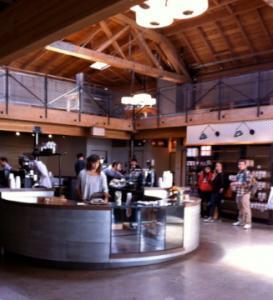
San Francisco’s original Sightglass Coffee Bar
One of the things I like best about going to a café to write is the opportunity to let someone else choose the music. At home, I often listen to the radio for company or sit in silence, rather than put the effort into picking something to listen to. It’s a pleasure to let someone else play DJ.
In fact, all other things being equal, the choice of music the first time I go to a café can encourage me to come back. That’s true for San Francisco’s Four Barrel. I fell in love with the place because it has four taxidermied boars’ heads on the wall. In addition to that, by playing David Bowie’s Diamond Dogs – in its entirety — the first time I visited, they cemented my adoration for the place, despite its unnecessarily strong coffee.
Promising me the most pretentious coffeeshop in San Francisco, my husband Mason took me to Sightglass. The competition for the title is stiff, so I was waiting to be impressed when we entered its industrial glass and hardwood warehouse south of Market. On the Sunday afternoon we stopped by, they were playing something that sounded remarkably like the soundtrack to La Dolce Vita. It was so over-the-top pretentious that I couldn’t help but award Sightglass the crown it so richly deserves. The experience made me want to go out of my way to come back, just to see what they’d be playing the next time.
Sitting in the Mercury Café one morning, I heard a Stranglers album from my long-distant past. One lyric jumped out at me and provided the title for my next novel.
I’ll even sit longer in a café than I plan to, if the music is enjoyable. That’s good for my productivity.
Music does more than set the mood. It welcomes people into the café, makes them feel at home, and can inspire as well as entertain. I think, as an element of design and ambiance, it’s often under appreciated.
What music do you like when you write?

June 16, 2014
Writing in Cafes: Table Rent
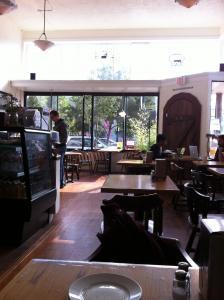
It amazes me the people who don’t understand the economics of running a café. If you’re lucky enough to find a place that allows you to come in and sit for a spell, you have to pay to rent the table. If you’re only staying for a little while, then a coffee drink is okay. If you’re planning to while away an hour, you’d better order a pastry. If you’ve camped for the afternoon, then you’d better buy lunch. And tip big.
People don’t seem to understand that tables in cafes aren’t free. If a paying customer comes in and sees that all the tables are full of people crouching over their laptops, that customer won’t buy lunch. She’ll go down the street to somewhere she can sit down. If enough paying customers walk away, the café can’t keep its doors open for all the freeloaders to come in.
It kills me that the café where I have breakfast three times a week had to have a bake sale to raise money for rent. It’s a great café and their pastries are amazing, but I don’t know if it will survive. I wonder if they’ll turn off their wifi — even though they believe strongly that wifi should be free — and chase the laptop jockeys out.
One of my friends opened a café a couple of years ago. He consciously chose not to offer wifi, to weed out the people who would come and sit all afternoon. Then again, he chose not to play music either, so eating in his café is like sitting in a library. A library without wifi. I find it uncomfortable to talk there, with my voice echoing around the room. I avoid the place unless I’m alone. If I’m alone, I put my headphones on.
Cafes are central to my writing life. There’s something about the anticipation of sitting down amongst strangers, getting that first jolt of caffeine, and opening my notebook.
A couple of years ago the SFEtiquette column atSFWeekly broke down the price scale down even finer than I do: http://blogs.sfweekly.com/foodie/2011/10/when_youre_working_in_a_cafe_d.php
I’m amused by the cafe that blocked its outlets, so people can work only as long as they have battery power.

June 15, 2014
Nice Day for a Graveyard Visit
Every tourist destination has a graveyard. Where are you going this summer?

June 14, 2014
The first journalist to inspire me
 When I was in elementary school, the highlight of my week was the Scholastic Books flyer. My mom let me pick ONE book each week, which was always a source of much internal debate. Not many of those books have stuck with me all these years, but one that did was a biography of Nellie Bly.
Nellie Bly was a small-town girl (like me!) who became independent by writing for newspapers in a time when women were barely allowed out of the house unescorted. She was one of the original immersion journalists, placing herself in the heart of a story to discover its truth.
One of her first adventures was to have herself committed to the Lunatic Asylum on Blackwell’s Island. After ten days there, she wrote a pair of scathing articles about the treatment of women, many of whom had been committed because they were headstrong, difficult for their male relatives to control, or did not speak good enough English to prove their sanity. As a child who’d never encounted the concept of mental illness before — to say nothing of the implication that doctors weren’t always right — it was a bombshell.
Nellie beat Jules Verne’s novel by traveling around the world in 72 days, an amazing feat in 1889, before there were airplanes or motorized vehicles. That a woman should do it…I was inspired for life.