Brett Weiss's Blog, page 8
July 9, 2022
Retro Video Game Conventions in 2022 - Brett Weiss
.jpg)
There are TONS of great retro gaming cons all over the country this year, and I will be at several, including some this summer. I love gaming cons for their vendor rooms, free play arcades, live music, VIP parties, and more. I’m also a huge fan of traveling to various cities and exploring on foot and checking out the local restaurants. To keep things organized, and to let you guys and gals know where and when I’ll be, I decided to post my schedule below.
I hope to see you at a video game convention very soon! Come by my booth, and let’s talk games! If you’re a writer, or you enjoy reading about video games and pop culture, let’s discuss!
Earlier this year, I did the Midwest Gaming Classic. I had an absolute blast hanging out with John Riggs, Metal Jesus Rocks, John Hancock, Adam Koralik, and others, and it was an incredible show with a huge arcade. I sold a bunch of books and had fun game hunting and exploring Milwaukee. You can check out my video report on the con HERE.
***And here's where I'll be in the near future. Click on the title of each show to go to the website.
►Southern Fried Retro Gaming Expo in Atlanta, July 15-17. I’m going to do a panel on The Great Video Game Crash of 1983 at 7:00 PM that Friday night. This will be my second time in Atlanta, but my first time at SFRG. My wife Charis will be going with me, and I’m looking forward to seeing other guests like Mr. Wright Way and ZapCristal, who are also based in Texas. Can’t wait!
►Classic Game Fest in Austin, July 23-24. I do this show every year and always sell a ton of books and other merch. Hosted by Game Over Videogames owner David Kaelin, who has been a big supporter of my work, it’s the biggest retro gaming con in Texas and one of the most enjoyable in the country. This show is always extra special because we visit my niece Cara and her family while we’re in town.
►Game On Expo in Phoenix, Aug. 5-7. This will be my second time doing Game On Expo, and I’m super stoked to go back! It’s a massive show run by John Lester, a good friend of mine and one of my favorite YouTubers. Like Classic Game Fest, they have live music, a big vendors room, an excellent arcade, and cool guests.
►Long Island Retro Gaming Expo, Aug. 12-14. I’ve been to New York twice, but this will be my first time visiting Long Island, and I’m super excited to check out the city and the gaming con. They contacted me years ago about being a guest at the show, and I’m glad it’s FINALLY going to work out with my schedule. As with SFRG, I'll be doing a panel on the Crash. I’ve heard GREAT things about this con!
►Portland Retro Gaming Expo, Oct. 14-16. Returning after a two-year pandemic absence, the long-running PRGE is one of my favorite expos. The always have excellent panels, a fantastic vendors room, and a terrific auction with lots of neat artifacts for sale. Cool guests as well. This show is the closest thing in spirit to the late, lamented Classic Gaming Expo in Las Vegas. It has that great super-old-school vibe!
►Retropalooza in Arlington. Texas, Oct. 22-23. I had to miss this show last year because I was doing CORGS in Ohio, but it usually works well for me because it’s only about a half-hour from my house. Plus, they always have a great vendors room with tons of games. It’s always good catching up with 8-Bit Eric, Tyler Esposito, Okchief, and various other guests when I do this con.
►TORG Gaming Expo in Columbus, Ohio, Nov. 5. Not to be confused with CORGS, which is also in Columbus, TORG is a show that I’ve never done before, but the promoters have absolutely convinced me it’s going to be great. They’ve done a spectacular job getting the word out on the con, and they are going to have a massive gaming museum with tons of rare consoles. I’ll be there with John Hancock for the TORG Gaming Power Exhibit, talking video game history with attendees.

AND MAYBE: ►Houston Arcade Expo, Nov. 11-13. I love this show, which is always a big party. It’s a total blast! I had so much fun last year hanging out with Rampage creator Brian F. Colin and Sam “Flash Gordon” Jones, and they had a killer arcade and swap meet, but I haven’t heard from the promoter this year. If you’d like to see me in Houston this year, let them know!


June 26, 2022
Great Video Game Find! Plus -- First Gaming Console!

I recently uploaded a video about a cool gaming find my wife made in an unlikely place. I show off my find as well, and read a fascinating article about video games from 1983. When I posted a link to that video on Facebook, a “Top Fan” of my FB page named Keith Maldonado left a great comment: a story of how he got his first video game console. I’ve reprinted that story here—ENJOY!
Great video! I’m really cracking up at the article’s author…Particularly when he called video games a waste of money! My mother thought the same thing back in 1982. I had wanted a console system pretty much since Atari introduced its 2600 in 1977. Well, my mother wanted to go shopping at Coronado Center in Abq NM, but knew I would be quite bored. I told her that I could keep myself busy with a mere dollar. She didn’t believe me BUT my grandmother took me up on it and gave me the dollar, which came with the lecture from my mother about asking for more money. Well, I had mastered Joust, which had been out a couple months at this point. Well, I spent only one quarter and was still playing when my mom and grandma came looking for me. I was on the game of my life that day! I had put away a few million points and had an unknown number of spare “lives” still to go. Anyway, when my mother discovered I had been entertained for hours on ONE quarter, she changed her mind on home video game consoles. She offered to get me that Atari 2600 (finally!) for Christmas! Well, it got better because we were watching television and lo and behold, Coleco advertised its new system, the ColecoVision! She asked if I’d rather have that. Totally jumped on that (because in the ad, they mentioned an expansion that played 2600 carts… win win)! That’s how I ultimately got my first home console! …no waste of money there! Mom even bought me a cartridge a month and I soon got a paper route to continue more purchases on my own!
June 22, 2022
Super Smash T.V. for the Super Nintendo - Essay by Todd Friedman

Todd Friedman, host of the Smash TV - The Video Game Facebook page, wrote a killer essay on Super Smash T.V. for the Super Nintendo for my forthcoming book, The 100 Greatest Console Video Games: 1988-1998. I decided to share the text from the chapter with you guys and gals months ahead of the book’s release. The book will be out in November, and the Kickstarter campaign is doing very well. ENJOY!
SUPER SMASH T.V.
SUPER NINTEDO
GENRE: TOP-DOWN SHOOTER
PUBLISHER: ACCLAIM ENTERTAINMENT
DEVELOPER: WILLIAMS ELECTRONICS
1 OR 2 PLAYERS (SIMULTANEOUS)
“The Year is 1999. Television has adapted to the more violent nature of man. The most popular form of television remains the game show. One show in particular has dominated the ratings. That show is Smash T.V. The most violent game show of all time.
“Two lucky contestants compete for cash and prizes. Each contestant is armed with an assortment of powerful weapons and sent into a closed arena. The action takes place in front of a studio audience and is broadcast live via satellite around the world. Be prepared, the future is now.
“You are the next lucky contestant!” - From the Super Smash T.V. manual
With the huge success of the original arcade version of Smash T.V. (1990), it was only natural for home consoles to jump onboard. The Nintendo Entertainment Systemhad an 8-bit version of the game, and then a 16-bit Super NES rendition called Super Smash T.V. followed. Despite the name change, it is a straight-up port of the arcade classic. (Smash T.V. was also ported to the Game Gear, Master System, and Genesis. For the computer market, Ocean published ports for the ZX Spectrum, Commodore 64, Amstrad CPC, Atari ST, and Amiga).

The concept for the game was the brainchild of Eugene Jarvis, who created various other historically important classics, including Defender and Robotron: 2084. Gameplay is similar to Robotron, and the plot and design were influenced by the 1987 films The Running Man and RoboCop. In fact, one of the announcers’ lines in the game is “I’d buy that for a dollar,” which is a direct quote from RoboCop.
According to the programmers of Smash T.V., among them Mark Turmell of NBA Jam fame, the original layout of the game had blood, but just a pixel here and a pixel there. However, they decided to test the limits and go above and beyond most gory games such as Mortal Kombat, and they did not disappoint. The blood quotient is in a class of its own, bringing many people to the game just to see how bloody it really was. Then, many of these players would get hooked and put in more quarters to see what the next screen would bring.
Unsurprisingly, the arcade game has higher resolution graphics than the Super Nintendo port, but the home game looks great nevertheless and retains most of the blood (only the big bloods sprays from certain bosses are missing). Better yet, the game manages to display dozens of sprites with little to no slowdown. The SNES game isn’t quite as fast as its coin-op cousin, but it’s a speedy game nonetheless.
In a recent interview I conducted with Jamie Rivett, the lead developer of the SNES port, he revealed that he was happy with the game and provided some behind-the-scenes info.
“All the heavy optimizations and work really paid off because the Super Nintendo version was actually a pretty faithful conversion of the actual game,” he said. “We never got source code, but I was able to replicate the various enemies by playing the game, and in some ways, this was more fun than if I had been given the code for everything. The one thing that Mark [Turmell] did give up was the spawn tables for each level. That defined which enemies, how many, max on screen, and what rate they came in. I think this is what really gave the SNES version the authentic feel.”

When I was 16, I absolutely loved Smash T.V. The announcer’s voice, the gameshow-style presentation, and the intense shooting action made it super appealing to me. I was excited for the home versions because the arcade game was taking all my money—it is one of the hardest coin-ops to finish on just a few credits. At home, I could play the game again and again without spending loads of money (except for the money it took to purchase the game, of course). To this day, I still play it when I have a chance. If given the choice, I will always play the SNES version as it’s the most realistic of the vintage ports.
Super Smash T.V. is likely not the first game you think of when it comes to the Super Nintendo, but it is a nice change of pace when you want a break from all the family-friendly, first-party titles like Super Mario World and The Legend of Zelda: A Link to the Past.
In this hardcore shooter, you are a contestant on a vicious, violent game show. With the cameras rolling, the announcer says, “Good Luck, You’ll Need It!” The action begins with you (or you and a friend in simultaneous two-player mode) entering the first room on the gameshow stage. Armed with a machine gun, you must run for your life in a series of closed arenas, avoiding bullets and bombs while blowing away baseball bat-wielding gangs, laser-firing orbs, exploding tin soldiers, and other killers bent on your destruction. There at times up to 20 different enemies onscreen at once in the Super Nintendo version and up to 30 in the arcade game. There are few breaks to catch your breath as more enemies come out the instant you kill the others. Each arena has different enemies and attack patterns for you to contend with.

Along the way, you’ll pick up such prizes as money and gold bricks—be careful, though, they may be sitting on top of a hidden landmine. You’ll also find grenade launchers, photon guns, missile launchers, and other weapons. After you clear a stage, you will have the option of going to a couple different rooms. Over time, you’ll learn which routes are easiest to travel and which arenas have more prizes for you to grab. At the end of each of the four rounds of play, a boss awaits: Mutoid Man, Scarface, Cobra Head, or The Game Show Host With The Most. Regular machine gun fire won’t work on them, so you must use your special firepower. There are more than 45 levels of carnage, plus bonus stages.
Playing Smash T.V. can be difficult at home. One of the coolest things about the arcade version is the dual-joystick control that lets you move your character in one direction and fire in another at the same time. The challenge was to replicate that for consoles. The NES did a good job of utilizing both controllers for a one-player game and four controllers for two-player action. Super Nintendo controllers have extra buttons, so you can use them to shoot up, down, left, or right while you guide your character with the d-pad. It’s not a perfect solution, but it gets the job done. In fact, it works pretty well.
When Super Smash T.V. was released, it garnered high marks from such publications as Computer and Video Games, which called it “the most awesome home arcade blaster yet seen,” and Electronic Gaming Monthly, which hailed it as a “winning effort that fans of the coin-op should not miss.”
The action can get a little repetitive, as certain magazine and website reviews point out, but most gamers agree that it is a highly entertaining shooter overall.
In my interview with Jamie Rivett, he further described his satisfaction with the port: “All the conversion shops said no to Smash T.V. because they thought it was impossible to replicate on the home consoles. I guess we proved them wrong!”
FUN FACT
After finishing Super Smash T.V., programmer Jamie Rivett realized that he had optimized the game so much that it could run faster, so he added a turbo mode after completing the regular game. After he implemented this, he would only play the game in that mode.
WHY IT MADE THE LIST
Super Smash T.V. is a controller gripping, heart pounding shoot-'em-up that will blow your mind. No cutscenes, prolonged build-up, or rescuing princesses here—just lots of ass kicking and taking names. Experience everything that made the arcade game great in the comfort of your home—it’s a great way to “kill” an afternoon.
~ Todd Friedman, author of Walter Day's Gaming Superstars, writer for Old School Gamer Magazine
June 20, 2022
Rare Game Boy Color Prototype that Sold for $14,000 in Action! Playing Tetris!

Earlier this year, Heritage Auctions sold a rare Game Boy Color prototype for a whopping $14,400. I actually got a chance to watch the system in action, with someone playing Tetris on it. You can check out my video HERE.
And here’s the auction write-up from Heritage, describing this incredibly cool item:
This is certainly something you don't see every day. A complete prototype board, not for a game, but for Nintendo's iconic "Game Boy Color" system.
Units like this were sent to developers and game publishers for the purpose of testing their games. It was necessary to get the hardware for Nintendo's new system into the hands of developers before its official launch. The unit contains all of the main components of the Game Boy Color system, giving this board full functionality. It includes all the features you'd expect on a handheld system - including a screen, speaker, volume control, IR sensor, and microswitch buttons. For power, the system uses a standard Super Nintendo power cord rather than AA-batteries. We can confirm that the unit functions properly. There's no cooler way to play Tetris than on this! And, yes, we have played Tetris (and Harvest Moon) on it because this prototype is fully functional.
The board sports a "NOA", likely "Nintendo of America", product number. Additionally, the board is labeled as "CGB-STB-X2". This follows Nintendo's standard "CGB" naming convention for Game Boy Color systems, games, and accessories. A very similar Game Boy Advance prototype system does exist\. Its product code of "AGB-STB-03" follows the same format as this Game Boy Color prototype.
June 11, 2022
The 100 Greatest Console Video Games: 1988-1998 - PlayStation - Nintendo 64 - Super Nintendo - Sega Genesis - NES - And More!

Hit a big milestone yesterday on Kickstarter and still going strong!
You can check out my Contra chapter in the book HERE.
And back the book on Kickstarter HERE.
*272-page hardcover book
*Hundreds of full-color photos
*Box art, screenshots and vintage magazine ads
*Production histories
*Reviews, author anecdotes and nostalgia
*Gameplay details and much more!
*Spotlights the greatest games for PlayStation, Nintendo 64, Super Nintendo, Nintendo NES, Sega Genesis, Sega Saturn, and other awesome consoles
June 8, 2022
Intellivision Amico News - CEO Phil Adam Breaks the Silence!

Intellivision CEO Phil Adam has broken the silence and sent out a letter updating people about the progress (or lack thereof) about the Intellivision Amico. There’s not much new information here, and as YouTuber Smash JT says, it seems like they are simply kicking the can down the road a bit. The Amico may come out some day, but I’m not holding my breath. You can read Mr. Adam’s email below, or watch me read and comment on it on YouTube HERE. Thanks!
Greetings,
It has been a while since our last official update, and I thank you for your patience. I hope that this update on the state of Intellivision will answer some of your questions and explain where we are and where we are heading. When I took over as CEO of Intellivision, my goal in leadership required some tough decisions to ensure that we launch a quality product.
1. We pulled down our investment campaign on StartEngine a few weeks after it launched in February of this year. Without better visibility of our path to profitability we felt this was the right decision in the short term. Any funds committed by StartEngine investors as part of the campaign were returned in full. Of course, this required us to take other financial measures to make up for the foregone new investment.
2. We have dramatically reined in operating costs, which unfortunately required a significant reduction in staff. Our resources are focused on engineering and testing to ensure we have a quality system, as we cannot succeed by producing anything less.
3. We are working with game development partners to license classic Intellivision intellectual property (IPs) for publication on other platforms. These licensing deals will help fund continued development of Amico. A broader distribution of Intellivision classic IP will also help raise awareness of Intellivision while not directly competing with Amico because of Amico’s unique controllers and family-focused gaming adaptations. Many people in the retro gaming community have embraced us because of our family focus and the fact that all our games (including retro titles) are adapted for group play. While Amico’s broad catalog will continue to include retro titles, our mission has been and remains cross-generational, in-home, family entertainment.
4. We have begun a test production run of Amico that includes every aspect of the product including packaging. This is first and foremost an assessment of our manufacturing approach and overall quality of the delivered product. It is critically important to show to our current/future investors, partners, and customers that we have built a sound platform that delivers on the in-home family experience, which requires our immediate focus on value engineering and hardening of the platform. These units should be completed in the next few weeks.
5. We are slowly processing refund requests. The public’s uncertainty of our status in the last few months have understandably led to an influx of pre-order refund requests. Because of reduced staff and financing requirements for continued operation, our responses to and processing of these requests has been delayed. Rest assured that our intention is to honor all refund requests. We will allocate a portion of all new funding and staff time to winding down the refund queue, while our primary focus is funding and completing a quality product ready for manufacturing. To make sure we see your request, please submit to support@intellivision.com.
6. We will focus our initial mass production on fulfilling pre-orders and supplying our two major distribution partners. The focus will remain on direct orders until our cost structure can support the margins required for retail channels. Obviously, the markets continue to be somewhat volatile with rising inflation, rising energy costs and lingering supply chain issues that affect all manufacturing businesses. This has impacted both our costs and pricing, and it has required us to narrow our initial distribution strategy. Our hope is that we start shipping production units this year.
Many challenges lie ahead for the business, and we appreciate our investors, partners and customers for your patience and support. We will be formally announcing some new IP licensing partnership deals soon, as well as showing off the Amico units currently in production. These units will be shared with partners, investors and a select few in the media. As more production units become available we will broaden the distribution to media outlets that cover our target demographic.
Thank you for your support, and thank you to our internal team and external developers that work tirelessly to create a family gaming experience on Amico that brings people of different ages and skills together in group play
Phil Adam
CEO
June 4, 2022
Adventure for the Atari 2600 - The 100 Greatest Console Video Games: 1977-1987

I recently did a video on Adventure, the legendary Atari 2600 game. You can check it out on YouTube by clicking HERE. If you prefer a deeper dive on the subject, check out the essay below from my book, The 100 Greatest Console Video Games: 1977-1987. And if you are really into reading about retro gaming, you can check out the sequel to the book, which is NOW ON KICKSTARTER.
Whichever way you go, enjoy!
Adventure
Atari 2600
Genre: Adventure
Publisher: Atari
Developer: Atari
1 player
1979
Although extremely dated in appearance, Adventure for the Atari 2600 is such an influential and continually endearing game that I simply had to include it in this book. Not only is it a fun game in its own right, it paved the way for countless adventure quests to following, including such favorites as The Legend of Zelda, Final Fantasy, and Tomb Raider.

Created by Warren Robinett, Adventure has players trying to retrieve an enchanted chalice, which was stolen by an Evil Magician and hidden somewhere in a labyrinthine Kingdom. Said chalice must be returned it to the Golden Castle where it belongs. Making this task difficult are three dragons created by the Evil Magician: Yorgle, the mean yellow dragon; Grundle, the mean and ferocious green dragon; and Rhindle, the fastest, most ferocious dragon.
There are three castles in the Kingdom for players to explore: Black, Gold, and White, each of which contains a gate over its entrance that must be opened with a color-coded key. Castles are separated by labyrinths, pathways, and rooms, and there are items scattered about these areas that will help the player in his or her quest. In addition to keys, players can find a bridge for passing through barriers, a magnet for moving objects and removing stuck and out-of-reach objects, and a sword for slaying the dragons.
Each dragon guards specific items. In addition, there’s a pesky black bat that tries to switch out items with the player, such as—god forbid—an enemy dragon in exchange for the fabled chalice.
Adventure offers three skill levels, the hardest and most tantalizing of which finds the objects and dragons placed randomly within the Kingdom. Further, when the left difficulty switch is set in the “B” position, the dragons hesitate before they attack the player, making the dragons a little easier to dodge.
Robinette got the idea for Adventure from a computer game, as he revealed in an interview published on www.dadgum.com. “I played the original text adventure, written by Don Woods and Willy Crowther, at the Stanford Artificial Intelligence Lab in 1978,” he said. “This was while I was working on Slot Racers. Then it was time to do another game, and I thought that doing Adventureas a video game would be really cool.”
Creating such a game with graphics created some “tricky problems,” as Robinette explained: “Text adventures used verbal commands like ‘Go North’ or ‘Take Wand’ or ‘Wave Wand.’ My idea was to use the joystick for the North/South/East/West commands, the button for picking up and dropping objects, and touching graphical objects together on the screen for all the other miscellaneous actions…instead of describing each room in text, I would show it on the screen, one room at a time…driving off the edge of the screen was the analog of ‘Go North’ or east or whatever. This allowed the game to have a much larger playing space than a single screen, which was a big change in the feel of a video game.”
The “character” players control in Adventure has the appearance of a simple square, and the dragons look like ducks you might find in a shooting gallery. The castles are comprised of squares and rectangles, and the mazes consist of the type of crude outlines found in such early Atari titles as Slot Racers (also by Robinett) and Maze Craze. The sparse sound effects are a meager collection of bleeps and bloops.
In a recent interview with Chris DeLeon (hobbygamedev.com), Robinett talked about working on Adventure and the special challenges of programming for the 8-bit console. “The Atari 2600 has so many limitations that it's hard to do anything” he said. “If I had more resources I might have represented it [the graphics in Adventure] differently, but it worked.”
When Robinett was developing Adventure, Atari didn’t pay royalties to programmers, nor did they publish creator credits, as he related in High Score! The Illustrated History of Electronic Games (Osborne/McGraw-Hill, 2002).
“When I first went to Atari, I thought I’d died and gone to heaven,” he said. “I was being paid to design games. But then, after about a year and a half, it started to dawn on me that Atari was making hundreds of millions of dollars and keeping us all anonymous. They didn’t even give you a pizza if you designed a good game. There was no incentive at all. Nothing. That’s when I had the idea of hiding my name in the game.”
As any retro gamer worth his thumbs knows, Robinett created a secret room in Adventure “that could only be accessible by selecting a single gray dot on a gray wall,” a major violation of company policy. “I could have been fired if anyone had discovered it, so I kept it secret for a year,” he said. “The game code would have been very easy for Atari to change if they had known about the secret room. But after 300,000 Adventure cartridges had been made and shipped around the world, it was too late.”

For years, Robinett’s name in Adventure was thought to be the first “Easter egg”—a term coined by Arnie Katz, Joyce Worley, and Bill Kunkel of Electronic Gamesmagazine—in a video game. However, in 2004 a programmer and collector named Sean Riddle found an Easter egg—programmer Bradley Reid-Selth's surname—in Videocart-20: Video Whizball (featured in “The Next 100” appendix at the back of this book) for the Fairchild Channel F system. Video Whizball was released to stores in 1978.
According to Before the Crash: Early Video Game History (2012, Wayne State University Press), however, the exact historical timeline of Easter eggs in video games is muddled. Contributor Zach Whalen writes, “…some confusion may yet exist over which programmer deserves credit, since Reid-Selth claims to have gotten the idea because of reports that programmers at Atari were already doing it, and Robinett had completed at least some of the code for Adventure as early as 1978."
Regardless of who invented the video game Easter egg, everyone agrees that Robinett popularized the idea, and most everyone agrees that Adventure is a great title, despite its primitive audio/visuals.
“Rich gameplay more than makes up for the game’s rudimentary graphics and sounds,” said Chris Cavanaugh of The All Game Guide (formerly at allgame.com). Jeff Rovin, in The Complete Guide to Conquering Video Games (1982, Collier Books), called the game “absorbing” and said that “if you like surprises [and] enjoy seat-of-the-pants play mixed with ingenuity and bravado, Adventure is your cup of hemlock.”
In a review published in issue #7 (June, 1984) of the British publication, TV Gamer, the writer said, “Adventureis one of the most enthralling games you can buy for the Atari 2600 and any adventure enthusiast should not be without it.”
In the “Digital Press Presents: Our 99 Favorite Classics” feature published in issue #33 (Sept./Oct., 1997) of the Digital Press fanzine, the contributors had predictably high praise for Adventure, calling it “a longtime favorite…arguably the most replayable adventure game because of its random skill setting on game 3…the perfect example of the video gaming spirit.”
In Classic Gamer Magazine #3 (Spring, 2000), Kyle Snyder said Adventure is “both charmingly simple and dauntingly difficult. It speaks to the inner child in all of us. Those of us who saw it brand new when we were six were blown away at all the things you could do. Whether you were busy searching catacombs, collecting objects, or slaying dragons, there was so much to interact with.” (Snyder was apparently a child prodigy—Adventure would have confused me silly as a six-year-old.)
In Ken Uston’s Buying and Beating the Home Video Games (1982), the noted gamer and gambler made a prescient prediction about Adventure: “I have a feeling that this cartridge…is going to be the wave of the future.”
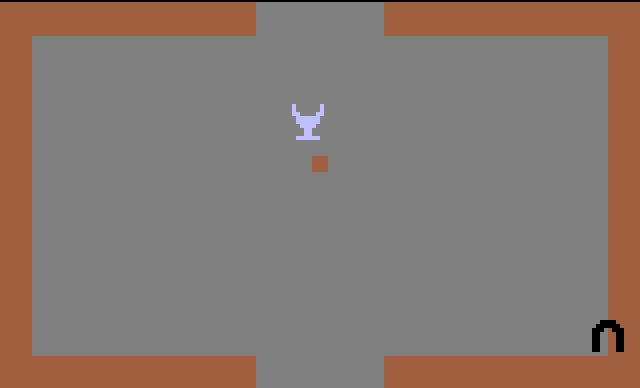
With countless fantasy adventure video games following in its wake, Adventure, which sold more than a million copies, did nothing less than change the industry forever. Not only did it create the fantasy adventure genre for consoles, it predicted an industry in which “entire games would be built around hidden surprises” (2001, The Ultimate History of Video Games: From Pong to Pokemon--The Story Behind the Craze That Touched Our Lives and Changed the World).
A timeless classic, Adventure has been reissued for modern systems on such compilation discs as Atari Anthology! (2004, PS2, Xbox) and Atari Classics: Evolved(2007, PSP). It’s also built into Atari Flashback consoles 1-3. In 2010, Microsoft made Adventureavailable as a downloadable title for the Xbox 360 Game Room service.
Atari announced a sequel to Adventure in 1982, but it devolved into the ill-fated Swordquest series. In 2005, Curt Vendel creature a true sequel, Adventure II, for the Atari Flashback 2 console. In 2007, AtariAge also released a game called Adventure II, this one a homebrew sequel for the Atari 5200. Epic Adventure, an AtariAge homebrew for the Atari 2600, followed in 2011.
FUN FACT: Adventure is parodied in "Cannot Be Erased, So Sorry," a 2009 episode of Robot Chicken (a stop-motion animated show produced by Seth Green).
WHY IT MADE THE LIST: “Possibly the greatest game ever written for the Atari 2600 platform” (Time Magazine, Nov. 15, 2012), Adventurenot only created a new console gaming genre, it is still widely played today.
***If you enjoyed this write-up on Adventure, consider purchasing a copy of The 100 Greatest Console Video Games: 1977-1987. THANKS!

May 30, 2022
GoldenEye for the Nintendo 64 - Book Excerpt from The 100 Greatest Console Video Games: 1988-1998 - NOW ON KICKSTARTER!
My forthcoming book, The 100 Greatest Console Video Games: 1988-1998 , features essays on some of the most amazing games of all time, including the classic Nintendo 64 first-person shooter, GoldenEye 007. A number of super talented writers contributed to the book, including Kale Menges, who wrote the GoldenEyeessay.
If you enjoy the essay below and want to read 99 more in full color with tons of gorgeous images and beautiful page layout, you can back The 100 Greatest Console Video Games: 1988-1998 on Kickstarter by clicking HERE. The hardcover book will feature production histories, gameplay info, author anecdotes, screenshots, box art, vintage ads, quotes from programmers, a foreword by Chris “The Irate Gamer” Bores, and much more. Thanks for reading, and thanks for your support!
GOLDENEYE 007
NINTENDO 64
GENRE: FIRST-PERSON SHOOTER
PUBLISHER: NINTENDO
DEVELOPER: RARE, LTD.
1-4 PLAYERS (SIMULTANEOUS)
1997
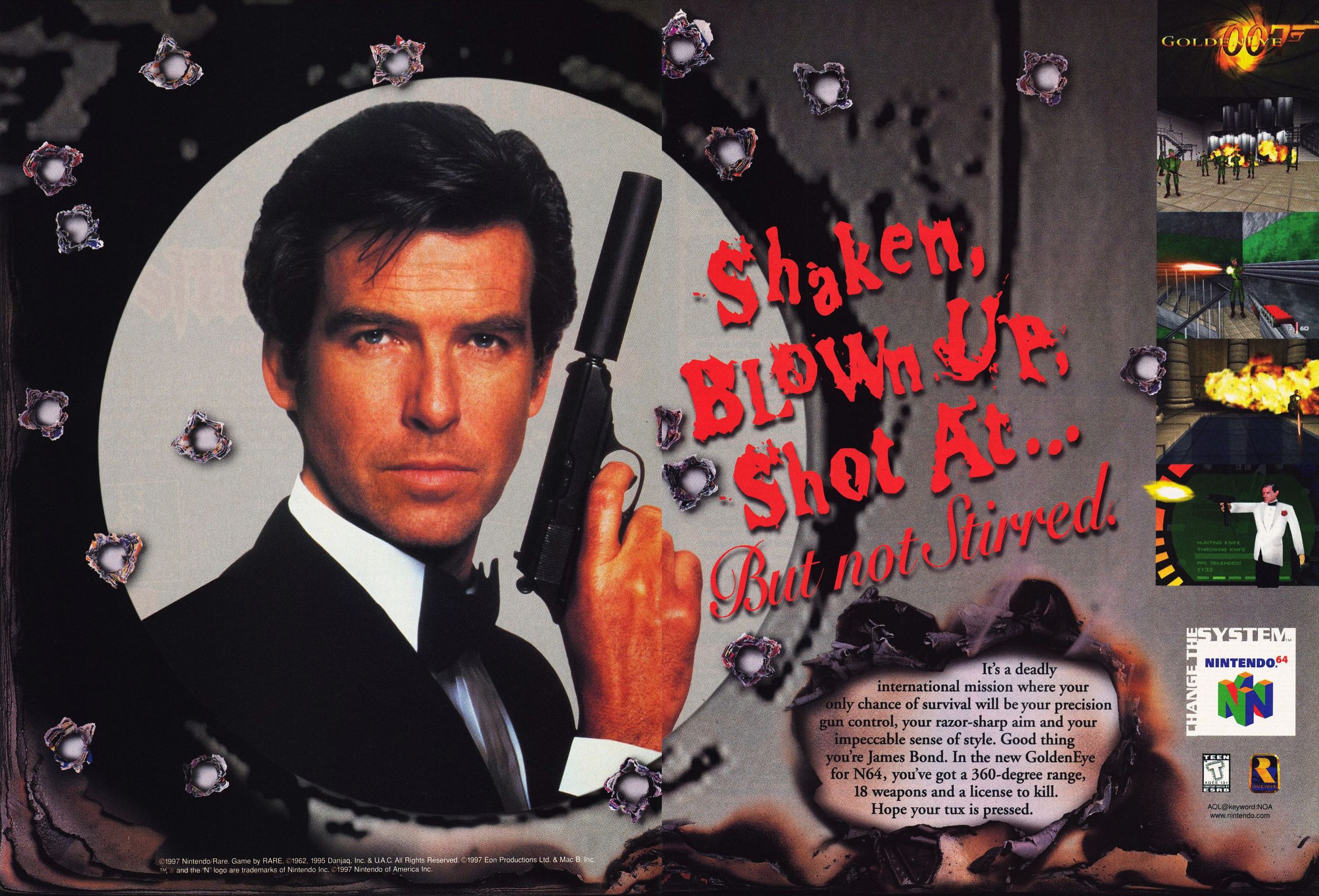
From the moment you hit the power button, you know GoldenEye 007 is special. Before a single corporate logo appears onscreen, you are presented with an official looking splash screen parodying the classic British Board of Film Classification ratings slide typically seen before theatrical presentations. It’s a simple touch, but it shows just the right amount of class before the gloves come off. There’s a crash of cymbals and a hit of brass as slickly rendered Nintendo and Rare logos appear, before a hard rock interpretation of the classic 007 anthem announces things are about to get real. Limited cartridge memory might mean no fancy full-motion video intro, but GoldenEye 007 has no need for such gimmicks. Recreating the classic James Bond rifled barrel shot, the short and sweet intro is perfectly on-point for a game that is the ultimate cocktail of secret agent action and style: shaken, not stirred.

I didn’t know what to make of GoldenEye 007 as I followed its development in magazines like Nintendo Power and GamePro before the Nintendo 64’s launch. Movie-based video games had a bad reputation for being cheap cash grabs, so I wasn’t hyped for it until I finally saw it in person on a demo kiosk in a Blockbuster Video store. I only rented it once before buying a copy of my own at Toys “R” Us the same day I had to return the rental. It was an amazing first-person shooter with incredible gameplay and genuinely deep mechanics that did a great job of recreating the film it was based on, completely defying my expectations.
That said, I will forever identify this game with one of the best friends I ever had. He had a rough home life and actually ended up living with my family the last couple years of high school. It was like having a slumber party every night, and we played an unholy amount of GoldenEye 007. The game became my friend’s release from his troubles and a coping mechanism. We spent countless long nights playing it, obsessively speed-running every level to unlock all the cheats and multiplayer maps and characters, and perfecting our secret agent techniques like planting remote mines on body armor pickups (ruthless, I know).
It’s only fitting that an amazing James Bond game should be developed by such a renowned British studio as Rare, Ltd. Based on the 1995 movie GoldenEye (the 17th film in the James Bond franchise), the game’s development started that same year shortly after the release of Rare’s Killer Instinct arcade title. Working with a surprisingly modest budget of around $2 million, GoldenEye 007’s development team of 11 full-time developers, led by game director Martin Hollis, was relatively inexperienced but took the challenges of developing for the notoriously complex Nintendo 64 head-on before the console’s hardware specs were even finalized. They employed Silicon Graphics Onyx workstations similar to what Rare had been using for pre-rendered CGI graphics in previous games like Donkey Kong Country and Killer Instinct.
GoldenEye 007’s first-person shooter design was initially heavily influenced by Sega’s Virtua Coparcade game, evident in the game’s toggled targeting mode and crouching mechanics, with “on-rails” level designs actually considered early in development. Thanks to the influence of id Software’s DOOM, though, Rare went with a much more non-linear approach to level design. Most of the game’s 3D environments were actually constructed as reproductions of real-world spaces with an emphasis on practical layouts and architecture.
Game design was then layered on top of the pre-existing environments after the fact, allowing the developers to create levels with multiple paths and solutions, almost becoming playgrounds for the game’s fluid, fast-paced combat and innovative stealth mechanics (avoiding/eliminating surveillance systems, monitoring noise levels, etc.). This also made adapting the single-player levels into multiplayer arenas a much more straightforward process. Programmer Steve Ellies developed the game’s generation-defining multiplayer mode during the final six months of development, with most of the team spending their nights and weekends play-testing relentlessly. After two-and-a-half years of development time, the cartridge was finally released to near-universal acclaim on August 25, 1997.
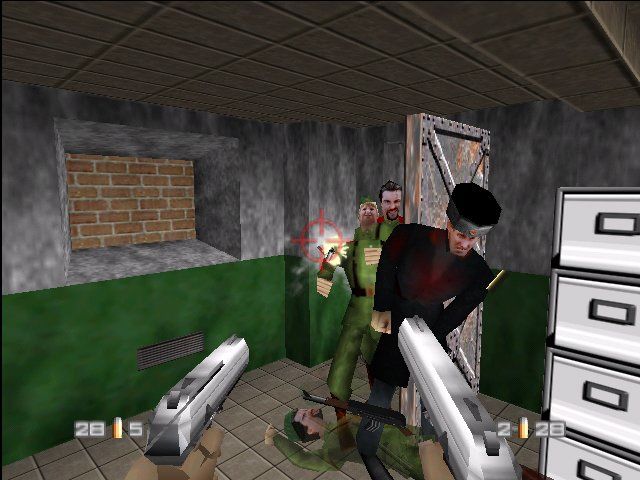
GoldenEye 007’s single-player campaign closely follows the plot of the movie. James Bond is on a mission to tie up loose ends from the Cold War with Soviet relics and double agents, traveling across Russia from a top-secret satellite base in Siberia to a harrowing car chase with a tank through downtown Moscow and eventually to a hidden nuclear weapons facility in Cuba where he must confront a longtime friend-turned-traitor to prevent a global catastrophe. The game’s visually detailed levels are excellent recreations of the film’s various locations and sets, capturing its look and feel in a way never really achieved in a movie-based game up to that point.
Using 007’s wristwatch as the in-game UI for menus and health gauge was a stroke of genius that seriously enhances the sense of being James Bond, really nailing the gadget aspect of the secret agent fantasy. The visual effects are also impressive, with nicely animated explosions and smoke, muzzle flashes, and all manner of small bits of polish like bullet holes that smolder for a moment after impact. The various animations for enemy characters are well done, too, with location-specific hurt reactions and death animations that are entertaining and also provide meaningful feedback to the player.
The character models themselves, unfortunately, are where a great deal of optimization was required to ensure the game’s phenomenal four-player split screen multiplayer mode ran well (nearly every character in the single-player game is playable in multiplayer). While the faces of the main characters are indeed texture mapped with the likenesses of Pierce Brosnan, Sean Bean, and other stars (even classic Bond villains like Jaws and Oddjob are playable in multiplayer), the character polygon counts and texture resolution aren’t exactly the best the system has to offer, but they get the job done.
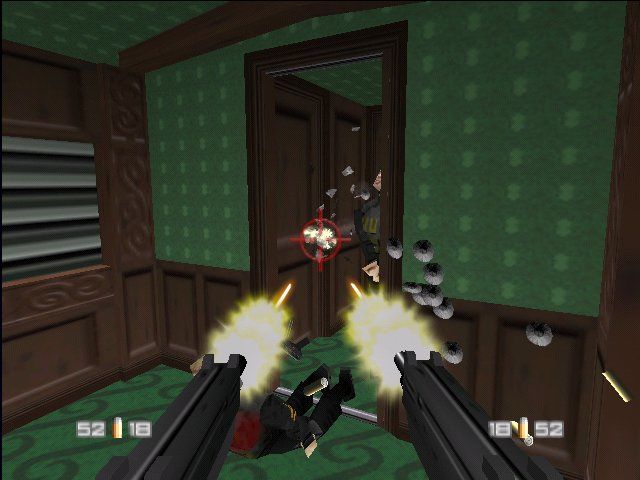
The audio actually outshines the visuals, with outstanding ambient sounds, gunfire, and explosion effects throughout, though the cartridge’s limited memory capacity does mean there are virtually no voices in the game. GoldenEye 007’s soundtrack, primarily composed by Rare veterans Graeme Norgate (Blast Corps) and Grant Kirkhope (Donkey Kong Country 2), is an electronic reimagining of classic Bond themes that is both iconic and modern. It mixes MIDI brass and rock guitars and ranks among the best the Nintendo 64 has to offer.
Fully embracing the N64’s unique controller, the intuitive play control and straightforward setup make it a breeze to get into. Playing through the single-player campaign is training for multiplayer, rewarding gamers by unlocking bonus characters and various cheat modes. “DK” mode gives all the characters gigantic heads and arms parodying the simian characters of the Donkey Kong Country games, and the “paintball” mode is actually a tongue-in-cheek jab at Nintendo’s then fairly strict policies on violence in games.
With over eight million copies sold and grossing more than $250 million in revenue worldwide, GoldenEye 007 is the third best-selling Nintendo 64 cartridge of all time, according to the Entertainment Software Association. The game was awarded the prestigious BAFTA “Game of the Year” award in 1998, and received several awards from the Academy of Interactive Arts and Sciences including “Interactive Title of the Year” and “Console Game of the Year.”
Despite its popularity and commercial success, licensing issues between various copyright holders have prevented any legitimate rereleases of the game. Ultimately, though, GoldenEye 007 will always be remembered for the way its multiplayer content reshaped console gaming at large. The incredible depth and variety offered through the game’s customization settings and cheat options in multiplayer, though, is something that few games since have come close to achieving, and gives GoldenEye 007 limitless replay value that has immortalized it as one of the crown jewels of the Nintendo 64 library and one of the greatest titles of a generation.
Rare originally created character models of all four actors to have portrayed James Bond up to GoldenEye’s release—Sean Connery, Roger Moore, Timothy Dalton, and Pierce Brosnan—for the game’s multiplayer mode, but Sean Connery declined to license his likeness for the game. The additional character models were ultimately disabled for the shipped version of the game, but the finished art assets are actually still stored intact on the game cartridge!
Every bit as suave and sophisticated as James Bond himself, GoldenEye 007 proved first-person shooters could thrive on home systems, redefining what was possible for multiplayer console games in the process.
~ Kale Menges, game developer and artist
May 28, 2022
Funded on Kickstarter! - The 100 Greatest Console Video Games: 1988-1998
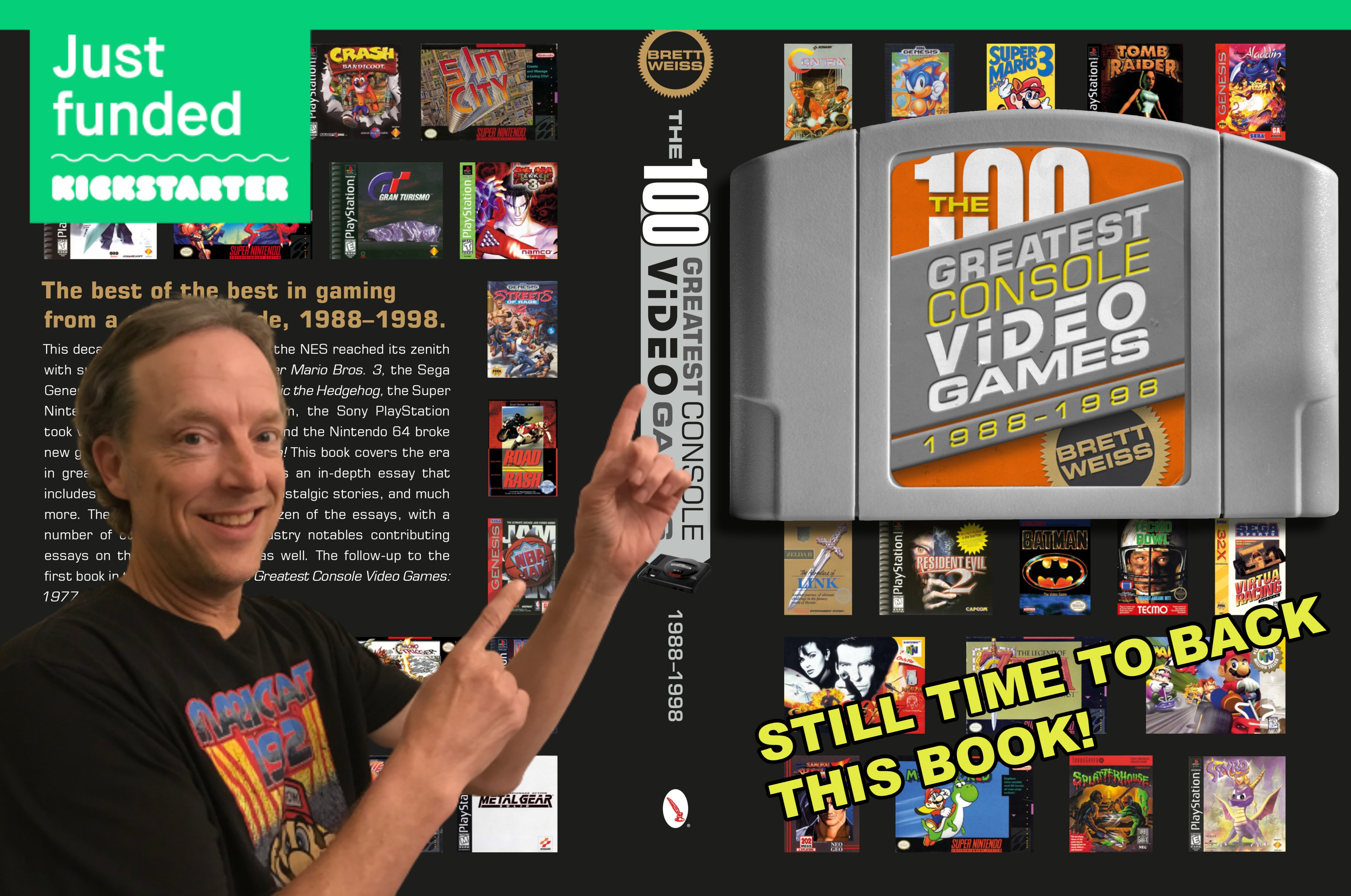
Wow, funded in just three days! Thanks to everyone who helped make this project a resounding success! Since I’m so jazzed about this, I decided to post my preface to the book where everyone can enjoy it. Even though the book has reached its goal, the campaign has a long way to go. You can back the book by clicking HERE.
Without further ado, here’s the preface to The 100 Greatest Console Video Games: 1988-1998:
When I’m a guest author (and now YouTuber) at various video game conventions around the country, including such shows as Classic Game Fest in Austin and the Portland Retro Gaming Expo, the question I get more than any other is, “What is your favorite game of all time?” The answer is always Mr. Do!, Universal’s 1982 arcade game ported brilliantly to the ColecoVision and Super Nintendo (my preferred home versions). If you haven’t played this classic maze title, you definitely should check it out.
The next most frequently asked question I get from fans is if I’m going to write a sequel to The 100 Greatest Console Video Games: 1977-1987, my first book from Schiffer, published in 2014. That book, which was inspired by the 2009 edition of Bill Warren’s titanic tome Keep Watching the Skies! American Science Fiction Movies of the Fifties (McFarland), has helped me connect with fans like nothing else I’ve ever written. To this day, I get a steady diet of feedback from readers on what for me was a pure labor of love. Many people tell me it’s their favorite book of mine and one of their favorite video game books all of time.
I’m truly humbled and flattered by all the attention the book has gotten, and I had a blast researching for and writing it. In fact, it’s the most fun I’ve ever had writing a book, thanks in part to the fact that all the games in it are, by definition, great. And I LOVE that era of gaming.
When 2020 hit, and the lockdowns began due to the Covid-19 pandemic, I decided to finally do what I’ve been wanting to for quite some time: heed the fans’ wishes and start writing The 100 Greatest Console Video Games Vol. 2: 1988-1998, which picks up where the original volume left off and covers another super important decade of gaming. Thanks to advances in technology and game development during the era, most of the games featured in this book are longer, more complex, and more story-driven than those in the first volume, which in some ways made it more interesting and more challenging to write. But the key qualification for each game remained the same: it must still be fun to play today, not just historically important (although that certainly plays a role).
During the timeframe this book covers, the Nintendo Entertainment System reached its zenith with such awesome games as Castlevania III: Dracula's Curse, my personal favorite in the series, Contra, the hardcore platform shooter that popularized the Konami Code, and Super Mario Bros. 3, which many players and pros cite as the greatest video game of all time. Do you have fond memories of playing Tecmo Bowl with friends and family members? You will of course find that game—one of the most beloved sports titles for any console—in these pages.
In 1989, Sega released the fantastic Genesis console, which would introduce the world to such concepts as “blast processing” (a marketing term created by Sega), “Sega does what Nintendon’t,” and a certain furry, attitudinal blue hedgehog that quickly became the company mascot. The Genesis originally came packaged with Altered Beast, which didn’t make the cut here, but the “Genny” is well-represented in this book by such titles as: Gaiares, an amazing hardcore “shmup” with an odd name; Gunstar Heroes, a dazzling platform shooter that will make Contra fans stand up and take notice; Mega Bomberman, my personal favorite in that killer multi-player series; NBA Jam, which is entertainment personified; and of course Sonic the Hedgehog (which replaced Altered Beast as the pack-in with the console), one of the most iconic video games of all time. The Genesis add-ons even get some love in these pages, with entries for such stellar titles as Earthworm Jim: Special Edition for the Sega CD and Virtua Racing Deluxe for the Sega 32X.
Nintendo released their follow-up to the NES in 1991 with the Super Nintendo, which regularly shows up at or near the top of greatest video game console of all time lists. It is indeed amazing, featuring such legendary titles as Contra III: The Alien Wars, The Legend of Zelda: A Link to the Past, and Super Castlevania IV, each of which carried forward a series featured on the NES and amped it up considerably in terms of graphics, sounds, size, sizzle, and overall awesomeness. The console also boasted awesome RPGs (such as Chrono Trigger), groundbreaking titles (such as Super Mario Kart), and games that breathed new life into tired genres (such as Donkey Kong Country).
If you aren’t super well-versed on the Neo Geo, Phillips CD-i, Panasonic 3DO, Sega Saturn, Atari Jaguar, or TurboGrafx-16, no worries—this book features the best-of-the-best for each of these relatively obscure consoles. If you’ve never played Metal Slug, Devil’s Crush, Tempest 2000, Panzer Dragoon Saga, or Wing Commander III: Heart of the Tiger, I pretty much guarantee you will want to after reading the chapters on these great, often underappreciated gems. If you’re a hardcore gamer, you know what I’m talking about.
And, then, of course, there’s the original Sony PlayStation and the Nintendo 64, consoles that gave us games that countless people of all ages still talk about, collect, and play on a frequent basis today. (You could say that about the NES, Genesis, and SNES as well, but I digress…)
The PS1, as it’s commonly known, was released in Japan in 1994 and hit the rest of the world in 1995. It brought mature, 3D gaming into the mainstream, changing the industry forever with such sophisticated titles as: Gran Turismo, a shockingly realistic racer; Castlevania: Symphony of the Night, a masterpiece co-architect of the “Metroidvania” subgenre; Metal Gear Solid, a stealth game with movie-quality production values; and Crash Bandicoot, which showed that the PlayStation could provide simple, charming, mascot-driven family entertainment as well.
Thanks to its air of elegance and refinement, the PlayStation was seen as less of a toy than most previous consoles and was viewed as more of an accepted entertainment device along the lines of a stereo or a VCR. For many gamers, it was their first CD player as it was compatible with that then-burgeoning music format. I was extremely impressed with the PlayStation, but as an old-school gamer it was the Namco Museum collections that truly sold me on the console and made me plunk down my heard-earned cash. For the first time, I could play pitch-perfect emulated versions (as opposed to close approximations) of classic arcade games at home. (I quickly grew to love many of the system’s more advanced/complex offerings as well.)
The Nintendo 64, released in 1996, has been criticized for sticking with the cartridge format, but it has some of the best, most fondly remembered first-party titles of any console. Like Super Mario Bros. for the NES, Super Mario 64 redefined and expanded the platformer genre, this time in glorious 3D. Despite showing its age, Goldeneye 007 is a fondly remembered multi-player game that introduced the concept of the first-person shooter to many gamers who were too young to remember DOOM and Wolfenstein 3D. And games like Banjo-Kazooie, Mario Kart 64, and Diddy Kong Racing were just plain fun.
As I mentioned earlier, I had a lot of fun writing this book. I had a blast editing it as well. In fact, editing was a HUGE part of the process because, unlike the first 100 Greatest book, a number of other scribes pitched in on the project and wrote their own essays about important games they love. These creators include: Greg Sewart, former editor for Electronic Gaming Monthly; Shane Stein, Executive Producer of Adventures in Game Chasing; Brian Lesyk, host of the Pass The Controller podcast; Kale Menges, a game artist and developer; and Matt Miller, a high score champion. I included these and other talented folks so you guys and gals would get opinions and nostalgic recollections from a variety of perspectives and not just my own. Plus, I needed writers to do chapters on games that I knew belonged in the book but that I’m not super passionate about, such as Final Fantasy III, Metal Gear Solid, and SimCity. (Spectacular games, of course, but I prefer more action-oriented titles.) The contributing writers did a fantastic job, and I truly believe you’ll enjoy reading their essays as much as I did. This book was truly a collaborative effort!
So, how did I come up with the list of 100 games? Good question. As with the first book, whether or not I thought the game holds up in terms of sheer entertainment was the primary determining factor. Graphics, sounds, historical significance, and other factors played a role as well, but enjoyment level and timelessness were more important. I did the research, replaying and brushing up on countless games, created the list, and ran it by my contributing writers and my Patrons for their feedback. They offered suggestions, some of which I took. The list is largely the same one I originally drafted, but I did change out a few titles. For example, Brian Lesyk suggested I replace The Legendary Axe II with The Legendary Axe. Both are great, but he was more passionate about the original than he was the sequel, and he felt it was a superior game. Since he was doing the essay, I complied.
So, what about games released from 1988-1998 (U.S. release dates) that are clearly top-notch but that aren’t featured in the book? Sonic the Hedgehog 2 was edged out by Sonic the Hedgehog. Both are amazing and still super fun, but the latter is more historically important (see, historical importance does count for something). Same with including Donkey Kong Country over Donkey Kong Country 2: Diddy's Kong Quest. I didn’t want to feature too many examples of games from the same series for the same console, but then, you might ask, why did both Resident Evil and Resident Evil 2 for the PS1 make the cut? And what about the inclusion of Streets of Rage 2—where’s the original game? Good questions that we can discuss if I ever see you at a gaming convention. Or, you could reach out to me on social media—I’m pretty easy to find. I’d love to hear your opinion on which games I should have included but didn’t and which ones that shouldn’t grace these pages but do. In other words, tell me where I went wrong!
Now, I’d better wrap up this lengthy rant so you can get to reading about what you came for—the games!
~ Brett Weiss
P.S. If you enjoy my work, please check out more content at www.brettweisswords.com. There you can find articles and reviews, as well as links to my books, Patreon page, social media, and YouTube channel. Enjoy!
May 24, 2022
Chris "The Irate Gamer" Wrote the Foreword to My New Book!
.jpg)
My newest book, The 100 Greatest Console Video Games: 1988-1998, is now on Kickstarter, and I’m super excited that Chris “The Irate Gamer” Bores agreed to write the foreword! He did an amazing job putting the era in perspective, providing some great memories, and preparing gamers to dig into the book and check out the best of the best from an incredible decade of gaming. Here’s Chris’s foreword in its entirety, for your reading pleasure. Thanks for checking it out!
FOREWORD to The 100 Greatest Console Video Games: 1988-1998 by CHRIS BORES:
Video gaming from 1988 to 1998 was an incredible time in the evolution of home consoles. The previous decade molded and popularized the medium with hit after hit, including such seminal titles as Pitfall! for the Atari 2600, Major League Baseball for the Intellivision, and Super Mario Bros. for the Nintendo Entertainment System, but the period this book covers is my favorite era.
While the NES was test marketed in 1985 and released across the country in 1986, it really began picking up steam in 1987. By 1988, things went into overdrive as references to the console and its games began working their way into the pop culture landscape at large. My first memory of this was in 1989 while I was watching an episode of Doogie Howser. During the show, a new patient at the hospital wouldn’t talk to anyone. The only thing that got the kid to open up was when Doctor Doogie began speaking with him about The Legend of Zelda.
Beginning in 1987, I dressed up as Mario for Halloween several years in a row. That first year, nobody knew who I was. The next year, people one after the other said, “Hey, it’s Mario!”
Indeed, America was primed and ready for a new, post-Crash invasion of electronic entertainment. From sitcoms to films to MAD magazine and beyond, NES references sprung up everywhere. Networks began airing a host of cartoons, including Captain N: The Game Master, The Power Team, and The Super Mario Bros. Super Show!, the last of which also included live action segments.
Boxes of Nintendo Cereal System, featuring fruit-flavored Marios and berry-flavored Links, lined super market cereal aisles while Panini produced Super Mario stickers and McDonald’s included Super Mario Bros. toys with their Happy Meals. One highlight of the NES craze was the 1989 feature film The Wizard, which featured a Super Mario Bros. 3 competition before the game was even released. (The less said about the 1993 Super Mario Bros. movie, the better.)
After the above-referenced Great Video Game Crash of 1983, gaming magazines largely vanished, but that didn’t stop Nintendo from launching Nintendo Fun Club News in 1987. The magazine featured hints, tricks, and, of course, news. The mag was such a success that Nintendo cancelled it in 1988 and began publishing the thicker, more elaborate Nintendo Power, which began as a bi-monthly publication and then quickly changed to a monthly format. I read and re-read those magazines cover to cover until the dang things practically fell apart—I wanted to know every detail about the games I loved and then some!
As gaming entered the 1990s, the 16-bit Sega Genesis (1989) and Super Nintendo (1991) juggernauts battled it out for supremacy in the marketplace, resulting in the famed Console Wars. Systems like the 3DO, Neo Geo, and TurboGrafx-16 tried to compete with Sega and Nintendo, but they lagged far behind. Growing up, I had no idea Sega existed (no one I knew had a Master System) until the 1991 release of Sonic the Hedgehog, the company’s faster, edgier answer to Mario.
My uncle had a Genesis, and I went over to his house to play it. I remember looking at the controller and thinking, “Three buttons? What do I need a third button for?” I liked Sonic the Hedgehog, but I was especially enamored with 1992’s Sonic the Hedgehog 2—talk about a game-changer! That holiday season, Sonic and his new sidekick Tails successfully lured me away from the clutches of Nintendo. I was now a Sega fan. The graphics and unique “dash at ’em” gameplay was revolutionary, especially when it came to the fun 3D bonus rounds.
Seemingly overnight, the blue hedgehog spun his way into the hearts of gamer kids everywhere. Soon he had his own daily cartoon, a Saturday morning cartoon, a comic book series published by Archie, Happy Meal toys, and much more. Then when Sonic & Knuckles (1994) came out and featured the whole backwards compatibility thing, that really blew my mind. Plugging Sonic the Hedgehog 2 into the top of the game to unlock a hidden character was a fascinating concept—I haven’t seen anything like it before or since.
Sega released some really great games during this time, including such classics as Ecco the Dolphin, Golden Axe, and Streets of Rage. Their downfall was when they followed up the Genesis with the Sega CD, which was ahead of its time but had too many cringy full-motion video titles, and the Sega 32X, which was a plug-in Genesis upgrade whose games didn’t seem all that advanced over what we were already playing on the console. And don’t get me started on the botched surprise launch of the Sega Saturn.
Once Sega began sinking, I jumped back over to the Super Nintendo, with its incredible library of games, including Donkey Kong Country, Star Fox, and Super Mario World.
When the Nintendo 64 was released in 1996, I didn’t join that bandwagon. The console came out at a time when the SNES was still being pushed to its limits, and hit titles were still being released. I always felt like the N64 came out a little too early (even though it was originally slated for release by Christmas of 1995). Even third-party developers for the N64 seemed to be going through this weird “growing pains” phase by cranking out a constant stream of games that operated on a similar premise: create a 3D environment and have their characters run around it in Super Mario 64 fashion. To me, this formula quickly grew old.
Super Mario 64changed the industry, creating a new genre—the 3D platformer—in the process, but not in a way that I wanted. As a kid who grew up on 2D games, I was completely turned off by the Nintendo 64 and Sony PlayStation. I was pulled in the direction of PC games because hit titles like Diablo were more to my liking. By sticking to that comfortable 2D landscape, it gave me a nice respite from all the 3D games that kept pounding the console market over the next decade and into the 2000s. I’m sure this is appalling to many of you reading this, but hey, that’s okay. There are plenty of 3D games in this book, and I’m sure they are quality titles, but they’re just not my cup of tea.
I’m honored that Brett asked me to write the foreword to this book because most of my favorite games of all time are from this era (3D titles notwithstanding). While Dig Dug, Q*bert, Peter Pepper, and Dirk the Daring certainly hold a special place in my heart, so do Mario, Sonic, The Blue Bomber, and Simon Belmont, to name just a few.
I’m sure it was quite the feat to boil down the entire decade into just 100 great titles, but I think I speak for gamers everywhere when I say that the effort is greatly appreciated by anyone who grew up during that era.
~ Chris Bores
Retro gaming expert Chris Bores, aka The Irate Gamer, has been seen on Atari: Game Over, Hardcore Pawn, truTV, and the Travel Channel, and he’s been heard on Coast to Coast AM. In 2010, he held the honor of “YouTube’s 55th Most Subscribed Channel.” Chris is the author of Ghost Hunting 2.0. (2015), a best-selling book on the paranormal.