Sean Gabb's Blog, page 9
July 11, 2014
Who’s Been Misleading The EU?
by Dick Puddlecote
http://feedproxy.google.com/~r/DickPuddlecote/~3/QiF-QzWn4SI/whos-been-misleading-eu.html
Who’s Been Misleading The EU? Now this is interesting.
European officials have been wrongly labelling e-liquid as extremely toxic.
The civil servants had been misclassifying e-liquid as either a CLP category 2 product, alongside strychnine, or a category 3 product, alongside formaldehyde. The new report demonstrates that the acute oral and dermal toxic hazards of the strongest consumer e-liquids only merit being classed as category 4 – along with washing-up liquid – while the vast majority of e-liquid (which has nicotine concentrations below 25mg/ml or 2.5%) does not require any type of formal hazard warning.
So if mandatory toxic hazard warnings are to be required on e-liquid, the same should go for Fairy Liquid too, surely? Ha! Like we’re ever going to see anything as hysterical as that from the EU.
It does beg the question as to whom the EU have been listening to if they’ve been proven to be so embarrassingly wrong though, doesn’t it? I mean, being a huge organisation with a galactic budget they have toxicology advisers and all that jazz, so who’s been feeding them duff info?
I’m sure the fact that a multi-national industry was caught lobbying the EU over the e-cigarette terms in the Tobacco Products Directive – the same industry whose products are tanking in member states due to the advent of e-cigs – has absolutely nothing to do with it.
Filed under: anti-smoking nazis, EvilEU, Liberty








David Hume: A Brief Appreciation
David Hume: A Brief Appreciation
by Sean Gabb
(Published in The Salisbury Review, Summer 2004)
In writing about David Hume (1711-76), it is hard to know where to begin. He was a first rate philosopher, historian, economist, political philosopher and literary critic. He was also one of the greatest prose writers of his age. How does one appreciate that achievement – especially as briefly as the space here requires?
One answer is to see his work, in all its diversity, as part of one consistent project. Hume was interested above all in what we can know about ourselves. His philosophy can be seen as a purely negative achievement – as a retreat into scepticism. It is that. But it is also a great clearing away of misconceptions. Most previous thinkers had regarded knowledge as most surely gained by a chain of deduction from undeniable first principles. Hume denied that reason in itself gave any knowledge about the world. For him, there could be no jump – as there was for Descartes – from simple to complex certainties. He rejected the old Platonic distinction between an intelligible world of essences and the world of appearances. Instead, he completed the work of Locke and Berkeley, focussing attention on the world of appearances. Even this, however, could not yield certain knowledge. The evidence of our senses was no more than a stream of sense impressions that might or might not be related to an external reality. These impressions we processed according to conceptions of cause and effect that could not themselves be rationally demonstrated. To say that A caused B for Hume meant only that we had always experienced certain effects one after the other, and that we had a customary expectation that they always would be.
He did not deny the possibility of knowledge. But he did define our capacity to know in far less ambitious terms than it usually had been. There could be no dogmatic certainties, only provisional hypotheses. The test of truth was to be not its inventiveness or its appeal to the emotions, but its economy of hypotheses and its accordance with common sense.
This was the conclusion of his philosophy, and the beginning of his investigations into the world of appearances.
His most important achievement here was to introduce the notion of impersonal laws into the study of mankind. In the previous century, Newton had replaced the mass of speculation on occasional miracles that passed for physics with a few simple laws of motion. These could be used to explain the position of every atom in the universe. By observing human affairs over a long period, Hume believed it possible to arrive at similar laws for ourselves.
Therefore, his writings on history explained events in terms less of individual character than of general tendencies. James I and Charles I, for example, were stupid men who helped bring on a revolution. At the same time, though, the progress of commerce was raising up classes of men who could not be contained within the old order, and was bringing problems of finance and administration that could not be solved in the old ways. Some reconstruction of English government would have happened regardless of who wore the crown or of what he did. Hume was one of the first historians to move away from the chronicle of events inherited from the middle ages, or from the analysis of high politics inherited from the ancient world, towards an understanding of the social and economic tendencies that connected events and that gave shape to the actions of those in and around power.
These laws or tendencies of human nature could be used not simply to explain events, but also to reconstruct them from the distant past. Most famously, he rejected the almost universal belief of his day that the ancient world had been more densely populated than the modern. He looked at the rate of interest on loans, and at the forms and productivity of ancient agriculture. He used a combination of literary sources and linguistic analysis to guess the nature and extent of slavery in the Roman Empire; and he used the known facts of slave reproduction from the Americas to discuss birth rates. He looked at probable death rates. His interpretation of all the evidence pointed to a very sparsely populated Western Empire compared with the France and Italy of his own day. A quarter millennium of further work in historical demography has not shaken his conclusions.
Hume was not original in all his work. There had been intelligent writers on economics and history before he came to those fields. But what he did was to provide a theory of knowledge that justified a search for general laws; and he showed how those laws so far discovered could be unified into a single conceptual framework with which to explain and predict human affairs.
His philosophy stands on its own merits. Indeed, it may be fair to say that the whole of modern philosophy is an argument over the first book of his Treatise of Human Nature (1739). But in other subjects he was eventually eclipsed by his contemporaries or by those who came soon after. In economics he was excelled by Adam Smith, in history by Edward Gibbon, in moral philosophy by Adam Smith and the utilitarians of the next century. For every ten who read them, perhaps only one reads Hume. But it is hard to imagine how, without his own example, they could have written as they did.
To argue for precedence in an age as rich in genius as 18thcentury Europe is perhaps unwise. But any short list of candidates for the title greatest man of the Enlightenment must include David Hume.
Filed under: Liberty, MARKET CIVILISATION







Free Immigration Is Forced Integration
by Hans-Hermann Hoppe
http://www.lewrockwell.com/2014/07/hans-hermann-hoppe/free-immigration-is-forced-integration/
Free Immigration Is Forced Integration
The classical argument in favor of free immigration runs as follows: Other things being equal, businesses go to low-wage areas, and labor moves to high-wage areas, thus affecting a tendency toward the equalization of wage rates (for the same kind of labor) as well as the optimal localization of capital. An influx of migrants into a given-sized high-wage area will lower nominal wage rates. However, it will not lower real wage rates if the population is below its optimum size. To the contrary, if this is the case, the produced output will increase over-proportionally, and real incomes will actually rise. Thus, restrictions on immigration will harm the protected domestic workers qua consumers more than they gain qua producers. Moreover, immigration restrictions will increase the “flight” of capital abroad (the export of capital which otherwise might have stayed), still causing an equalization of wage rates (although somewhat more slowly), but leading to a less than optimal allocation of capital, thereby harming world living standards all-around.
In addition, traditionally labor unions, and nowadays environmentalists, are opposed to free immigration, and this should prima facie count as another argument in favor of a policy of free immigration.
II
As it is stated, the above argument in favor of free immigration is irrefutable and correct. It would be foolish to attack it, just as it would be foolish to deny that free trade leads to higher living standards than does protectionism.
It would also be wrongheaded to attack the above case for free immigration by pointing out that because of the existence of a welfare state, immigration has become to a significant extent the immigration of welfare-bums, who, even if the United States, for instance, is below her optimal population point, do not increase but rather decrease average living standards. For this is not an argument against immigration but against the welfare state. To be sure, the welfare state should be destroyed, root and branch. However, in any case the problems of immigration and welfare are analytically distinct problems, and they must be treated accordingly.
The problem with the above argument is that it suffers from two interrelated shortcomings which invalidate its unconditional pro-immigration conclusion and/or which render the argument applicable only to a highly unrealistic – long bygone – situation in human history.
The first shortcoming will only be touched upon. To libertarians of the Austrian school, it should be clear that what constitutes “wealth” and “well-being” is subjective. Material wealth is not the only thing that counts. Thus, even if real incomes rise due to immigration, it does not follow that immigration must be considered “good,” for one might prefer lower living standards and a greater distance to other people over higher living standards and a smaller distance to others.
Instead, a second, related shortcoming will be the focus here. With regard to a given territory into which people immigrate, it is left unanalyzed who, if anyone, owns (controls) this territory. In fact, in order to render the above argument applicable, it is – implicitly – assumed that the territory in question is unowned, and that the immigrants enter virgin territory (open frontier). Obviously, this can no longer be assumed. If this assumption is dropped, however, the problem of immigration takes on an entirely new meaning and requires fundamental rethinking.
III
For the purpose of illustration, let us first assume an anarcho-capitalist society. Though convinced that such a society is the only social order that can be defended as just, I do not want to explain here why this is the case. Instead, I will employ it as a conceptual benchmark, because this will help clear up the fundamental misconception of most contemporary free immigration advocates.
All land is privately owned, including all streets, rivers, airports, harbors, etc. With respect to some pieces of land, the property title may be unrestricted; that is, the owner is permitted to do with his property whatever he pleases as long as he does not physically damage the property owned by others. With respect to other territories, the property title may be more or less severely restricted. As is currently the case in some housing developments, the owner may be bound by contractual limitations on what he can do with his property (voluntary zoning), which might include residential vs. commercial use, no buildings more than four stories high, no sale or rent to Jews, Germans, Catholics, homosexuals, Haitians, families with or without children, or smokers, for example.
Clearly, under this scenario there exists no such thing as freedom of immigration. Rather, there exists the freedom of many independent private property owners to admit or exclude others from their own property in accordance with their own unrestricted or restricted property titles. Admission to some territories might be easy, while to others it might be nearly impossible. In any case, however, admission to the property of the admitting person does not imply a “freedom to move around,” unless other property owners consent to such movements. There will be as much immigration or non-immigration, inclusivity or exclusivity, desegregation or segregation, non-discrimination or discrimination based on racial, ethnic, linguistic, religious, cultural or whatever other grounds as individual owners or associations of individual owners allow.
Note that none of this, not even the most exclusive form of segregationism, has anything to do with a rejection of free trade and the adoption of protectionism. From the fact that one does not want to associate with or live in the neighborhood of Blacks, Turks, Catholics or Hindus, etc., it does not follow that one does not want to trade with them from a distance. To the contrary, it is precisely the absolute voluntariness of human association and separation – the absence of any form of forced integration – that makes peaceful relationships – free trade – between culturally, racially, ethnically, or religiously distinct people possible.
IV
In an anarcho-capitalist society there is no government and, accordingly, no clear-cut distinction between inlanders (domestic citizens) and foreigners. This distinction comes into existence only with the establishment of a government, i.e., an institution which possesses a territorial monopoly of aggression (taxation). The territory over which a government’s taxing power extends becomes “inland,” and everyone residing outside of this territory becomes a foreigner. State borders (and passports), are an “unnatural” (coercive) institution. Indeed, their existence (and that of a domestic government) implies a two-fold distortion with respect to peoples’ natural inclination to associate with others. First, inlanders cannot exclude the government (the taxman) from their own property, but are subject to what one might call “forced integration” by government agents. Second, in order to be able to intrude on its subjects’ private property so as to tax them, a government must invariably take control of existing roads, and it will employ its tax revenue to produce even more roads to gain even better access to all private property, as a potential tax source. Thus, this over-production of roads does not involve merely an innocent facilitation of interregional trade – a lowering of transaction costs – as starry-eyed economists would have us believe, but it involves forced domestic integration (artificial desegregation of separate localities).
Moreover, with the establishment of a government and state borders, immigration takes on an entirely new meaning. Immigration becomes immigration by foreigners across state borders, and the decision as to whether or not a person should be admitted no longer rests with private property owners or associations of such owners but with the government as the ultimate sovereign of all domestic residents and the ultimate super-owner of all their properties. Now, if the government excludes a person while even one domestic resident wants to admit this very person onto his property, the result is forced exclusion (a phenomenon that does not exist under private property anarchism). Furthermore, if the government admits a person while there is not even one domestic resident who wants to have this person on his property, the result is forced integration (also non-existent under private property anarchism).In an anarcho-capitalist society there is no government and, accordingly, no clear-cut distinction between inlanders (domestic citizens) and foreigners. This distinction comes into existence only with the establishment of a government, i.e., an institution which possesses a territorial monopoly of aggression (taxation). The territory over which a government’s taxing power extends becomes “inland,” and everyone residing outside of this territory becomes a foreigner.
V
It is now time to enrich the analysis through the introduction of a few “realistic” empirical assumptions. Let us assume that the government is privately owned. The ruler literally owns the entire country within state borders. He owns part of the territory outright (his property title is unrestricted), and he is partial owner of the rest (as landlord or residual claimant of all of his citizen-tenants real estate holdings, albeit restricted by some kind of pre-existing rental contract). He can sell and bequeath his property, and he can calculate and “realize” the monetary value of his capital (his country).
Traditional monarchies – and kings – are the closest historical examples of this form of government.
What will a king’s typical immigration and emigration policy be? Because he owns the entire country’s capital value, he will, assuming no more than his self-interest, tend to choose migration policies that preserve or enhance rather than diminish the value of his kingdom.Traditional monarchies – and kings – are the closest historical examples of this form of government.
As far as emigration is concerned, a king will want to prevent the emigration of productive subjects, in particular of his best and most productive subjects, because losing them would lower the value of the kingdom. Thus, for example, from 1782 until 1824 a law prohibited the emigration of skilled workmen from Britain. On the other hand, a king will want to expel his non-productive and destructive subjects (criminals, bums, beggars, gypsies, vagabonds, etc.), for their removal from his territory would increase the value of his realm. For this reason Britain expelled tens of thousands of common criminals to North America and Australia.
On the other hand, as far as immigration policy is concerned, a king would want to keep the mob, as well as all people of inferior productive capabilities, out. People of the latter category would only be admitted temporarily, if at all, as seasonal workers without citizenship, and they would be barred from permanent property ownership. Thus, for example, after 1880 large numbers of Poles were hired as seasonal workers in Germany. A king would only permit the permanent immigration of superior or at least above-average people; i.e., those, whose residence in his kingdom would increase his own property value. Thus, for example, after 1685 (with the revocation of the Edict of Nantes) tens of thousands of Huguenots were permitted to settle in Prussia; and similarly Peter the Great, Frederick the Great, and Maria Theresia later promoted the immigration and settlement of large numbers of Germans in Russia, Prussia, and the eastern provinces of Austria-Hungary.
In brief, while through his immigration policies a king might not entirely avoid all cases of forced exclusion or forced integration, such policies would by and large do the same as what private property owners would do, if they could decide who to admit and who to exclude. That is, the king would be highly selective and very much concerned about improving the quality of the resident human capital so as to drive property values up, not down.
VI
Migration policies become predictably different, once the government is publicly owned. The ruler no longer owns the country’s capital value, but only has current use of it. He cannot sell or bequeath his position as ruler; he is merely a temporary caretaker. Moreover, “free entry” into the position of a caretaker government exists. Anyone can, in principle, become the ruler of the country.
Democracies as they came into existence on a world-wide scale after World War I offer historical examples of public government.Migration policies become predictably different, once the government is publicly owned. The ruler no longer owns the country’s capital value, but only has current use of it. He cannot sell or bequeath his position as ruler; he is merely a temporary caretaker. Moreover, “free entry” into the position of a caretaker government exists. Anyone can, in principle, become the ruler of the country.
What are a democracy’s migration policies? Once again assuming no more than self-interest (maximizing monetary and psychic income: money and power), democratic rulers tend to maximize current income, which they can appropriate privately, at the expense of capital values, which they cannot appropriate privately. Hence, in accordance with democracy’s inherent egalitarianism of one-man-one-vote, they tend to pursue a distinctly egalitarian – non-discriminatory – emigration and immigration policy.
As far as emigration policy is concerned, this implies that for a democratic ruler it makes little, if any, difference whether productive or unproductive people, geniuses or bums leave the country. They have all one equal vote. In fact, democratic rulers might well be more concerned about the loss of a bum than that of a productive genius. While the loss of the latter would obviously lower the capital value of the country and loss of the former might actually increase it, a democratic ruler does not own the country. In the short run, which most interests a democratic ruler, the bum, voting most likely in favor of egalitarian measures, might be more valuable than the productive genius who, as egalitarianism’s prime victim, will more likely vote against the democratic ruler. For the same reason, a democratic ruler, quite unlike a king, undertakes little to actively expel those people whose presence within the country constitutes a negative externality (human trash, which drives individual property values down). In fact, such negative externalities – unproductive parasites, bums, and criminals – are likely to be his most reliable supporters.
As far as immigration policies are concerned, the incentives and disincentives are likewise distorted, and the results are equally perverse. For a democratic ruler, it also matters little whether bums or geniuses, below or above-average civilized and productive people immigrate into the country. Nor is he much concerned about the distinction between temporary workers (owners of work permits) and permanent, property owning immigrants (naturalized citizens). In fact, bums and unproductive people may well be preferable as residents and citizens, because they cause more so-called “social” problem,” and democratic rulers thrive on the existence of such problems. Moreover, bums and inferior people will likely support his egalitarian policies, whereas geniuses and superior people will not. The result of this policy of non-discrimination is forced integration: the forcing of masses of inferior immigrants onto domestic property owners who, if they could have decided for themselves, would have sharply discriminated and chosen very different neighbors for themselves. Thus, the United States immigration laws of 1965, as the best available example of democracy at work, eliminated all formerly existing “quality” concerns and the explicit preference for European immigrants and replaced it with a policy of almost complete non-discrimination (multi-culturalism).
Indeed, though rarely noticed, the immigration policy of a democracy is the mirror image of its policy toward internal population movements: toward the voluntary association and dissociation, segregation and desegregation, and the physical distancing and approximating of various private property owners. Like a king, a democratic ruler will promote spatial over-integration by over-producing the “public good” of roads. However, for a democratic ruler, unlike a king, it will not be sufficient that everyone can move next door to anyone else on government roads. Concerned about his current income and power rather than capital values and constrained by egalitarian sentiments, a democratic ruler will tend to go even further. Through non-discrimination laws – one cannot discriminate against Germans, Jews, Blacks, Catholics, Hindus, homosexuals, etc. – the government will want to open even the physical access and entrance to everyone’s property to everyone else. Thus, it is hardly surprising that the so-called “Civil Rights” legislation in the United States, which outlawed domestic discrimination on the basis of color, race, national origin, religion, gender, age, sexual orientation, disability, etc., and which thereby actually mandated forced integration, coincided with the adoption of a non-discriminatory immigration policy; i.e., mandated inter-national desegregagtion (forced integration).
VII
The current situation in the United States and in Western Europe has nothing whatsoever to do with “free” immigration. It is forced integration, plain and simple, and forced integration is the predictable outcome of democratic – one-man-one-vote – rule. Abolishing forced integration requires a de-democratization of society, and ultimately the abolition of democracy. More specifically, the authority to admit or exclude should be stripped from the hands of the central government and re-assigned to the states, provinces, cities, towns, villages, residential districts, and ultimately to private property owners and their voluntary associations. The means to achieve this goal are decentralization and secession (both inherently un-democratic, and un-majoritarian). One would be well on the way toward a restoration of the freedom of association and exclusion as it is implied in the idea and institution of private property, and much of the social strife currently caused by forced integration would disappear, if only towns and villages could and would do what they did as a matter of course until well into the nineteenth century in Europe and the United States: to post signs regarding entrance requirements to the town, and once in town for entering specific pieces of property (no beggars or bums or homeless, but also no Moslems, Hindus, Jews, Catholics, etc.); to kick out those who do not fulfill these requirements as trespassers; and to solve the “naturalization” question somewhat along the Swiss model, where local assemblies, not the central government, determine who can and who cannot become a Swiss citizen.
What should one hope for and advocate as the relatively correct immigration policy, however, as long as the democratic central state is still in place and successfully arrogates the power to determine a uniform national immigration policy? The best one may hope for, even if it goes against the “nature” of a democracy and thus is not very likely to happen, is that the democratic rulers act as if they were the personal owners of the country and as if they had to decide who to include and who to exclude from their own personal property (into their very own houses). This means following a policy of utmost discrimination: of strict discrimination in favor of the human qualities of skill, character, and cultural compatibility.The current situation in the United States and in Western Europe has nothing whatsoever to do with “free” immigration. It is forced integration, plain and simple, and forced integration is the predictable outcome of democratic – one-man-one-vote – rule. Abolishing forced integration requires a de-democratization of society, and ultimately the abolition of democracy. More specifically, the authority to admit or exclude should be stripped from the hands of the central government and re-assigned to the states, provinces, cities, towns, villages, residential districts, and ultimately to private property owners and their voluntary associations. The means to achieve this goal are decentralization and secession (both inherently un-democratic, and un-majoritarian).
More specifically, it means distinguishing strictly between “citizens” (naturalized immigrants) and “resident aliens” and excluding the latter from all welfare entitlements. It means requiring as necessary, for resident alien status as well as for citizenship, the personal sponsorship by a resident citizen and his assumption of liability for all property damage caused by the immigrant. It implies requiring an existing employment contract with a resident citizen; moreover, for both categories but especially that of citizenship, it implies that all immigrants must demonstrate through tests not only (English) language proficiency, but all-around superior (above-average) intellectual performance and character structure as well as a compatible system of values – with the predictable result of a systematic pro-European immigration bias.
Filed under: Culture War, Liberty







The Question is, Why Would ANYONE Trust the Government?
by Kevin Carson
http://c4ss.org/content/29187
The Question is, Why Would ANYONE Trust the Government?
The drastic long-term drop in Americans’ trust for government since the 1950s periodically evokes pearl-clutching on the center-left. Liberal radio talk show host Leslie Marshall recently tweeted, as apparent cause for concern, a Pew Research poll finding the percentage of the public that trusts government to “do the right thing” most of the time or “pretty much always” at 19% in 2013 (by way of background, it peaked at 77% in 1965). She linked to a piece by Julian Zelizer at CNN (“Distrustful Americans still live in age of Watergate,” July 7), lamenting the low level of faith in government (“which is necessary for a healthy society”) as a cultural inheritance from Vietnam and Watergate and calling for political forms to root out corruption, restore public trust and render the political system once again functional.
But what does “functional” mean? What kind of government did Americans live under in 1958 (when public trust was 73%) or in 1965 (77%) before Vietnam destroyed that trust? Samuel Huntington, who shared Zelizer’s horror over declining popular trust in government, described it well in a 1973 Trilateral Commission paper on the “crisis of governability” and “excess democracy.” For Huntington, the US postwar role as “hegemonic power in a system of world order” relied on a domestic system of power. Under this system, the US “was governed by the president acting with the support and cooperation of key individuals and groups in the Executive office, the federal bureaucracy, Congress, and the more important businesses, banks, law firms, foundations, and media, which constitute the private establishment.”
And high levels of public trust, like in the good old days before Vietnam and Watergate, were necessary to keep that system of power stable. The proper functioning of this global hegemony, Huntington said, required a state ability “to mobilize its citizens for the achievement of social and political goals and to impose discipline and sacrifice upon its citizens” in pursuit of them — in turn requiring Americans to trust their government and not look too hard into what it was doing.
What was government doing, back when trust was so high? As soon as it emerged as global hegemon after WWII, the US began resorting to direct invasions, military coups and death squads when countries refused to cooperate with the post-war corporate world order.
The much-vaunted “New Deal Compact,” besides providing sufficient aggregate demand to prop up a mass-production economy based on waste production, was also a way of engineering the kind of public consent Huntington nostalgized over. “Just look the other way when we overthrow Arbenz, Mossadeq, Sukarno and Diem, and you can have a split-level ranch and a new car!”
I remember well the one time since Watergate that public trust in government to “do the right thing” spiked above 50%: September 2001. Congress gave Bush a blank check to fight anywhere in the world, forever and amen, along with police state powers rivaling Hitler’s after the Reichstag fire. Noted watchdog Dan Rather said “Just tell me where to line up, Mr. President.”
So why should anyone trust the US government? It’s been the tool of one economic ruling class or another ever since the big merchants, bond holders, land barons and slave owners at Philadelphia created it. At the most delusional height of confidence in government, it was promoting torture, murder, terror and tyranny to defend a neocolonial world order — and it never stopped doing that. Indeed, the state takes advantage of every increase in public trust to ramp up its criminal activities.
So maybe popular distrust of government isn’t such a bad thing.

Filed under: Liberty, politicians, Scumbags







EU politics: MPs duck out on opt-ins
by Richard North
http://www.eureferendum.com/blogview.aspx?blogno=85073
EU politics: MPs duck out on opt-ins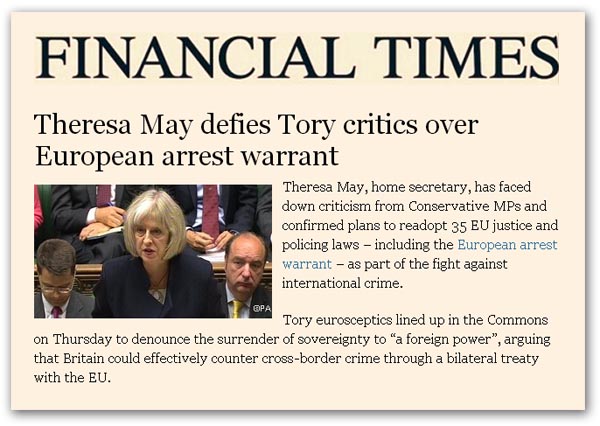
The Financial Times tells the tale of the House of Commons “rebellion” that never was, with the Guardian (and others) adding more detail. You wonder how well briefed the MPs (and the media) actually are, though, when the still refer to 35 opt-back-ins, when the actual figure has been reduced to 33. But then, what does a little detail like that matter?
What is of more interest, though, is how many of the 20 or so Tory “eurosceptics” who lined up to denounce what John Redwood claimed to be a “surrender of sovereignty” to “a foreign power” had actually looked in detail at the opt-back-ins of which they were complaining.
For instance, there was some considerable talk about the Council Framework Decision 2008/909/JHA of 27 November 2008 on the application of the principle of mutual recognition to judgments in criminal matters imposing custodial sentences or measures involving deprivation of liberty for the purposes of their enforcement in the European Union.
Clearly, this provision is very much to the advantage of the UK. It allows the transfer of prisoners who are foreign nationals, so that convicted criminals from other member states can serve their sentences in their home countries, reduces overcrowding and saves us the costs of looking after them.
But while the likes of Jacob Rees Mogg arguing that Britain could effectively counter cross-border crime through a bilateral treaty with the EU, neither he nor anyone else in the House mentioned that the prisoner transfer agreement does not actually stem from the EU.
In fact, all the framework decision does is set out the procedure for transfers, but in so doing all it does is implement theCouncil of Europe Convention on the Transfer of Sentenced Persons of 21 March 1983.
Under that Convention, sentenced persons may be transferred to serve the remainder of their sentence only to their state of nationality and only with their consent and that of the States involved. There is also an Additional Protocol to that Convention of 18 December 1997, which allows transfer without the person’s consent, subject to certain conditions.
The interesting thing here is that, even if the UK had not opted-back-in to the EU framework decision, the prisoner transfer agreement would still stand, and it would still apply even if we left the EU, implementing as it does a Council of Europe Convention.
Without the opt-in, though, there would be no agreed procedure implementing the Convention, so to stay aloof from an unexceptional procedural decision would be a tad absurd.
For sure, there are issues with the headline opt-back-in, the notorious European Arrest Warrant. However, as Teresa May explained, she has legislated to reform the operation of the arrest warrant and increase the protections for those wanted for extradition.
On the issue of British citizens being extradited for disproportionately minor offences, the law has been changed to allow an arrest warrant to be refused in respect of minor offences. A British judge will now consider whether the alleged offence and likely sentence are sufficient to make the person’s extradition proportionate.
Then, on the issue of people extradited for actions that are not against the law of this land, the rules on dual criminality have been clarified to ensure that an arrest warrant must be refused if all or part of the conduct for which the person is wanted took place in the United Kingdom and it is not a criminal offence in the UK.
As far as it goes, the worst excesses of the arrest warrant have thereby been removed and, if there was no opt-back-in, we would have problems of our own getting hold of alleged offenders we wanted to see in our own courts.
Most of the other matters are also unexceptional, such as Council Decision 2000/375/JHA on combating child pornography on the internet, and Council Decision 2002/348/JHA (and amendment) concerning security in connection with football matches with an international dimension.
These we would be implementing anyway and such is the situation with football matches that UK law is already in place, and no new law is required to implement the Council Decision.
However, with there being no vote in the Commons, the MPs obviously – and rightly – decided that this was not an issue on which they should go to the wire. It seems that Conservative MPs have taken a strategic decision not to rock the boat before next year’s general election.
“We want to win the election”, said one Tory eurosceptic. “The time to question the prime minister’s strategy is when he has completed his renegotiation – then people can make up their mind whether it is good enough”.
Whatever one’s views on that, there is an element of tactical acumen there. Now is not the time for the big fight. We want that on a larger canvas – just supposing we can win the argument. Fighting over this level of technical detail, at this stage in the electoral cycle, is not of the essence.
Filed under: EvilEU, Law, Liberty







Trade agreements: is “unbundling” the future?
by Richard North
http://www.eureferendum.com/blogview.aspx?blogno=85071
Trade agreements: is “unbundling” the future?
A little while ago, the Financial Times ran a piece by Alan Beattie on UKIP’s trade policy (above), who argued that it “would leave Britain isolated and vulnerable”. I didn’t write a review then, as there was more to the issue which Beattie raised that, what he termed “Farage’s dream of prosperity” which is to be “born of a US treaty”. This, Beattie thinks, is “a dangerous fantasy”.
The points made, however, are bigger than UKIP’s trade policy, and could have been raised without reference to “Farage’s dream”, one that comes with a promise of a new trade deal “as soon as Britain’s exit liberates the UK from the dead hand of European protectionism”.
To the unjaundiced eye, writes Beattie, this looks great. But he then observes: “Sadly, such agreements with the US have progressively less to do with free trade and more with restricting competition at the behest of well-organised American industry lobbies”.
This is actually the substantive point. Trade agreements are not what they used to be. Beattie suggests that, if we attempted a deal with the United States, first up would be the US pharmaceutical industry targeting the National Health Service, the very name of which makes American drug lobbyists visibly bristle.
The centralised NHS procurement system holds down the price of drugs based on the service’s own assessments of value for money. This has far-reaching consequences: a quarter of all government purchases of medication worldwide use NHS reference prices, according to estimates by the Office of Fair Trading. That does not suit American pharmaceutical companies, which prefer procurement prices based on markets rigged by restrictive, litigious patent regimes.
The inference, which Beattie develops in his piece, is that trade deals have become encumbered with all sorts of side issues, which extend far beyond the simple necessities for international trade, and move into the area of harmonising domestic properties.
Then, on Monday last, this same theme was picked up by Martin Khor, an executive director of the South Centre, a research centre of 51 developing countries, based in Geneva.
Khor writes of “overloaded ‘trade deals’”, opening his piece by declaring: “Once upon a time, trade agreements were just about trade. The negotiator’s principle was: I’ll allow some of your products to enter my market if you allow some of mine to sell in yours”. He adds: “Both countries could estimate what the benefits would be for them, and if it was mutually satisfactory, a good deal was made”.
Today, though, Khor continues: “trade deals are not mainly about trade any more”. The trend, he says, started when intellectual property, services and investment measures entered into the system of trade rules when the old GATT (General Agreement on Tariffs and Trade) was transformed into the WTO (World Trade Organisation).
By way of example, Khor offers companies’ patent rights. If they are not “respected”, it permits the aggrieved nation to impose extra tariffs on imported products, and block them as punishment.
This, we are told, has complicated the rules of trade since non-trade issues invaded the system. But this complication at the WTO is minor compared to the bilateral free trade agreements (FTAs) involving the United States and the European Union (EU).
A prime example is the Trans Pacific Partnership Agreement negotiations, involving Malaysia and eleven other countries. Under the leadership of the United States, the TPPA includes chapters on many non-trade issues including intellectual property (with standards far higher than in the WTO), rules on investment liberalisation, a system where foreign investors can sue the host states in an international tribunal, and opening up of services sectors to foreign ownership.
Then there are the two issues that directly intrude into the way the government operates. Government procurement, or the rules on how the state decides to award contracts for goods, services and projects, is to be opened to foreigners as if they were locals.
And government-owned enterprises, including private companies in which the state has a share, are to be governed by rules that prevent them from having advantages. The way they buy and sell goods and services are also to be opened to foreigners as if they were locals.
In other words, says Khor, the “free trade agreement” has gone far beyond the terms of importing and exporting goods, and penetrated deep into the structure of the domestic economy, including how local businesses are allowed or disallowed from benefiting from government policies, and how the government conducts its business.
Central to this process is the concept of “regulatory convergence”, not dissimilar to the harmonisation of rules that has been a core feature of the EU’s Single Market, so much so that when the EU sets the parameters for third countries to join the European Common Aviation Area (ECAA), it writes of its neighbours “linked to regulatory convergence through gradual implementation of EU rules”.
Despite the pervasive influence of this concept, to be found as much in the current Transatlantic Trade and Investment Partnership (TTIP) negotiations, too many of the more superficial pundits – Farage included – still believe that current trade deals are a way of cutting back the burden of regulation. As both Beattie and Khor testify, it has precisely the opposite effect.
For this reason, and a complex of others, resistance to the current range of negotiations is building. It is getting harder to reach agreement, and taking longer, so much so that many believe that the day of the comprehensive FTA is over. There are simply too many obstacles.
As an alternative, we are now suggesting in Flexcit a process called “unbundling”. Rather than relying on ambitious free trade agreements that promise much but are often able to deliver little, the idea is to go for sector-specific (or even product-specific) solutions, on a multi-lateral or even global level.
Sometimes known as the “single undertaking” approach, they are easier to negotiate and can yield results relatively quickly. They also pose less of a challenge to sovereign entities, which makes them less of a threat to small nations.
An example is the initiative on the classification, packaging and labelling of dangerous substances, which emerged as the Globally Harmonised System of Classification and Labelling of Chemicals (GHS). The first version of the code was formally approved in December 2002 and published in 2003.
This very small step exactly typified “unbundling”. Globally negotiated rather than geographically anchored, this was a multilateral rather than a bilateral agreement with a very narrow but vital effect on one particular sector.
Labelling of hazardous materials – more particularly difference in labelling – has been an important non-tariff barrier, restricting trade in a major industrial sector. The entirely uncontentious initiative eases the flow of goods for negligible cost.

But what gives this a topical “hook” is that yesterday the EU, together with 13 other WTO members (Australia, Canada, China, Costa Rica, Chinese Taipei, Hong Kong (China), Japan, Korea, New Zealand, Norway, Switzerland, Singapore and the US) seem – without actually labelling it thus – to have discovered “unbundling” (above).
These fourteen formally opened “plurilateral negotiations” in the WTO on liberalisation of trade in so-called “green goods”. At the first stage, the members of this initiative will aim to eliminate tariffs or customs duties on a broad list of goods that help clean the air and water, help manage waste, are energy efficient, control air pollution, and help generate renewable energy like solar, wind, or hydroelectric.
At the second stage, the negotiations could also address non-tariff barriers and environmental services. The EU is particularly interested to reduce barriers to trade in services ancillary to goods exported. It cites an example of producing wind energy. It is not enough just to buy the wind turbine: companies also need to have access to the maintenance and engineering services necessary to keep it running smoothly.
It is a great pity that such a noble venture should be addressed to such a base area of commerce, but the negotiations which are about to start are very much worth watching. Compared with the progress of TTIP, my guess is that we will more sooner, potentially re-writing the book on international trade.
One thing which should already be lodged, though, is the realisation that free trade areas are not a single, constant type of entity, but a highly varied and continually evolving form of international agreement.
When thus, we see people extol the virtues of FTAs, one need to ask “what kind”? And, as it stands, for many types of agreement, there are more disadvantages than advantages. Here then, there is more than one “dangerous fantasy”. Merely to assume that all FTAs are the same and all work equally well is another one. We have to be more specific.
Filed under: Economics, EvilEU, Liberty







July 8, 2014
“No blacks, no Irish, no gays?”
by Jock Coats
April 4, 2010
There’s been a right royal fuss been made in the past couple of weeks or so concerning a Bed & Breakfast owner in Cookham, Berkshire (unrelated note – my school had Stanley Spencer’s “Crucifixion” – the original – as its alter piece) who, having accepted a phone or internet booking from a gentleman who happened to be a Lib Dem parish councillor somewhere in Cambridgeshire, when he turned up with male partner in tow, politely turned them away, refunding them their money and saying she could not let two gay men share a double bed on the basis of her religious beliefs and she had no singles left to offer them. And now shadow Home Secretary for the Tories, Chris Grayling has been caught saying that they should have the right to refuse people for any reason in their own home, which has sparked of a furious reactions in the media, with blogs coming out both in favour of Grayling’s position and against it.
The two men have made a complaint to the police, since under one of the many “anti-discrimination” laws passed by this government (the Equalities Act 2006 in this case) it is illegal to refuse to provide goods and services to someone because of their age, race, disability, faith, gender or sexual orientation (there are probably more but you get the idea). Under similar laws forbidding so called “hate speech” we have seen all sorts of people stopped by police, or had police turn up at their homes to question them about some derogatory or discriminatory remark they have been alleged to have uttered somewhere.
And I suppose, as a gay man, you’d expect me to support such things. After all, don’t they level the playing field for us? Well, yes, and no. Clearly if they are something we are paying for through public funds collected from all of us through tax, nobody providing those goods and services or recruiting employees should be allowed to discriminate. That’s because we are already customers or users of that service by virtue of our funding it. It would be fraud in fact to discriminate (not that we aren’t already being massively defrauded by “public” services in any case).
But for private sector organisations and individuals, as businesses providing goods and services or as employers, actually it is I who is disadvantaged by these laws. Because the supplier or employer has by law to bite their lip and serve or hire me without discrimination (and preferably no doubt with a smile) I am not allowed to know in turn whether I am about to do business with someone whose real attitude toward me would probably make me not want to patronise their establishment or contribute to their success by being an employee. Of course you might say that yes, perhaps I have a right to know, but that the supplier or employer still has no right to refuse you if you still insist – and I suppose some people might, just to “spite” the supplier, but there’s another issue here…
As a private individual i can choose what to spend my money on, how to make my money indeed, and to build up capital goods that I can then choose how to use. It’s my property. Now why, just because I am offering as a “business” to sell or rent some of my property or provide a service for money, should the government be allowed to decide for me whom I must serve? Of course, if I were simply a rational economic actor out to maximise my income and profit, I would rather rent the room out to a gay couple than to have an empty room for the same fixed costs – Adam Smith’s self-interested butcher applies, but people, even business-people, are entitled not to be entirely rational all the time, especially where that rational choice clashes with some other deeply held belief.
Anyhow, I read somewhere that the couple who own the Cookham Bed & Breakfast had had a torrent of abusive emails and letters, so I sought out their website and sent them a message explaining that I am a gay, Lib Dem, Christian (not necessarily in that order!) and that I supported their right to dispose of their own property as they choose. Here is their rather nice reply:
Dear Jock
You have written one of the loveliest emails of the hundreds we have received in support.
You have understood we have no hate for gay people, but quite the opposite. It is also true that we would never refuse single rooms for gay people.
It is our prayer that the law will be amended to give us back the freedom which has been taken away from us in this area of our personal faith and integrity. You have been a great encouragement and we thank you so much for taking the time to write.
Thanks again and God bless
I find discrimination repulsive, but humanity has actually evolved by discrimination – it is in our genes; we have made great strides in eradicating much unjust discrimination, through inculturation, education and, well simply by living with each other, but this has to be allowed to happen naturally.
We can’t end discrimination simply by state fiat, by making it unlawful, and I find it dangerous to try. Not only is it a breach of freedom of speech, of expression and of association, but a curtailment of rights to use one’s own property as one wishes and of the rights of the purchaser of the good or service or the potential employee to discriminate against doing business with someone who doesn’t like them. But also it is artificially suppressing an instinct that lies deep inside many people and I have little doubt that one day that will return to bite us. Is it really so different from this sort of state censorship? And I for one do not relish being an innocent victim if any backlash comes.
Filed under: Culture War







On the Persecution of Christian Bakers in Ulster
by Simon Muir
Note: I have spent much of my life denouncing the persecution of homosexuals. More recently, I have turned to denouncing the persecution of Christians by homosexuals. I do both on exactly the same grounds, of freedom of speech and freedom of association.
I urge our gay readers to join in these denunciations. The current persecution is wrong in itself, and is also undertaken without regard for its consequences. These, I have no doubt, will eventually include the recriminalisation - probably indirectly in the first instance – of homosexual acts. Homosexuals are the weakest element in the pc coalition of the oppressed. On the one hand, they are widely hated within the other groups. On the other, most of them have the option of creeping back into the closet the moment the winds shift direction – one whiff of persecution, and the gay lobby will become a leadership without a membership.
Now is the time for us all to take a stand for the traditional liberal values of freedom of speech and association. These cover the right of gay people to live as they please – and also of traditionalist Christians to have nothing to do with them. SIG
I ur
<http://www.christian.org.uk/news/legal-action-christian-bakers-in-gay-campaign-cake-row/>
I was sent this story (above) today.
It is clear to me: this is yet another set-up, intended to use the present, morally wrong, law and politically-biased public institutions, to attack traditional Christian belief and practice.
The position of evangelical Christians in the United Kingdom is rapidly becoming similar to that of Hugenots in C17th France.
I note the following points:
1. There are no shortages of either guest houses in Cornwall, nor cake makers in Northern Ireland. Given homosexual “marriage” is illegal in N.I. this cake order could only, ever, have been raised by an activist group or individual.
2. Indeed, it turns out that the complainant, Gareth Lee, is an activist in campaign group
“QueerSpace”, and the decoration on the cake was to be his group’s campaigning image and slogan. It appears to be, not for any sort of wedding at all, but for a political event promoting the introduction of homosexual “marriage” into Northern Ireland.
3. The group apparently obtained exactly the cake they wanted elsewhere, without ifficulty.*
4. The cake maker involved, Asher’s Baking Co., appears to have been selected SPECIFICALLY because it has a Christian ownership. Its name comes from a Biblical verse (Gen.49 v.20).
Regarding homosexual “marriage” as a concept, the ONLY logical reason for the present law is to oppress traditional evangelical Christians and suppress traditional Christian expression in daily life:
“Civil partnership” has legal equivalence to marriage and, in any event, many different places
and buildings can now be licensed for the purpose of a marriage ceremony. There is no necessity at all for churches who reject homosexual “marriage” to have their buildings appropriated.
There is no shortage of ministers to perform the ritual, either: many Christian denominations give their ministers considerable autonomy regarding services they hold. Whatever one thinks about the concept, it is relatively easy for those wanting a homosexual “marriage” service to find a clergyman willing to officiate.
There is significant unanimity amongst adherents of other faiths in the UK against homosexual “marriage”, notably within Islam. The ‘middle ground’ in Islam is, in fact, far more condemnatory than that of Christians generally. Islam is NOT being subject to any legal attack over this issue, and it doesn’t take a genius to conclude this is because of a wider anti-Christian agenda within the establishment.
Thus CHRISTIANS ARE BEING PROSECUTED BECAUSE, POLITICALLY, THEY CAN BE, and a focused group within our political class wants this to happen. It is NOT because their stance on homosexual marriage is extreme in comparison to other groups,
religious and otherwise, in the British polity.
Thus it is clear that the present law was framed, not even to suppress dissent and debate, but to directly attack traditional Christian values. It has nothing to do with support for any oppressed minority.
It’s time the real agenda was “outed”.
Filed under: sex and more 






July 7, 2014
Twin Towers “Struck by Lightning” after Necrophile Sex Romp Involving Jimmy Savile and Ted Heath
See below for pictures.
GOTCHA!
Now, pull yourself together and please consider buying one of the books to the right of this posting.
Filed under: Humour







Politics has no place in a charity
by Robert Henderson
http://livinginamadhouse.wordpress.com/2014/07/06/politics-has-no-place-in-a-charity/
There are many aspects of modern charities which run contrary what is still, despite all the bad publicity charities have had in recent years, the general public’s idea of what a charity should be; an organisation which is doing good works by raising money from individuals, is the reverse of self-serving and a morally good thing.
There is much dislike about modern charities. They are frequently incompetently run, often too much of a charity’s income goes on administration, especially the pay of the senior staff, embezzlement by the staff of charities is too frequent for comfort and larger charities often take much of their funding from the state. However, those weaknesses are not the subject of this piece. What I am concerned with here is the political aspect of charities in Britain, an aspect which seems to loom ever larger.
Charities in Britain are very often overtly political, using much of their income to lobby politicians, pay for what are essentially political adverts and research which is no better than propaganda. The Charity Commission’s rules forbid charities being set up for a political purpose , charities campaigning for a political party or charities campaigning for a political end which does not accord with the declared purposes of the charity. Charities may lobby politicians and engage in campaigns which are inherently political to their heart’s content provided they observe these rules. The full Charity Commission Guidance on political activity by charities can be found here . In summary it is :
To be a charity an organisation must be established for charitable purposes only, which are for the public benefit. An organisation will not be charitable if its purposes are political.
Campaigning and political activity can be legitimate and valuable activities for charities to undertake.
However, political campaigning, or political activity, as defined in this guidance, must be undertaken by a charity only in the context of supporting the delivery of its charitable purposes. Unlike other forms of campaigning, it must not be the continuing and sole activity of the charity. (Section D5 provides a fuller explanation.)
There may be situations where carrying out political activity is the best way for trustees to support the charity’s purposes. A charity may choose to focus most, or all, of its resources on political activity for a period. The key issue for charity trustees is the need to ensure that this activity is not, and does not become, the reason for the charity’s existence.
Charities can campaign for a change in the law, policy or decisions (as detailed in this guidance in section C4) where such change would support the charity’s purposes. Charities can also campaign to ensure that existing laws are observed.
However, a charity cannot exist for a political purpose, which is any purpose directed at furthering the interests of any political party, or securing or opposing a change in the law, policy or decisions either in this country or abroad.
In the political arena, a charity must stress its independence and ensure that any involvement it has with political parties is balanced. A charity must not give support or funding to a political party, nor to a candidate or politician.
A charity may give its support to specific policies advocated by political parties if it would help achieve its charitable purposes. However, trustees must not allow the charity to be used as a vehicle for the expression of the political views of any individual trustee or staff member (in this context we mean personal or party political views).
As with any decision they make, when considering campaigning and political activity charity trustees must carefully weigh up the possible benefits against the costs and risks in deciding whether the campaign is likely to be an effective way of furthering or supporting the charity’s purposes.
When campaigning, charity trustees must comply not only with charity law, but other civil and criminal laws that may apply. Where applicable they should also comply with the Code of the Advertising Standards Authority.
A charity can campaign using emotive or controversial material, where this is lawful and justifiable in the context of the campaign. Such material must be factually accurate and have a legitimate evidence base.
The principles of charity campaigning and political activity are the same, whether the activity is carried out in the United Kingdom or overseas.
These rules allow charities to quite legally act as campaign groups and lobbyists and in practice charities often get away with throwing over even the mild restraints that the Charity Commission imposes.
Why should their politicisation be a concern? Because such behaviour undermines the very idea of a charity, which generally is to pursue unambiguously beneficent ends. Bring the pursuit of political ends into the picture and the moral purity of the charity is tarnished. I would also doubt whether the general public would want the state the state to provide privileges such as tax breaks for charities while they press their own political agendas.
Which charities now existing should have their status removed?
Where a charity receives a substantial part of its income from state bodies, as many of the larger ones now do, the use of the money to campaign for a political end is doubly unwarranted, for charities which receive money from public funds are not really charities at all but subcontracted arms of the state. Receipt of state money should mean no charitable status. (The practice of politicking is strong amongst charities which receive substantial funds from the public purse).
The donation of money by non-state bodies such as limited companies or organisations which are not commercial enterprises , for example trade unions, should be banned where the donations are such as to promote the interests of the donor.
Individual donations should be left to the discretion of the donor, but the charity should be legally obliged to provide the name of any donor providing more than 5% of a charity’s donations in any financial year, together with details of the person’s background including their political and commercial interest if they have them.
Some types of charity are too inescapably political to be charities. These include those concerned with human rights, immigration, race relations and charities which promote the cause of particular groups (especially ethnic minorities).
Charities which support criminality either directly through or indirectly, for example, by supplying goods and services which release funds to be spent on criminal activities such as terrorism. Good examples are Islamic charities which overtly or covertly support terrorism. There is also the problem of ostensibly legitimate mainstream charities donating to other charities which have links to terrorists.
Think Tanks which do nothing but produce reports and papers for discussion should not be charities because by definition they are not providing active relief of suffering or directly promoting something which is socially valuable.
Charitable status should only be granted for charitable work undertaken in the UK. The British taxpayer should not subsidise by the granting of tax relief work which does not benefit Britons.
Whether or not a charity currently pursuing political ends under the present rules receives money from the state, they should no longer have charitable status if they insist on political campaigning. They should sail under their true colours as political organisations and be subject to the same rules as other non-charitable bodies. Such organisations could be profit-making or non-profit-making and be treated as other political organisations which are not charities are treated.
None of the exclusions I have proposed mean that people will not be able to donate funds to whatever cause they wish to donate. All it means is that such donations will go to organisations which no longer have the tax privileges or the moral status of a charity.
What work should charities do?
They should be reformed to be what the general public thinks a charity should be, a beneficent organisation giving active help to people and other indisputable good causes which draws its money not from the state but from private donations drawn only from individuals. To this end charities should exist simply to provide goods and services to ameliorate the deficiency that they ostensibly were founded to lessen, whether that be the alleviation of an obvious need such as poverty or sickness or to provide something which is not an absolute need but which will be socially valuable such as specialist types of education such as music schools.
What would this mean in practice? Let me give a few examples.
1. Oxfam would cease to engage in political campaigning and concentrate solely on providing help to the poor.
2. Medical charities would cease to lobby for more government spending on medicine and concentrate solely on providing treatment and support to sufferers.
3. The RSPCA and the RSPB would confine themselves to providing for the welfare of animals by funding care for abandoned animals and purchasing land to provide habitat for specific wild species .
The advantages of these changes
The removal of politics from charities and of the state subcontracting to charities would change the relationship between the public and charities for the better, because the reality of charities would then be much closer to both their traditional role and the present day perception of what a charity should be in the public mind. That would be likely to increase donations.
Charities would be much less susceptible to political or commercial influence if they do not take money from the state or private corporations.
The changes would remove large swathes of charities which are manifestly not in the national interest . Any work overseas would not be classed as charitable and the army of human rights, immigration and ethnic minority charities would cease to be charities.
The type of person attracted to charity work would probably change significantly if the political aspect was removed. The charities which were left would have to concentrate on providing practical aid to the causes which they espouse. People would join because they wanted to be ministering directly to ends of the charity.
Filed under: Law, Liberty